Another of the recent Doc Rat suggestions. Jack Applin sent it in and thought “Perhaps this refers to a commercial well-known in Australia?”

Another of the recent Doc Rat suggestions. Jack Applin sent it in and thought “Perhaps this refers to a commercial well-known in Australia?”

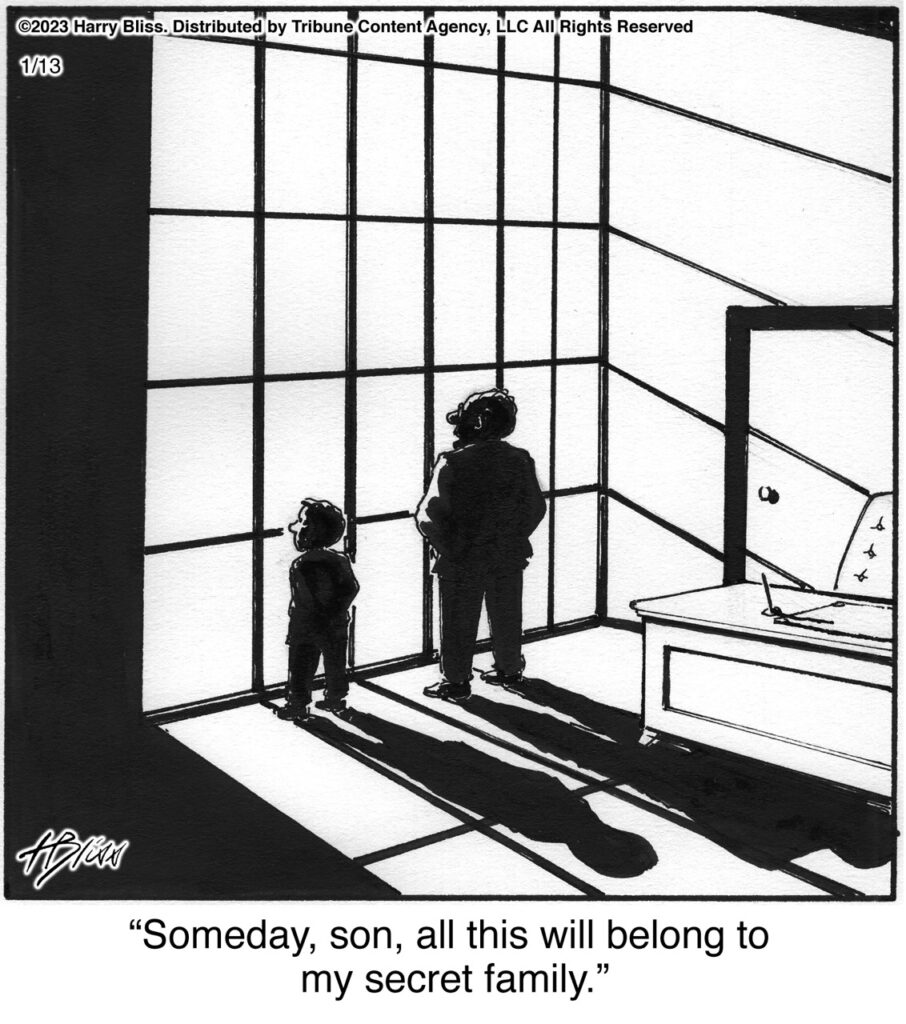
As we have asked a few times before, Does this Bliss cartoon work better in b/w or in color?


(As we probably have not asked before, Would this comparison slider presentation work better in this side-by-side format or in a vertical division?)
Our own Zbicyclist mentions the resemblance of the b/w paintings above to some works his family saw on a visit to the Fundació Joan Miró (Museum) in Barcelona, which features work by Miró as well as other 20th and 21st Century artists. This shot from the #FundacióMiró Foundation’s Instagram shows a work which was also shown in Zbicyclist’s family visit photo; the dot in the museum is either black or a very dark blue.
But then, don’t you also think “Such peacefulness”?

Perhaps a bit CIDU-LOL?

And another food-centered cartoon (older – you may have seen before):

I can forgive mispelins in comic strips, but the sloppy editing in the regular news (and the sloppy headlines) depress me.

Andréa sends in this update about Mutts:
Patrick McDonnell’s Mutts has a new look: “MUTTS might look a little different to you this week and in the future. If so, it’s because I’ve loosened up my art style, using very little preliminary pencils (in some cases none) and going straight to drawing in ink. It gives the strip more of the power and intimacy of a preliminary sketch, which I love. I’m also freehand lettering the dialogue”

Refusal with very good reason! (Awarded Arlo)

And here is the effect of his overactive pineal:

Back to Bliss!

From Usual John, who says “The second panel translates literally as “he runs me on the bean.” Idiomatically, it means “he annoys me a lot.” But I still do not understand why it is supposed to be funny.”

That’s the artist’s title for this one, as pointed out by Boise Ed, who further points out that we have no idea how that can be an organ-donor card.


The chronology and plot seem to be beyond me. There’s a panel marked “Yesterday” — when do we see any other time? Do the two extras at the top (bird & worm, and invisible ink) stand alone, or do they play into the main plot?
Thanks to Dirk the Daring for sending this in, and asking “Why is this funny?”. Your editors could only reply, “Forget it, Dirk. It’s The New Yorker.”

Thanks to Dale Eltoft.

Hey, we don’t get color very often from Eric Scott. I guess that was better than shading and labelling to indicate “a green screen”!
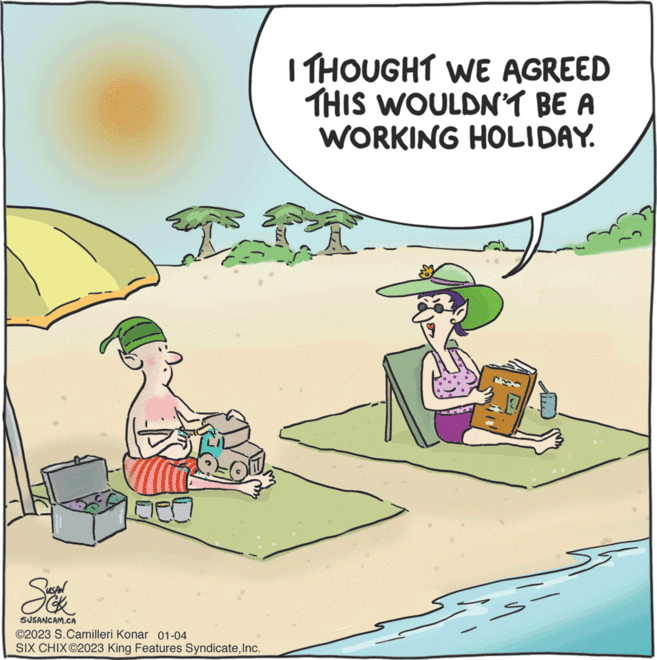
Usual John provided this mystery from Six Chix. Why robots? Why “back to the land” when their ancestors weren’t farmers? Much to puzzle over here.

Today’s CIDU appears not in this post, which is visible at the “front page” , but at a separate “Arlo Page” that is not accessed unintentionally — though all you need do is follow that link. That’s because it’s arguably (barely) NSFW, as the drawing of the comic includes a (tasteful) nude. It’s this Monday’s Lay Lines by Carol Lay.
And also, frankly, because we just wanted to try out this mechanism for placing the theoretically provocative comic on a Page within this same CIDU site, as we cannot place it on the external Arlo Page site that CIDU Bill used for that purpose.
If you drop in over there, and read Bill’s intro to the Arlo Page idea and the different Arlo Award concept, that may answer questions you had about the distinction. As implied there, “Arlo Award” is a label applied to a comic entered on this site, in the main flow of Posts, and not a sign that it is hidden from unintentional eyes, like “Arlo Page” items.
While we’re at it, Bill’s intro on the aforementioned external Arlo Page site also has this to say about Arlo Award: The Arlo Award goes to a cartoonist who sneaks something blatantly inappropriate past the syndicate’s censors. Obviously this doesn’t apply to Internet-only or self-published comics. But nowadays there is little that literally qualifies as subject to potential censorship in that same sense, so we are modifying the definition:
An Arlo Award label (tag or category, don’t fuss) can go to “A comic with somehow ‘racy’ or provocative content, which successfully disguises that aspect, particularly through double entendre. And regardless of the actual publication history and whether or not there was actual censorship potential.”
(Comments are open here and at the referenced page. This might be the better place for discussion of the above Arlo policies / definitions and attempted solutions, while comments on the page with the actual cartoon might be a better place to discuss what’s going on in that comic.)

Thanks to Darren for sending in this Rudy Park (via our not-entirely-new Suggest-A-CIDU form). He says “I don’t get it. Is the scone description odd in some way? Why does panel three focus on the customer without dialog? Is Rudy annoyed at someone ordering something to use the bathroom, or is something else happening?”