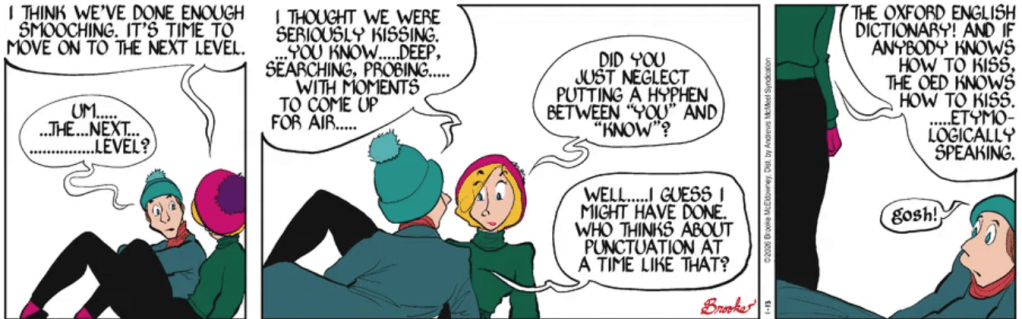
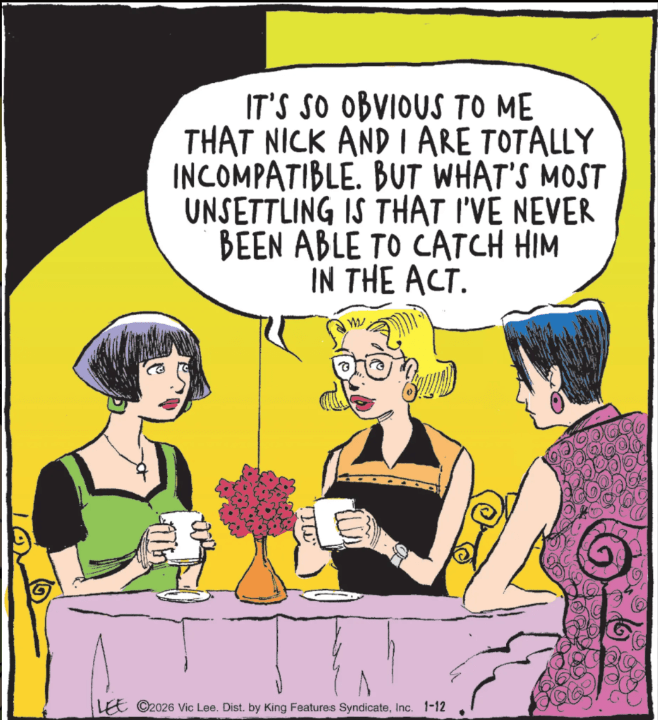
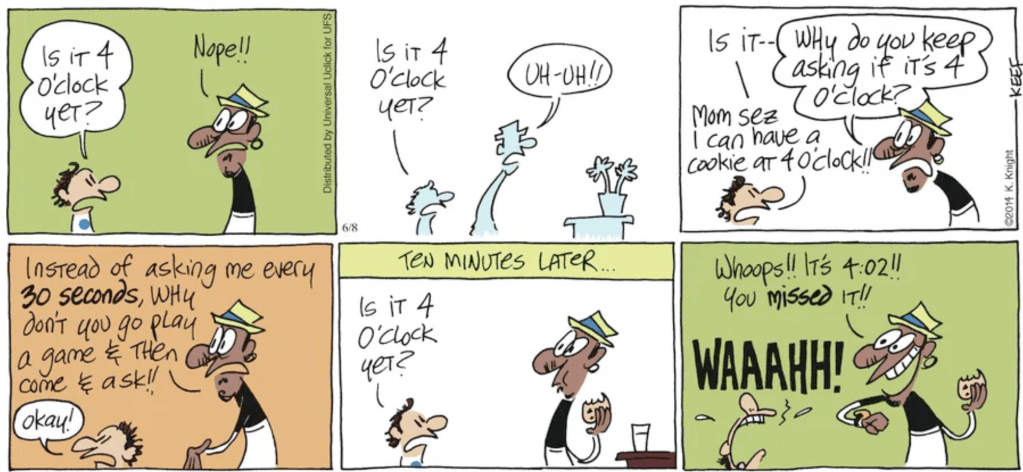
Jack Applin sends this in: “A hyphen between “you” and “know”? As in “you-know”? What sense does that make? If she will criticize his punctuation, then she should also condemn the excessive and random number of dots in his ellipses, though she is no better with her five-dot ellipsis.”
So she’s able to read thought balloons clearly enough to discern hyphens?
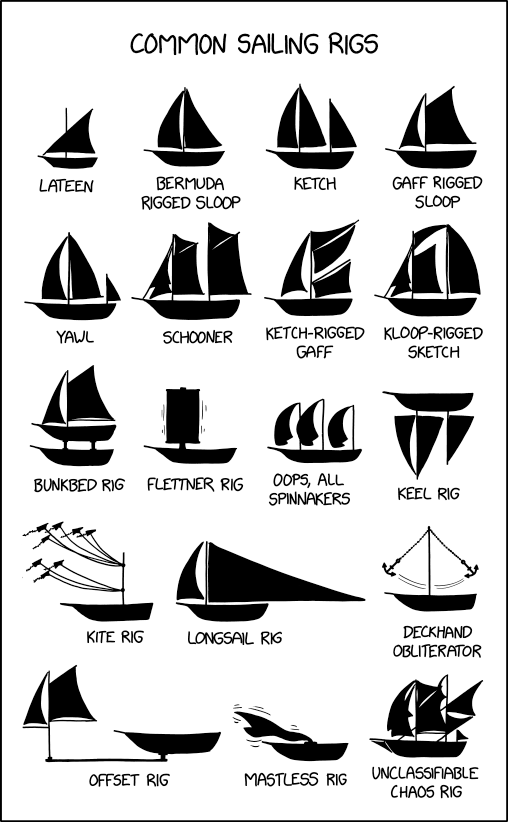
Is it possible for a comic to be able to be both CIDU & LOL? Because while I have less than no understanding of sailing ship rigging, (… which is likely part of the point of this… and several other … XKCD comics…) the hover text, where I don’t understand “yawl” or “ketch”, still had me LOL-ing: “I wanted to make the world’s fastest yawl, so I made the aft sail bigger, but apparently that means it’s not a yawl anymore! It’s a ketch-22.”
“Scott Adams, whose popular comic strip “Dilbert” captured the frustration of beleaguered, white-collar cubicle workers and satirized the ridiculousness of modern office culture until he was abruptly dropped from syndication in 2023 for racist remarks, has died of prostate cancer at 68.” [ I’m extensively quoting from the AP article]
At its height, Dilbert appeared in 2,000 newspapers.
For me, working in the space between tech and marketing departments, Dilbert had a particular resonance.
It all came crashing down in 2023 when Adams repeatedly referred to Black people as members of a hate group (etc.). Bill Holbrook, the creator of the strip “On the Fastrack,” told The Associated Press at the time. “I am in full support with him saying anything he wants to, but then he has to own the consequences of saying them.”
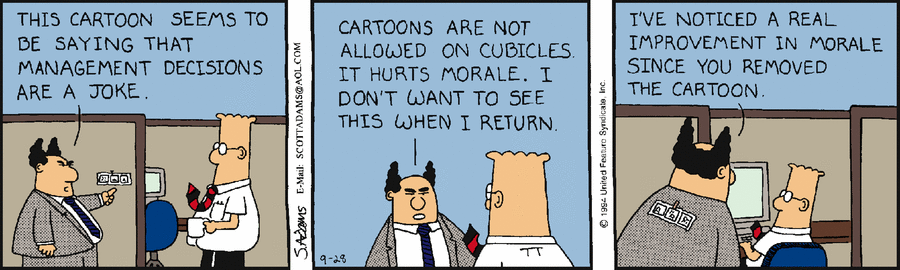
But in the fine tradition of not speaking too ill of the dead, here are some of the Dilbert strips I particularly enjoyed over the years:
I had a mug made of that one, which reminded me of a couple of C-level bosses I had who had risen to their level of incompetence. Didn’t take it in to the office, though; I’m not an idiot.
I remember this bit of advice: “Don’t ask your employees why they have Dilbert strips hung up in their cubicles.”






 Comics I Don't Understand