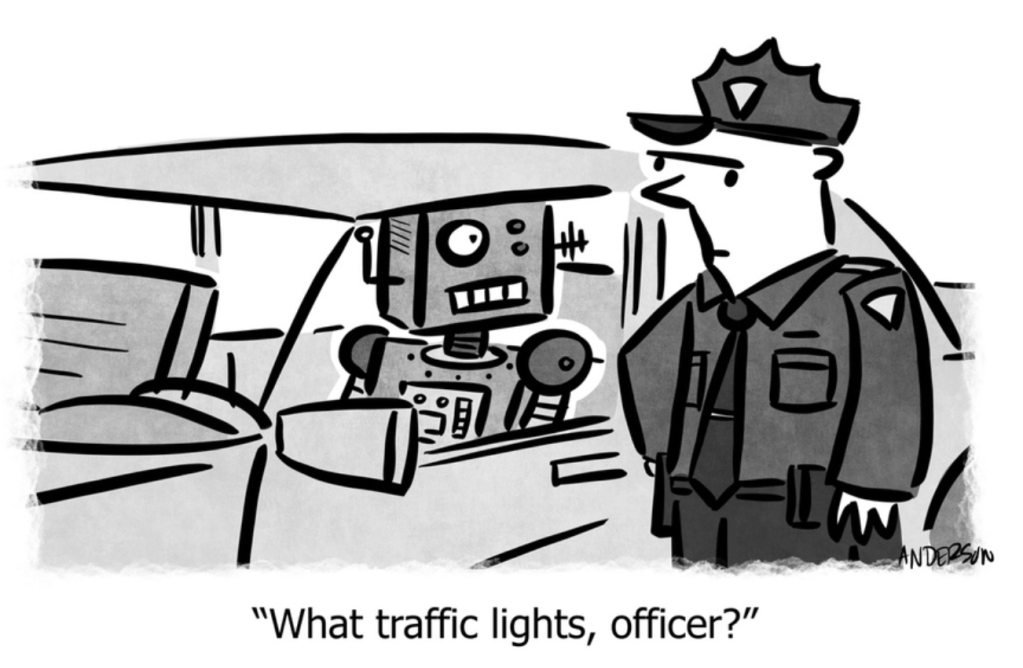
Jack Applin submitted this Andertoons as a CIDU, asking “Is the one-eyed robot unable to see the traffic lights? [OR] Is is programmed to ignore them, giving an advantage to “driverless” cars?“
… Mark Anderson’s original title for his comic #9221 reveals that Jack’s first question was right on the money: The gag is a reference to one of the most common anti-robot user verification tests, typically presented by the reCAPTCHA interface:
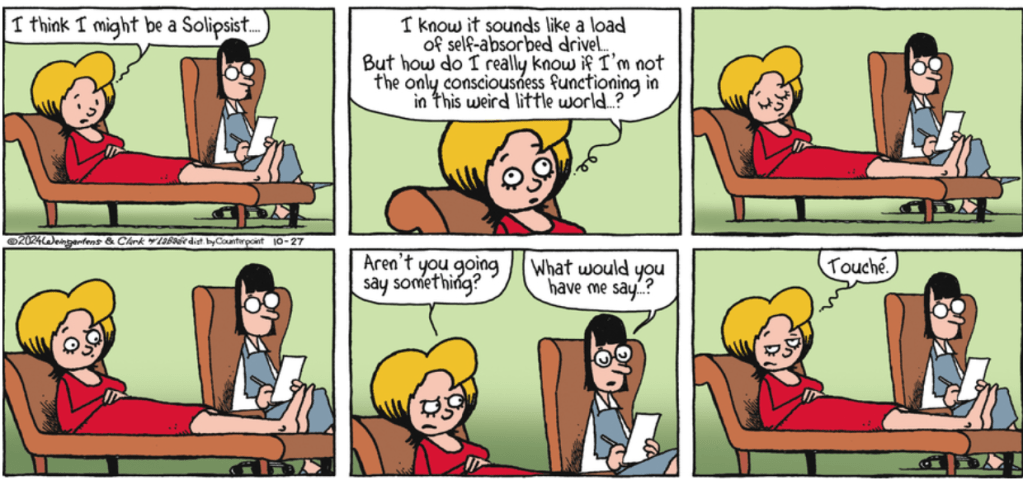
Later that same month (in 1967):
The punchline is in panel 5, but for many of us it would be a CIDU. The authors conveniently use panel 6 to make the joke clearer.
I understood the primary gag in the final panels, but I do not understand the meteorological setup in the first panel:
… Perhaps it’s just the awkward expression: how can a hurricane “drop a millibar“? Did anything like this actually happen during either of the recent hurricanes?
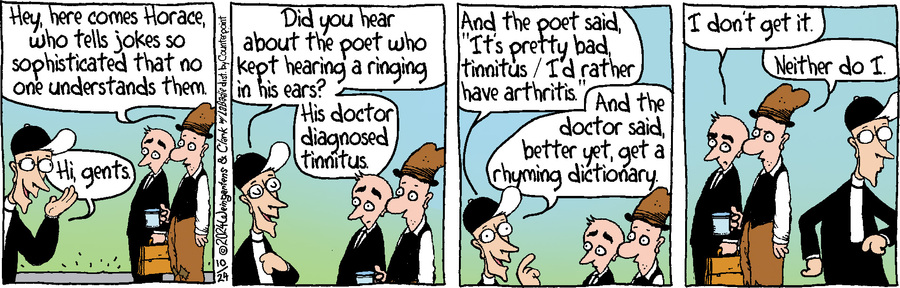
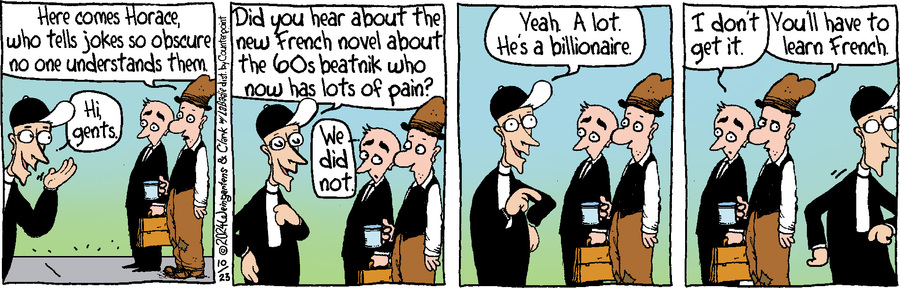
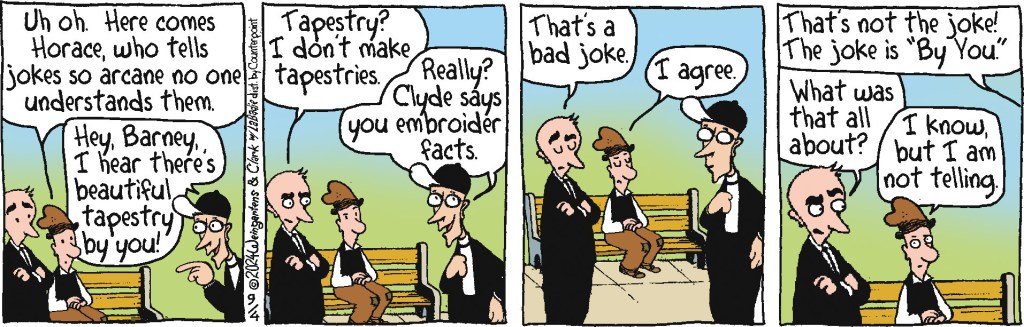
I might as well include the previous two B&C strips, which feature Horace’s “intentional CIDUs. The solution to the first one was explained in Week 94 of the Invitational, in which Gene Weingarten solicited even more obscure “Horace” material. (The results will appear in the Invitational on Halloween, and the better ones will probably be immortalized in future Barney & Clyde strips.)
The second one I had to look up myself, but Barney’s tip in the last panel was a big help:
P.S. Given the solution, this one might also need a “geezer” tag.
Here’s a third “Horace” strip from last year, which was also included (with its solution) in the Invitational article:
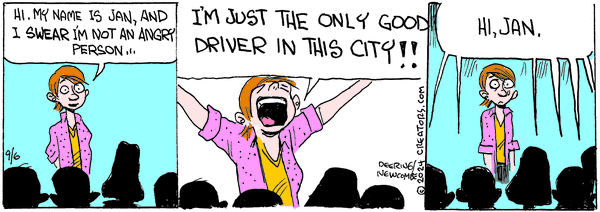
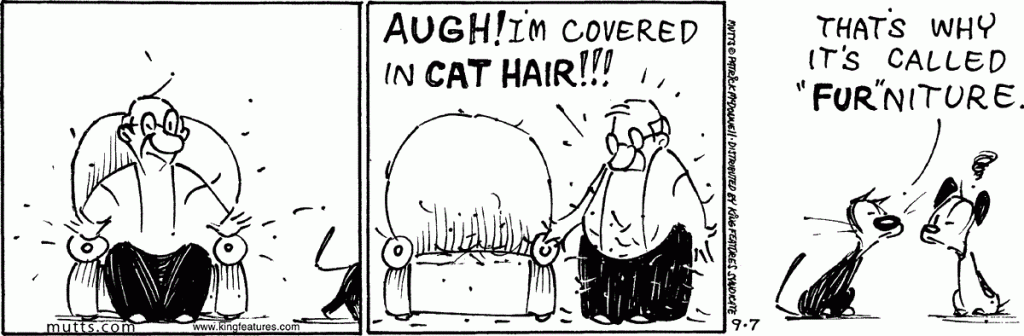
Two driving comics that arrived in my email inbox on the same 06 September delivery. (The Zack Hill was one in a series about Jan’s assignment to anger management school.)
For a while this felt like it should go somewhere in the “All we needed was the first panel” family of picky categorizations. But then it turns out I would have entirely missed the extra pun, were it not for the final panel telling us exactly what we were missing!
Perfectly good comics. But you have the nagging feeling the joke or pun would work just a tiny bit better if this-or-that could be edited a trifle. (Thus CIDUs by a polite extension — “I don’t understand why this little matter couldn’t be fixed up…”)
Here, for instance, the traditional form uses “get a haircut / hair cut” and always works smoothly; unlike in this strip, where the dialogue in panel 2 is quite unnatural. “Hey Harv, didja get a hair cut?” , “Nah, I got them all cut! Heh heh!”
A good chuckle from Arlo and Janis, sent in by Jack Applin who has a point about “breaking serve”.
As Jack explains, As I understand it, to “break serve” means to score a point in tennis when your opponent serves. However, Janis was serving (“Did you cover the charcoal fire?”), and Arlo neglected to do that, so Janis scored the point on her own serve, right? Even if we consider the entire strip one long volley, Janis still asked the initial question, so she’s serving.
I had been familiar with the Çedille Records label out of Chicago for quite some time before noticing that one reason for the name is that it would be pronounced much like “CD”.
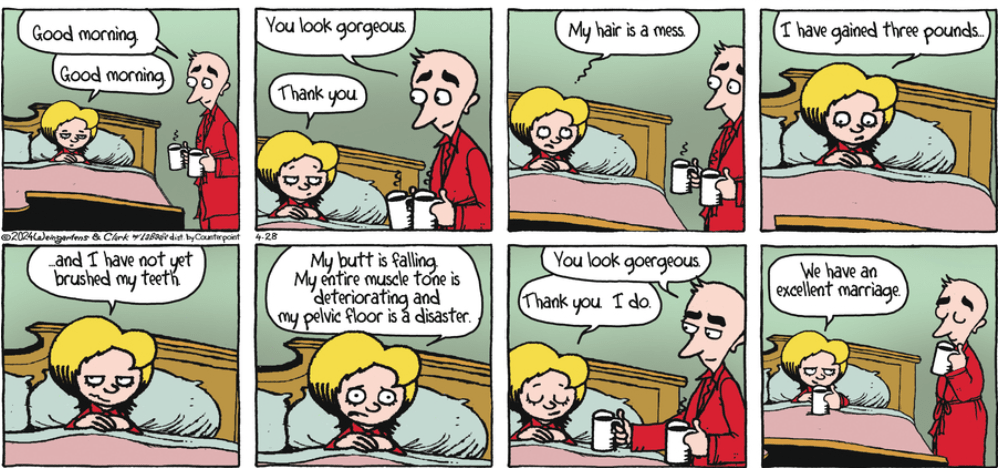
Jack Applin notes “First, he calls her “gorgeous”, later “goergeous”. Is she a goer? Nudge nudge? Also, she states that her hair “is a mess”, but it’s rendered as identical to how it’s always depicted.”
Looking this up, I see this from the Urban Dictionary:
In panel 7, the repeated compliments, and perhaps the coffee, have mollified her, but I don’t get the expression in her eyes in panel 8.
This is a (very) long post, and I hope that it will generate an equally large amount of discussion. Everyone here is of course free to express their own opinions, and while I do not expect that everyone will agree with everything that I have written, I hope that you all will continue to observe the customary standards of decorum that have become a hallmark of CIDU.
Over the past few months the Daily Cartoonist has reported extensively about the way that Gannett has “restructured” the comics for all of their newspapers. A more recent TDC report theorized that one motivation for Gannett’s microscopic menu was misogynistic chauvinism, and Georgia Dunn adapted this hypothesis into Breaking Cat News:
It is undeniably true that newspaper comics have been a male-dominated business for over a century, but I think it both misses the point (and weakens the argument) to ascribe Gannett’s motivation exclusively to chauvinism. Gannett has simply selected old, reliable, and non-controversial mainstays. The average age of the strips on their “approved” list is approximately half a century, and back then virtually every single comic author was male. Gannett is not discriminating directly against “women”, the company is discriminating against all new authors, no matter whether they are women, men, or transgender.
As I already commented at TDC, “Gannett has selected a tired collection of dull, ancient (mostly zombie) strips, and has presumably negotiated a massive volume discount from the syndicate, because they are in a position to impose this lame collection onto dozens of defenseless editorial offices, in complete disregard of what readers would actually prefer. This is just window dressing for the sake of being able to claim that the Gannett papers still offer a comic section; the corporate leadership doesn’t care one iota whether anyone would bother to keep a subscription to read any of those features, and Gannett would probably prefer if all of their papers dropped the comics entirely.“
In addition, I also do not think that it is fair to assume that only a woman can create a convincing female character. Although female authors have always been in short supply, there are nevertheless a number of strong, positive girls in the comics, each of which goes a long way to dismantle the antiquated stereotypes set by “Blondie“, “Momma“, and “Nancy“, or (even worse) in “Andy Capp” and “The Lockhorns“.
Here’s a selection of some of my favorites. Most are written by men, but there is one woman and one trans author in this collection:
First and foremost, there are both Amelia and Rose in Will Henry’s “Wallace the Brave“:
Then we have Henrietta (Enriqueta) in “Macanudo” (by Liniers, not to mention whoever does those brilliant English translations; his only translator’s name that I was able to discover was – not surprisingly – a woman: Mara Faye Lethem):
Cynthia in “Barney & Clyde“:
Danae (and her sister) in Wiley’s “Non-Sequitur“:
The last BCN panel shown above refers to “Phoebe (and her Unicorn)”. Personally, I preferred Dana Simpson’s original title (“Heavenly Nostrils“), but I guess it just wasn’t marketable:
Making an exception for a re-run, there’s Alice in Richard Thompson’s “Cul de Sac“:
Making another exception for a zombie, especially because it was inherited by a woman, there’s “Heart (of the City)“:
P.S. The bottom line is that the only thing that publishing companies care about are their own bottom lines. If we are ever going to get an inclusive (multi-gendered) set of new authors in newspaper comics, it will be necessary for the readership to change their fossilized habits and to start petitioning for papers to drop all the reruns that are currently cluttering (even choking) those comic sections. That doesn’t just mean “Cul de Sac“, it also means letting “Peanuts“, “Calvin & Hobbes“, and a number of other popular “zombie” strips go. I regret to say that for obvious reasons, I don’t think this is going to happen any time in the near future.
This “Barney & Clyde” strip was submitted by Usual John:
I think the gag is that the strip itself does not have (and does not need) a gag, but I’m sure there are other possible explanations.
I went hunting to see if there were any other worthwhile April Fools’ strips, but was sorely disappointed. Almost all of the “standard” setups simply showed one character playing a typically lame practical joke on someone else. The best strips were those few that elevated the humor with some sort of “meta” component. Here are a few examples:
(I especially liked this “Thatababy” strip because this year, my daughter decided to rearrange the silverware drawer as an April Fools’ joke. Unfortunately, it didn’t work, because we all just assumed that she had forgotten the usual arrangement.)