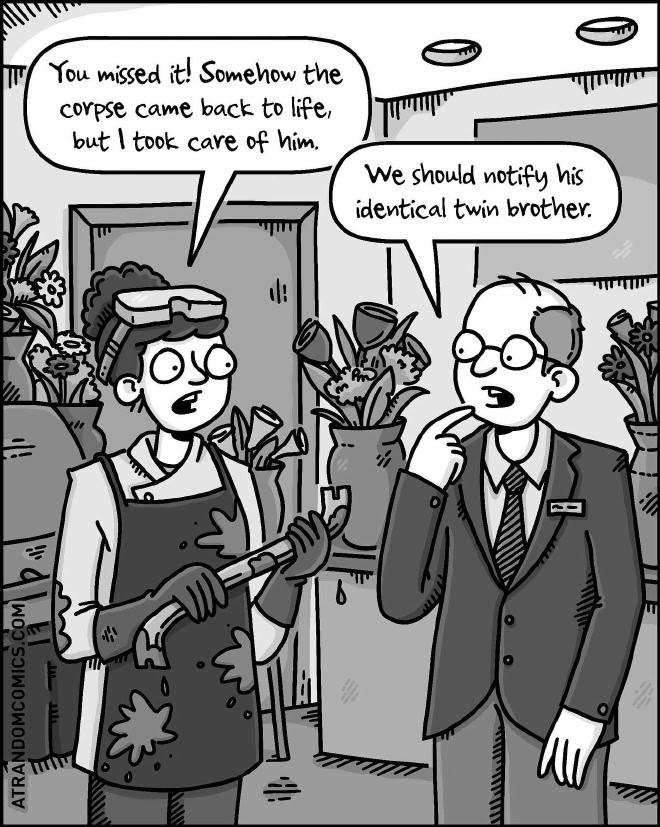
Here’s a LOL/semi-CIDU courtesy of Dale Eltoft – and thanks for the intro to Ryan Mason / At Random Comics.
I had trouble with the premises of the original Topper TV series because I didn’t understand the distinction between when the ghosts would “dematerialize” and when they were simply invisible.
This is a (very) long post, and I hope that it will generate an equally large amount of discussion. Everyone here is of course free to express their own opinions, and while I do not expect that everyone will agree with everything that I have written, I hope that you all will continue to observe the customary standards of decorum that have become a hallmark of CIDU.
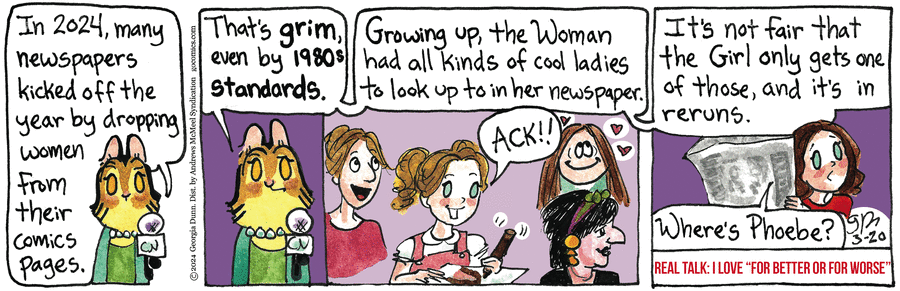
Over the past few months the Daily Cartoonist has reported extensively about the way that Gannett has “restructured” the comics for all of their newspapers. A more recent TDC report theorized that one motivation for Gannett’s microscopic menu was misogynistic chauvinism, and Georgia Dunn adapted this hypothesis into Breaking Cat News:
It is undeniably true that newspaper comics have been a male-dominated business for over a century, but I think it both misses the point (and weakens the argument) to ascribe Gannett’s motivation exclusively to chauvinism. Gannett has simply selected old, reliable, and non-controversial mainstays. The average age of the strips on their “approved” list is approximately half a century, and back then virtually every single comic author was male. Gannett is not discriminating directly against “women”, the company is discriminating against all new authors, no matter whether they are women, men, or transgender.
As I already commented at TDC, “Gannett has selected a tired collection of dull, ancient (mostly zombie) strips, and has presumably negotiated a massive volume discount from the syndicate, because they are in a position to impose this lame collection onto dozens of defenseless editorial offices, in complete disregard of what readers would actually prefer. This is just window dressing for the sake of being able to claim that the Gannett papers still offer a comic section; the corporate leadership doesn’t care one iota whether anyone would bother to keep a subscription to read any of those features, and Gannett would probably prefer if all of their papers dropped the comics entirely.“
In addition, I also do not think that it is fair to assume that only a woman can create a convincing female character. Although female authors have always been in short supply, there are nevertheless a number of strong, positive girls in the comics, each of which goes a long way to dismantle the antiquated stereotypes set by “Blondie“, “Momma“, and “Nancy“, or (even worse) in “Andy Capp” and “The Lockhorns“.
Here’s a selection of some of my favorites. Most are written by men, but there is one woman and one trans author in this collection:
First and foremost, there are both Amelia and Rose in Will Henry’s “Wallace the Brave“:
Then we have Henrietta (Enriqueta) in “Macanudo” (by Liniers, not to mention whoever does those brilliant English translations; his only translator’s name that I was able to discover was – not surprisingly – a woman: Mara Faye Lethem):
Cynthia in “Barney & Clyde“:
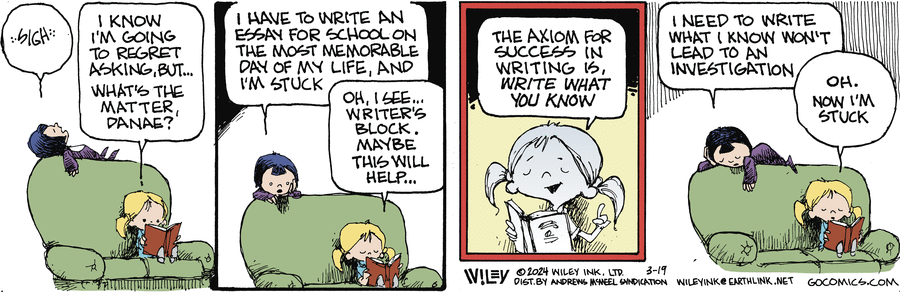
Danae (and her sister) in Wiley’s “Non-Sequitur“:
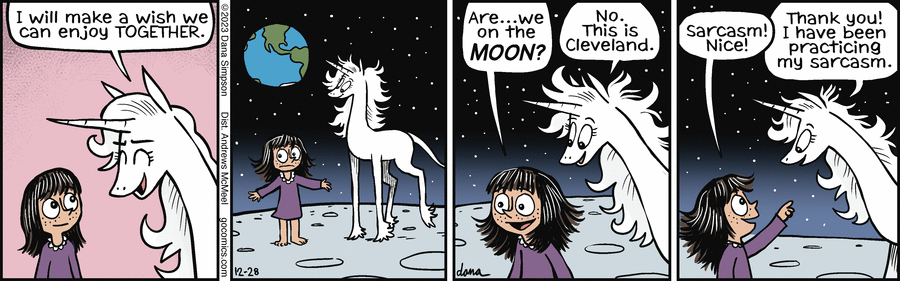
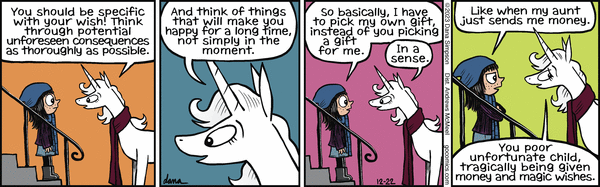
The last BCN panel shown above refers to “Phoebe (and her Unicorn)”. Personally, I preferred Dana Simpson’s original title (“Heavenly Nostrils“), but I guess it just wasn’t marketable:
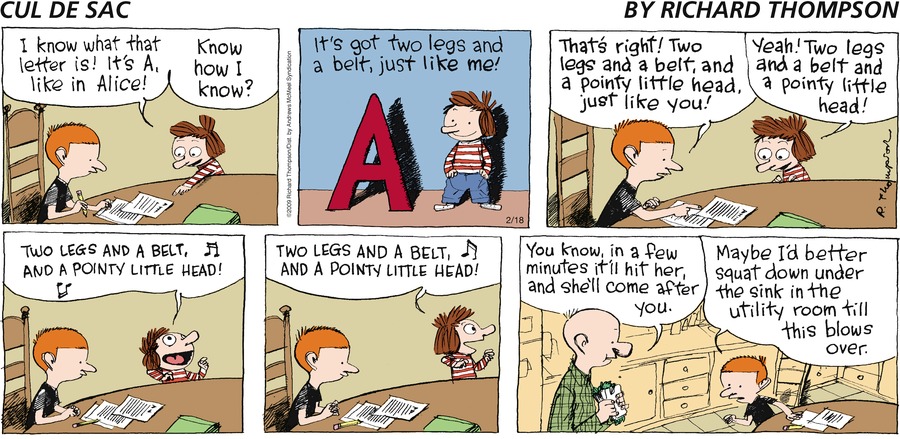
Making an exception for a re-run, there’s Alice in Richard Thompson’s “Cul de Sac“:
Making another exception for a zombie, especially because it was inherited by a woman, there’s “Heart (of the City)“:
P.S. The bottom line is that the only thing that publishing companies care about are their own bottom lines. If we are ever going to get an inclusive (multi-gendered) set of new authors in newspaper comics, it will be necessary for the readership to change their fossilized habits and to start petitioning for papers to drop all the reruns that are currently cluttering (even choking) those comic sections. That doesn’t just mean “Cul de Sac“, it also means letting “Peanuts“, “Calvin & Hobbes“, and a number of other popular “zombie” strips go. I regret to say that for obvious reasons, I don’t think this is going to happen any time in the near future.
I thought I *knew*, as an evidence-based origins account and “official” answer, that the term flack for a public relations officer was closely tied to flak “anti-aircraft fire” — via the intermediate occupational descriptive term flak-catcher for their role in deflecting or absorbing abuse and accusation. And that this was popularized in Tom Wolfe’s essay title “Maumauing the Flack Catchers”. (His flak-catchers were local bureaucrats rather than p.r. agents but the idea was closely related.)
But I wanted to check with something besides my own memory, in scholarly sources or some easily-accessible online approximation thereto.
And so, how disappointing that Dictionary.com gives us a story about some guy named Flack, and no mention of flak except a link in a “words sometimes confused with flack” section.
ORIGIN OF FLACK
1935–40; said to be after Gene Flack, a movie publicity agent
Well! At least some support from Etymonline, though they also give precedence to Gene Flack, but give some skeptical considerations against him.
flack (n.)
“publicity or press agent,” in Variety headlines by September 1933; sometimes said to be from name of Gene Flack, a movie agent, but influenced later by flak. There was a Gene Flack who was an advertising executive in the U.S. during the 1940s, but he seems to have sold principally biscuits, not movies, and seems not to have been in Variety in the ’30s.
The holidays are done, but the cartoons are not all done with Xmas and NYear LOLs!
LOL-Ewww did you say?
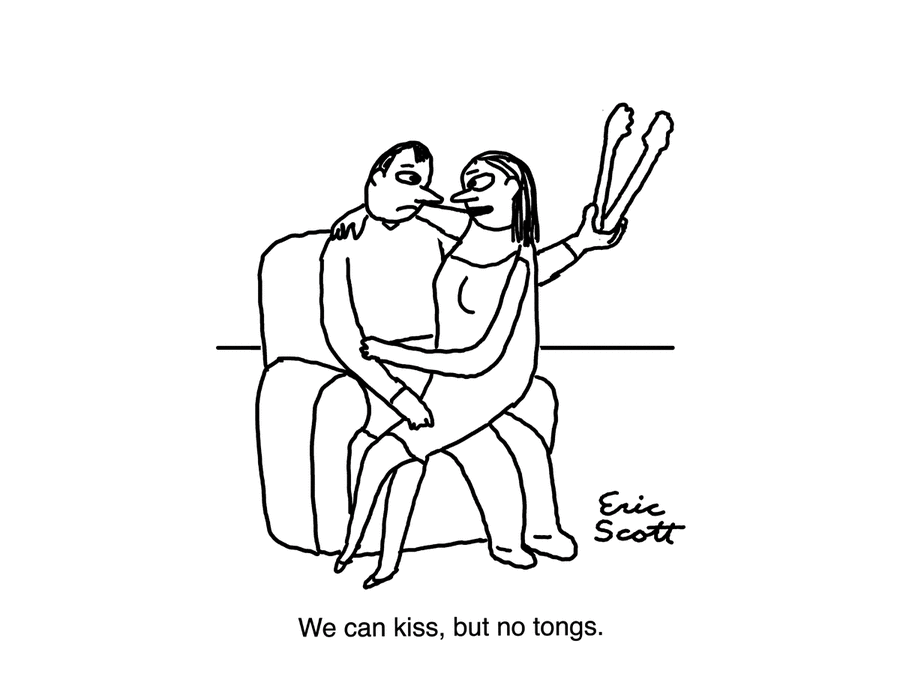
Does Eric Scott’s drawing style sometimes seem to have a Thurber feel?
This Santino is an almost-CIDU: commenters on his page talk about getting it only after pausing and looking at it another way, or filling in their literary knowledge.
Once upon a time (it was December, actually) Sandra sent this in, and noted it could be a LOL-semi-CIDU as it’s not first-glance obvious what’s going on.
Actually, the editors’ feeling of confidence in one explanation faded upon discussion. Is this cat-behavior being actively performed by an animated cat-statue? Or is it a static statue of characteristic cat-behavior?
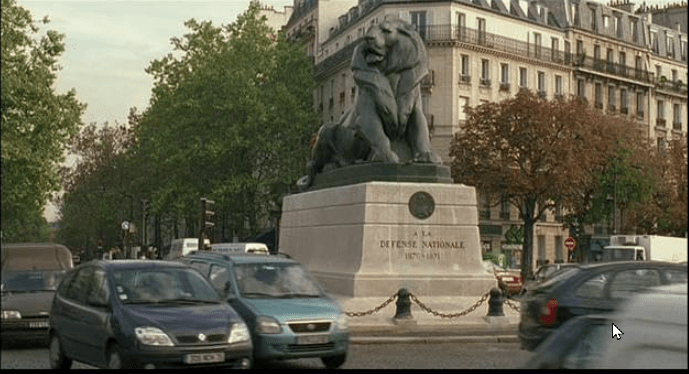
Either way, it’s the sort of thing cat people regard with loving exasperation. The great filmmaker Agnès Varda felt like putting her cat on a monument, and did so in her short Le Lion Volatil (actuality on left, modification on right):
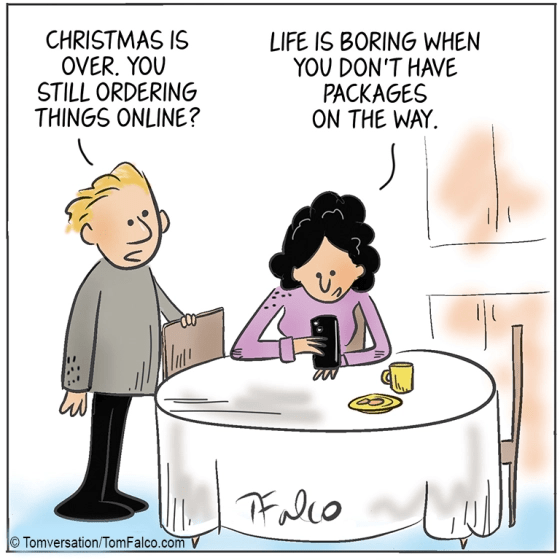
And as Aaron notes when sending this next one in, Falco really wants to say something about this gap-week.




























 Comics I Don't Understand