Labor Day 2024


A bit of nostalgia here, since we seem to have been in a continual U.S. political campaign since 2018, with little or no letup.


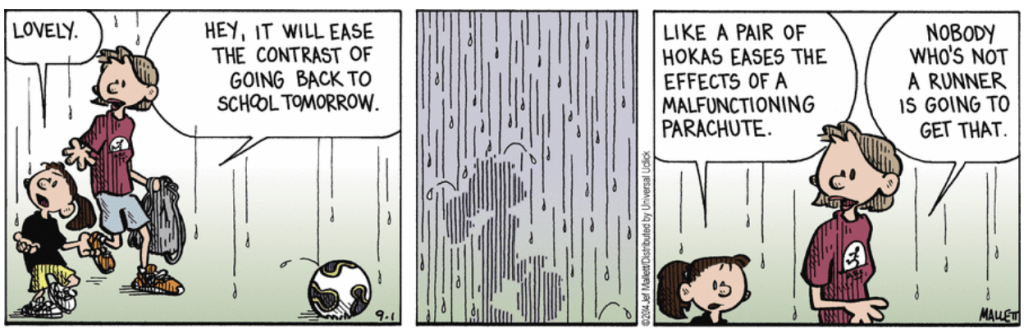
The day after Labor Day used to be the traditional day for school to start, but the start has crept backwards: the local schools start a full two weeks earlier. Are there schools that have the patience to wait until after Labor Day? (colleges don’t count).

Since this is CIDU, we’re including this one, that’s not so much a CIDU as a search engine lookup for Hokas.


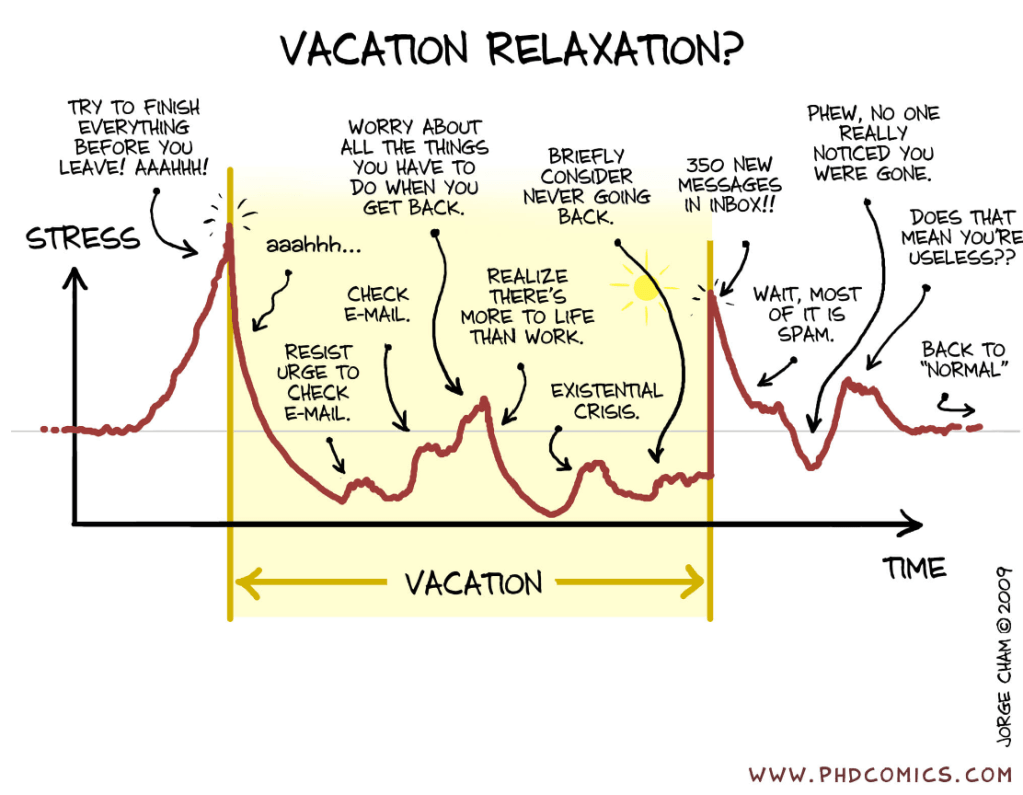
Labor Day is typically the end of the period when vacations are taken for adults as well, at least those who have children in school.


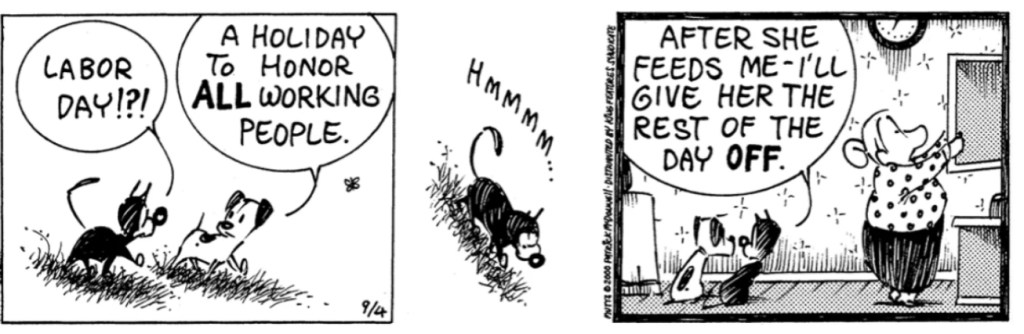
And to close out with a return to a pet view :

They both work!

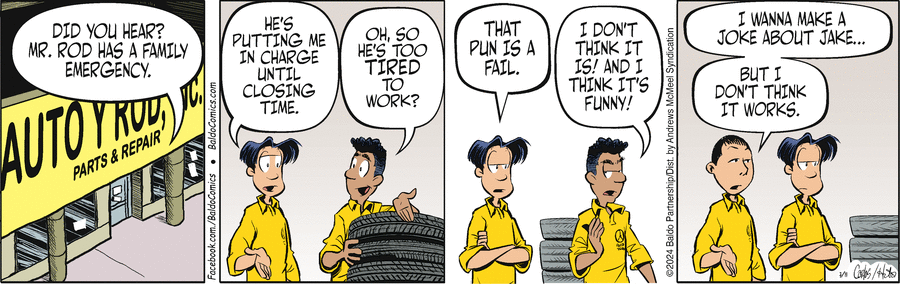
As we have asked before with Baldo, does the joke depend on language, and does it work in both the Spanish and the English versions of the strip?

Here there are two loci for our standard questions: In panel 2, the dialog from the second character (who I think must be Jake); and in panel 4, the second part of the dialog from the speaking character.

My take on those two, in short summary: The panel 2 pun works fine in English, and the Spanish also has something of a pun, by substituting a different statement instead of a translation. In panel 4, in the Spanish there seems to be an amusing equivocation, by virtue of a grammatical ambiguity; which does not carry over into English.

In some detail:

In the English, notice the emphasis given in the lettering to the word TIRED. And while Jake says that, he is all over a stack of TIRES; even seemingly pointing to them as though in a sort of illustration.

In the Spanish, Jake’s line translates according to Google as “Oh, so you roll out of here early?” (and I think the “you” is not the only choice — it’s more of an impersonal, and might amount to “we”). So it no longer mentions tires or tiredness, but with the mention of rolling still manages to indirectly bring in the tires and roughly complete a pun. (And as a noun instead of verb, rueda is rendered first off as wheel.)

OK, a bit of background. English (like, say, French) in simple sentences, in at least semi-formal speech or writing, requires an overt subject, even if a person and number could be inferred. Spanish (like many other European languages) allows skipping a subject pronoun if the verb form is enough to determine person and number. You can see this in both of Jake’s sentences in panel 3 — creo is 1st-person singular, but the sentence does not need to say yo creo; same for pienso not needing yo pienso.

Then in panel 4, the third character’s line Pero no creo que trabaje could be But I don’t think it works [it = the potential joke], or But I don’t think he works [he = Jake]. Which is a fairly good joke, or anyway language-amusement. [My point about not requiring overt subject pronoun turns out not crucial here, since if this sentence did use a subject pronoun, él for he or it would still be indeterminate.] But in English we get But I don’t think it works, and no secondary dig at lazy Jake.

It’s the 4th of July!

[2024-07-04 note: This post was originally from last year, 2023, but now bumped up as a republish. One or two strips added to the post proper as of the 2024 republish. Previous comments are retained, and current readers are encouraged to continue the comments thread!]


July 4th is zbicyclist’s wife’s birthday. She had to age a few years before she realized the fireworks weren’t for her.


But that’s not all of the story: On July 4, 1826, the 50th anniversary of the adoption of the Declaration of Independence, John Adams also died. His last words included an acknowledgement of his longtime friend and rival: “Thomas Jefferson survives.” Adams was unaware that Jefferson had died several hours before. At 90, Adams was the longest-lived U.S. president until Ronald Reagan surpassed him in 2001. (and now Jimmy Carter, born October 1, 1924) Source: Wikipedia.


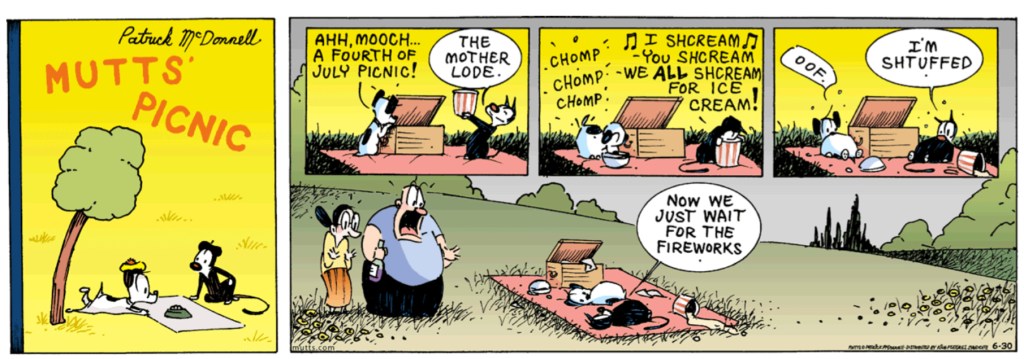
[This Mutts strip added for 2024. It was just too sweet to resist.]


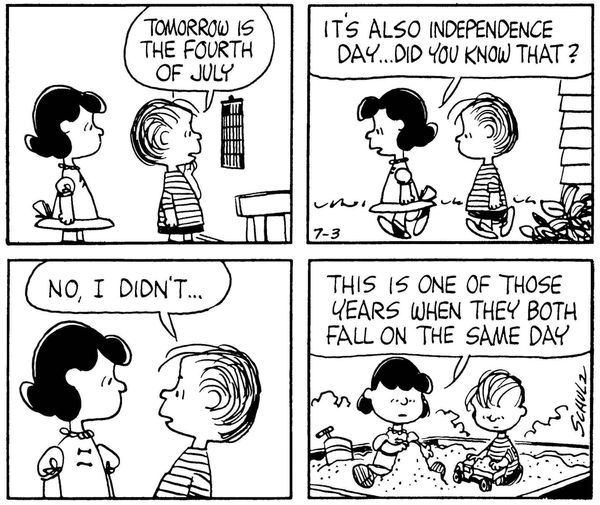
[This Peanuts is from 1964]

Bonus post: Back in the translation shop

Today’s Macanudo, twice:

“It was nice while it lasted.” Okay, I’ll buy the pairing. Both are sweetly regretful but have just a tiny bit of a sting, don’t you think?

But now, today’s Baldo, also twice:

Now at first this looks like something we’ve seen a few times with Baldo: A pun or language-dependent joke in the English version, and then a reduction to a univocal expression in the Spanish version with no attempt to preserve the polysemy needed for the pun.

But not this time!

The key is in hachacento, which does not register as a recognized or translatable Spanish word, at least by Google Translate. But looking at parts:

hatchet ==> hacha
accent ==> acento

So we do get both axe and accent! (But not sent ==> enviad{o/a}. But who cares at this point!)

P.S. Don’t forget to stop and smell the noises in panel 3.

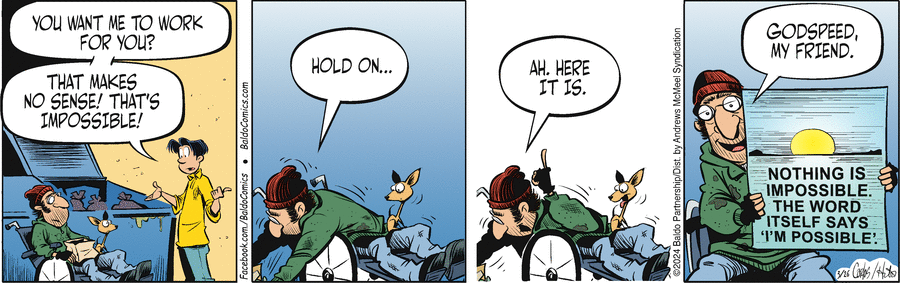
Impossible!

Let’s revisit a topic we’ve seen in different lights at different times: How the English and Spanish versions of Baldo may differ in how a joke works.

Here the joke comes off okay in English, as based in written language (or anyhow spelling). The specifics won’t work in Spanish, so they settle for a less striking point.

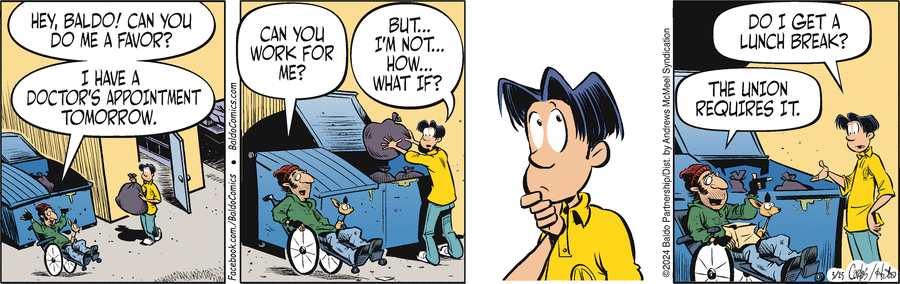
P.S. The previous day’s comic clarifies that “work for me” probably means more like “as a substitute” than like “as an employee”.

Labor-day-published gallery

These are just whatever was at least pretty good, was dated today, and was in some way about the Labor Day holiday or tradition. … A quick survey of which cartoons were willing to be about the holiday and which preferred to go on their own way.

So cool! ¡Muy chevere!

Thanks to Philip, who sent this in and suggested a better wording for the punch line. … Which we’ll print below the cartoon image, so you have a moment to comment with your own suggestion first, if you like.

As Philip asks, Wouldn’t this be better as “Making a cool car is hot work.”?

I think we have established pretty confidently that Baldo is done in English first then translated for the Spanish edition; so missing the pun-portunity in the English is not likely explained as translation problem from the Spanish original . Nonetheless, for whatever light it may shed, here is the Spanish version:

Independence Day!

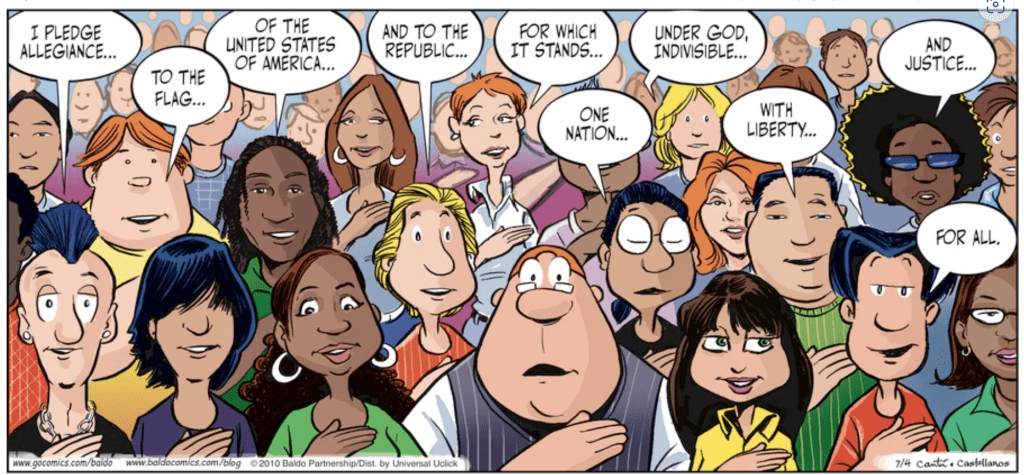
Let’s appropriately start with the Pledge of Allegiance.

A serious moment from Nancy. The Gilchrists could do this type of thing well.

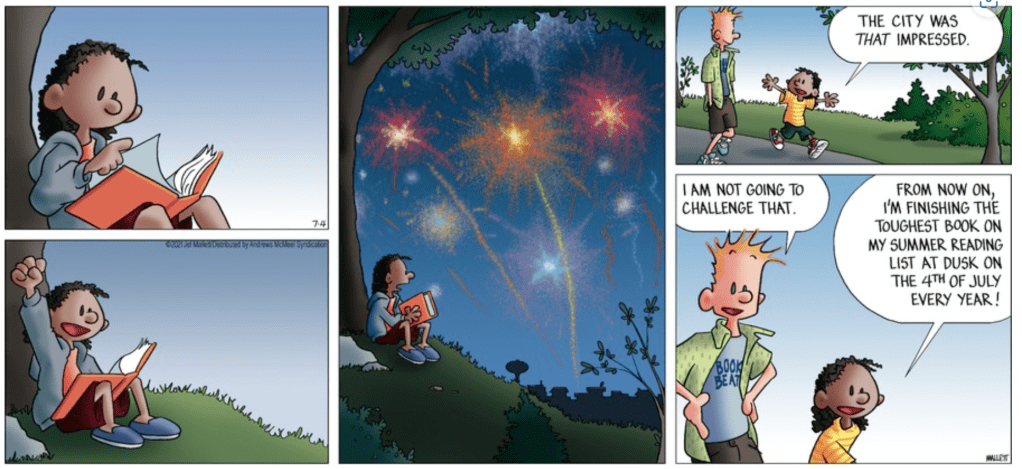
Now it’s time for a picnic and fireworks!

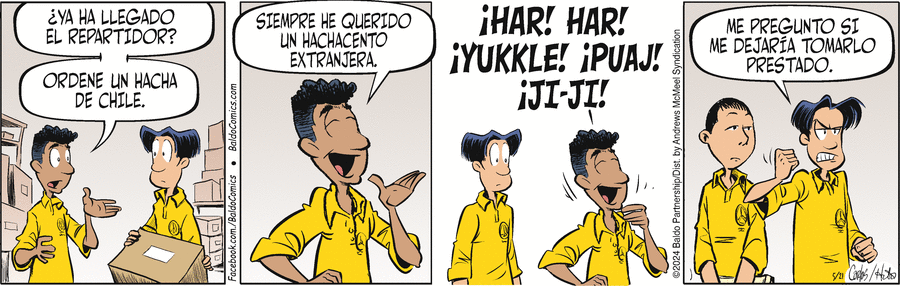
And one good Baldo deserves another! We never got anything more exciting than sparklers, regardless of what the neighbors got.

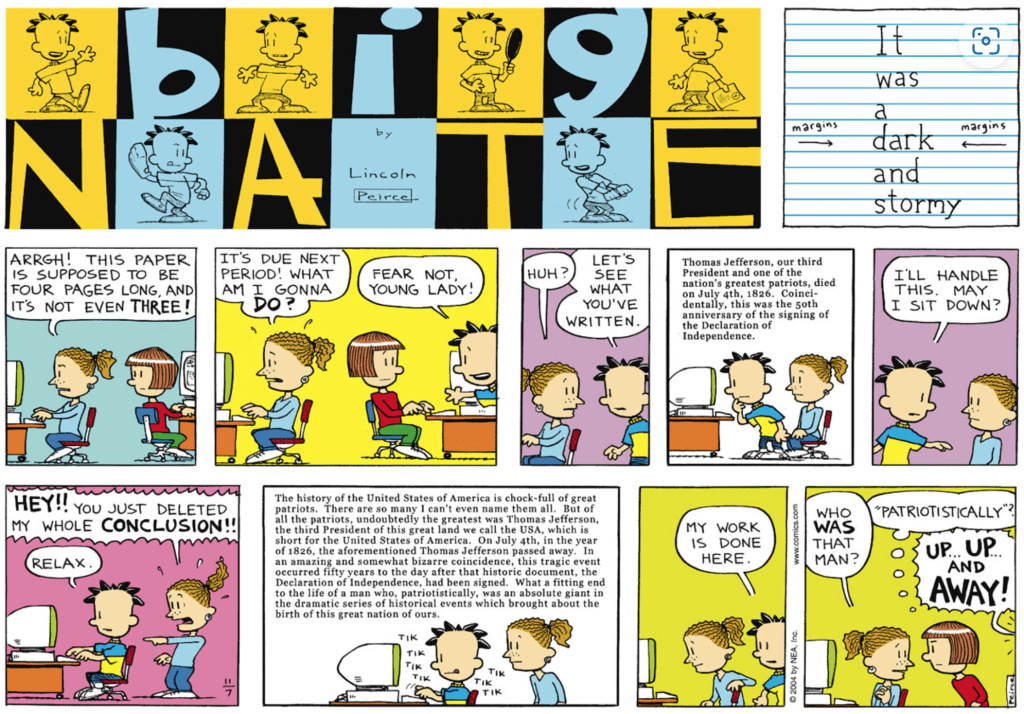
The Founding Fathers had to contend with a lot of logistic difficulties in declaring independence.

Let’s not forget, though, that the Founding Fathers were also quite interested in making a buck, and modern America continues that tradition!

But eventually the Founding Fathers brought their interests into harmony with each other.

But beyond commercialism and politics, there’s a country out there to treasure.

This land is your land and this land is my land
From the California to the New York island
From the redwood forest to the Gulf Stream waters
This land was made for you and me (Woody Guthrie)