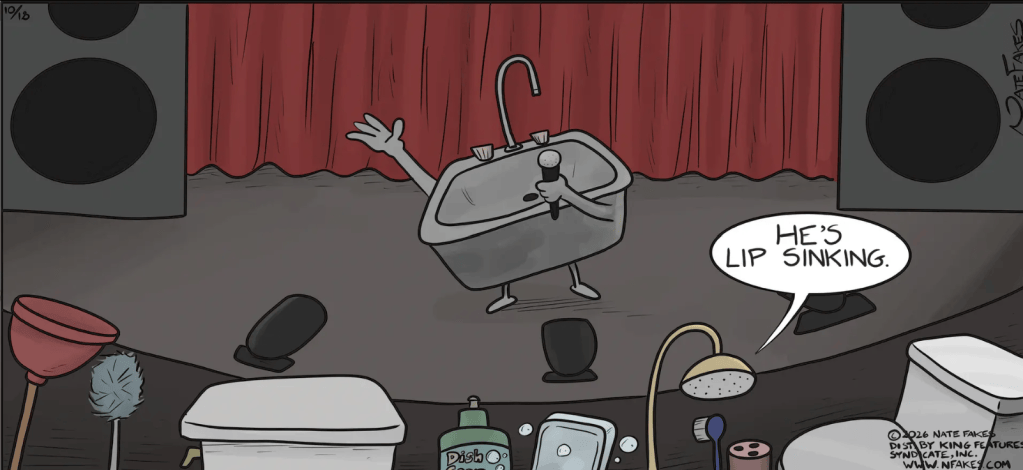
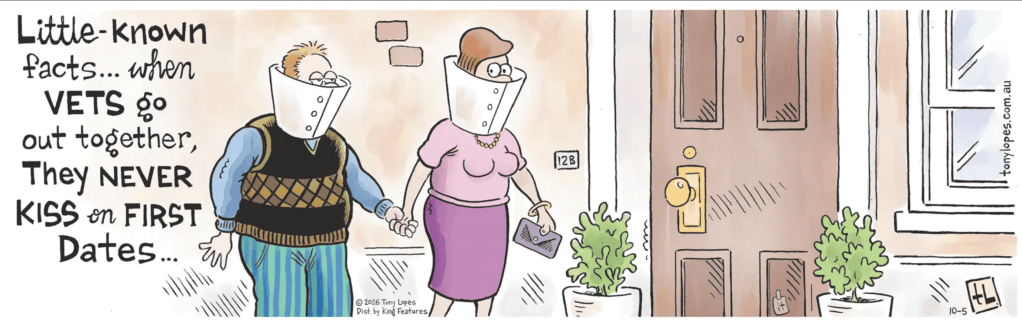
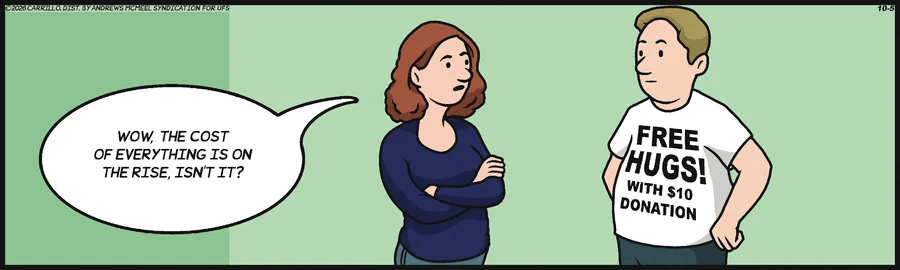
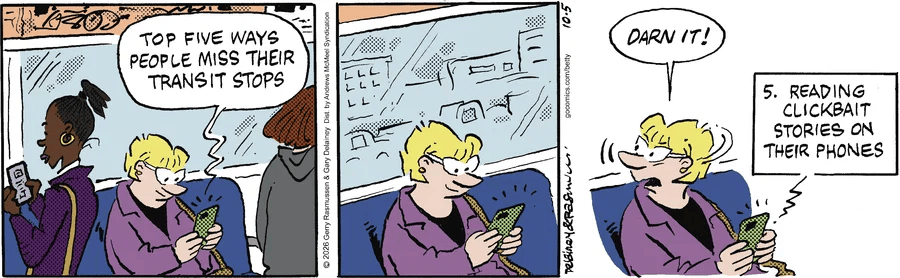
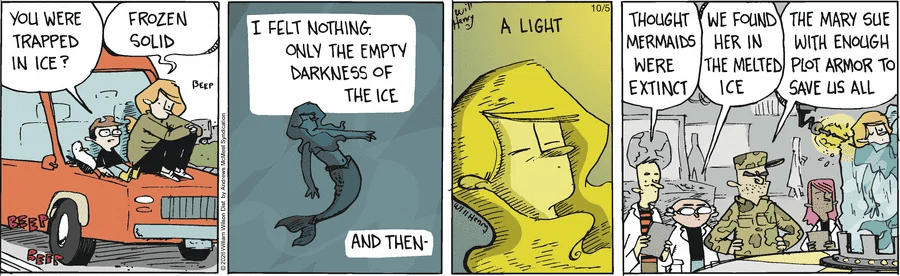
Mitch4 sends in this stinker: “This should really lead into another classic groaner: You rip-pa deese? You mend-a deese!”
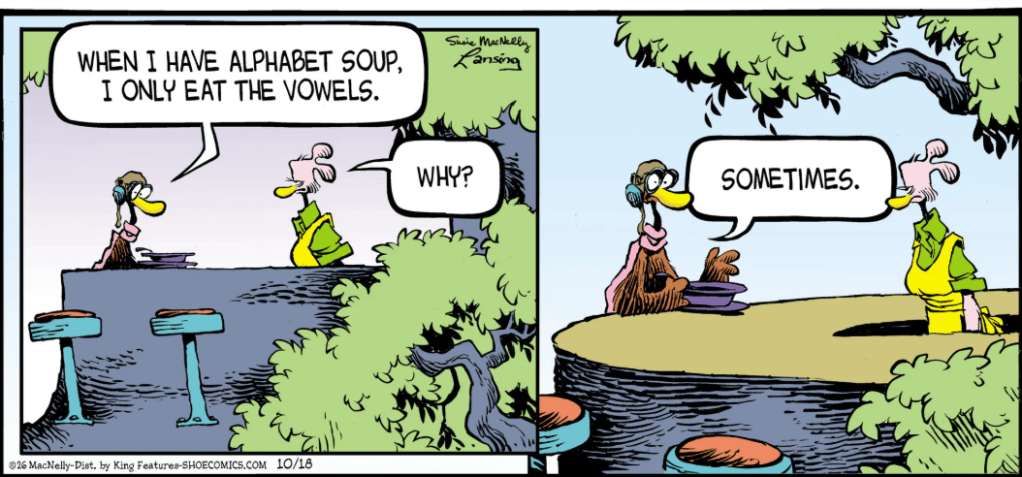
Thanks to Mitch4 for sending this in: “guess it’s not strictly speaking puns, but certainly some kind of word-play. And it did take me a couple panels to see that there was some rule-following going on.”
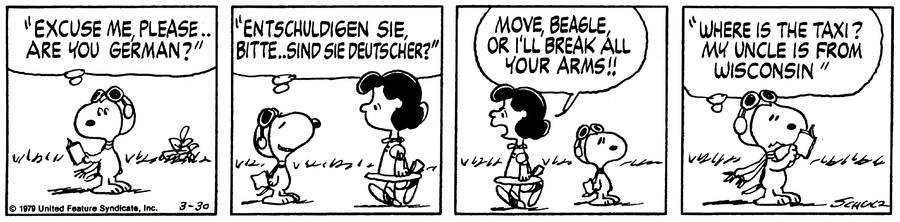
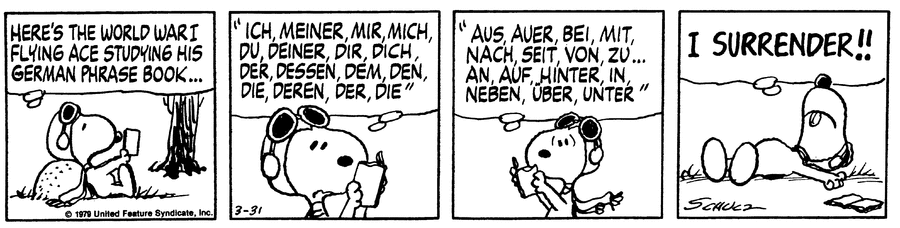
Here are a few Peanuts strips to celebrate the 35th anniversary of the “Tag der Deutschen Einheit“. Even before Schulz invented the incessant running gag about Snoopy being a WWI flying ace, he used German surprisingly often (much more than any other foreign language, Spanish included). The strip shown above was published in 1953; the title mentioned in the second panel is a piece by Bach, called “Sheep May Safely Graze“. The other four strips below are all from a story arc that appeared in March 1979.
… Although the word “Fräulein” is technically correct “textbook” German for “miss”, it has now become severely outdated, and is no longer used in normal German conversation, except occasionally for sarcastic emphasis. The standard German form of address for a woman (spoken or written) is now “Frau“, regardless of marital status; girls (and teenagers) are referred to as “Mädchen“.
… Snoopy should not have addressed Lucy as “Deutscher“, because that is the masculine declination. The correct form would have been: “Sind Sie Deutsche?” Nevertheless, Lucy responding with “…all your arms” seems a little excessive: Snoopy has only two of them, so that “both” would have been sufficient.
… The pronouns in the second frame are “I, You, He, She“, each listed in each of the four German grammatical cases: Nominative, Genitive (possessive), Dative, and Accusative. This is the standard order used in all German grammar textbooks, in which the cases are usually numbered, and thus referred to as the 1st, 2nd, 3rd, and 4th “Fall” (“case”). Yes, Germans are notorious for excessive orderliness.
The 15 prepositions in the third frame can be translated into English as: from/out, except/outside(†), at/by, with, after, since, from, to, at/on, on(top), after/behind, in, next to, over, under. German prepositions are normally followed by the term declined in a particular “case”, but some prepositions can take either of two cases, depending on the situation, or possibly even a choice of three different cases (but only in very rare circumstances).
P.S. (†) The second word in the third panel is an error, it should have read “außer” (optionally capitalized as “AUSSER“). Schulz was famous for doing all of his own lettering, and in any case this strip predates the availability of handwritten computer fonts, so the most likely explanation for the missing letter is simply a slip of the pen, or possibly a transmission error from wherever he obtained the text.
P.P.S. I think it would have been funnier if Snoopy’s exclamation in the final panel had been “Ich ergebe mich!!“, but I admit that nobody reading an American newspaper would have understood the joke.
As a kid in the back seat, I used to look up after seeing “Watch for Falling Rock” signs to see if there were rocks falling. This, of course, was futile. Drivers on curvy mountain roads should be looking at the road, and looking for fallen rocks, not staring up at the bluff on the off-chance that there’s a boulder coming down right at this very second. Most, but not all, signs I see on the highway now say fallen, not falling.
Mark H. sends this in as a fourth wall breaker, and wonders: “Do cartoon characters count in base eight?”
JMcAndrew sends this in: “IMDB and Rotten Tomatoes have no results for anything called “The Immortal Weekend”. Does Brutus think this is a pornographic movie?”
Maybe just hoping.
Now some food-related:
On group bike rides, you call out a hazard as a courtesy to the riders behind you so they don’t hit it. So, you might call out “road kill” or “squirrel” or “skunk” … or “lunch”.
JMcAndrew sends this in: “Did someone spike it with LSD? Probably should call 911 if all these people were exposed and exhibiting symptoms.”
As these first two strips show, Charlie Brown’s shirt had already become an icon just six months after Peanuts began syndication, and Schulz created a number of gags on the topic.
There is danger in innovation:
Nevertheless, the rewards can be satisfying:
Do clothes make the man?
Mark Parisi frequently uses Peanuts characters in “Off the Mark“, and has produced a number of gags based on Charlie Brown’s shirt.
This one is directly from Parisi’s OtM website, because it predates the archive at GoComics:
Reworking the coloration produces an alternative gag:
As this screenshot from one of the TV specials shows, Schulz was well aware of Charlie Brown’s selection dilemma: