As always — but it needs saying explicitly again now and then — we like to think of this as a reader-participation site, and not just for your invaluable (or anyhow amusing) comments, but for suggestions of comics to run and discuss.
Please share your specific suggestions of panels or strips, in CIDU, LOL, and OY categories, either by direct email to
The estimable Allan Holtz, comic strip historian and proprietor of The Stripper’s Guide, has invited CIDU readers to join in trying to make sense of these example panels from the vintage series Papa Knows. He provides an historical deep-dive and some interpretive overview in last Friday’s blog column, in the Obscurity of the Day series, but leaves these four as examples where it seems no genuine attempt at a gag can be found. — What we like to call Comics I Don’t Understand!
(As Allan explains, “Obscurity of the Day is just posts about rare and overlooked newspaper comics; generally speaking if they’re hard to understand it’s because of the gulf between our time and theirs. Papa Knows, on the other hand, seems to be downright weird no matter when you might have read it!”)
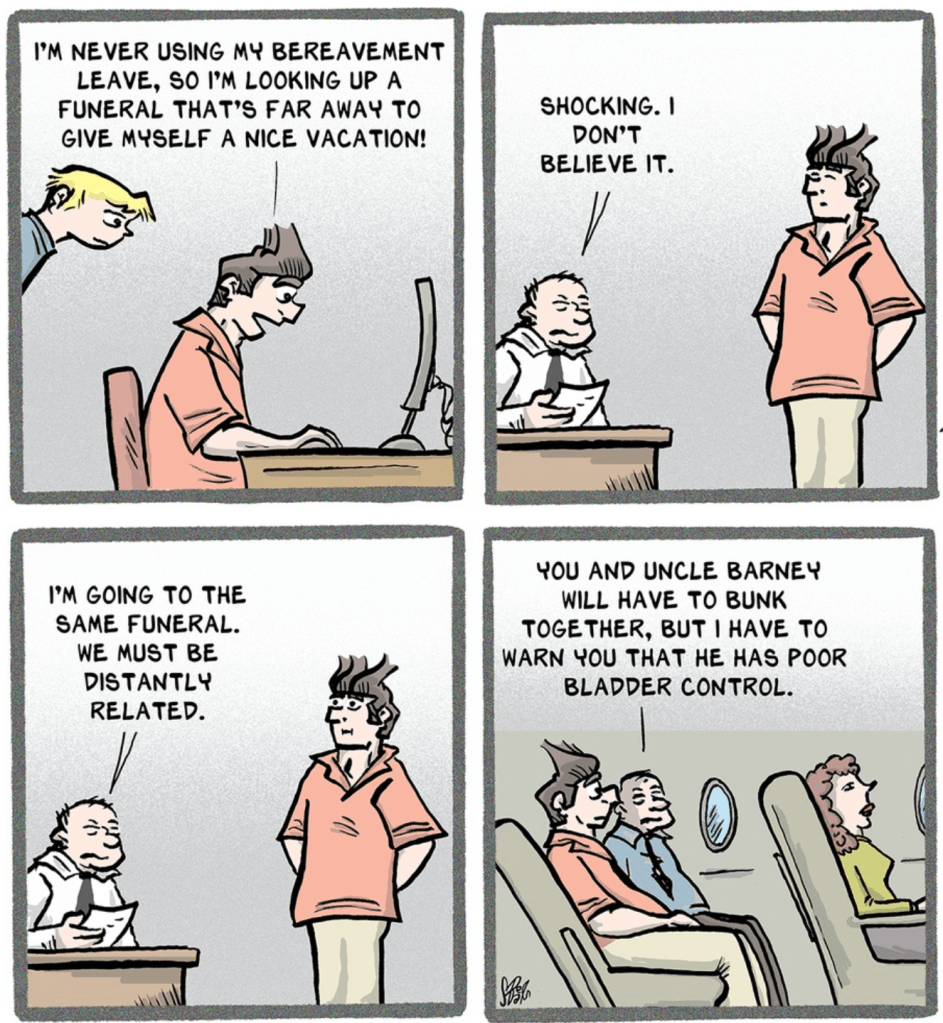
Usual John sent this one. The older man is the manager two levels up.
Puzzled? Think “Exit 1, Exit 2, and Exit 3.”
A devoted cat person is going to be reluctant to blame sneezes on sensitivity to the cat. And cats are in return sensitive over human sneezing, as shown in panels 3 and 4. My cats are even more sensitive than Ludwig, and likely would run away at the point of Achoo!
In His Last Bow, Sir Arthur Conan Doyle mentions that Holmes retired to a small farm on the Downs five miles from Eastbourne where he was “living the life of a hermit” among his bees and books. This would hardly be orange and lemon growing territory.
This was initially posted as a CIDU. Then, all at once, ZBicyclist realized it belonged on the OY page.
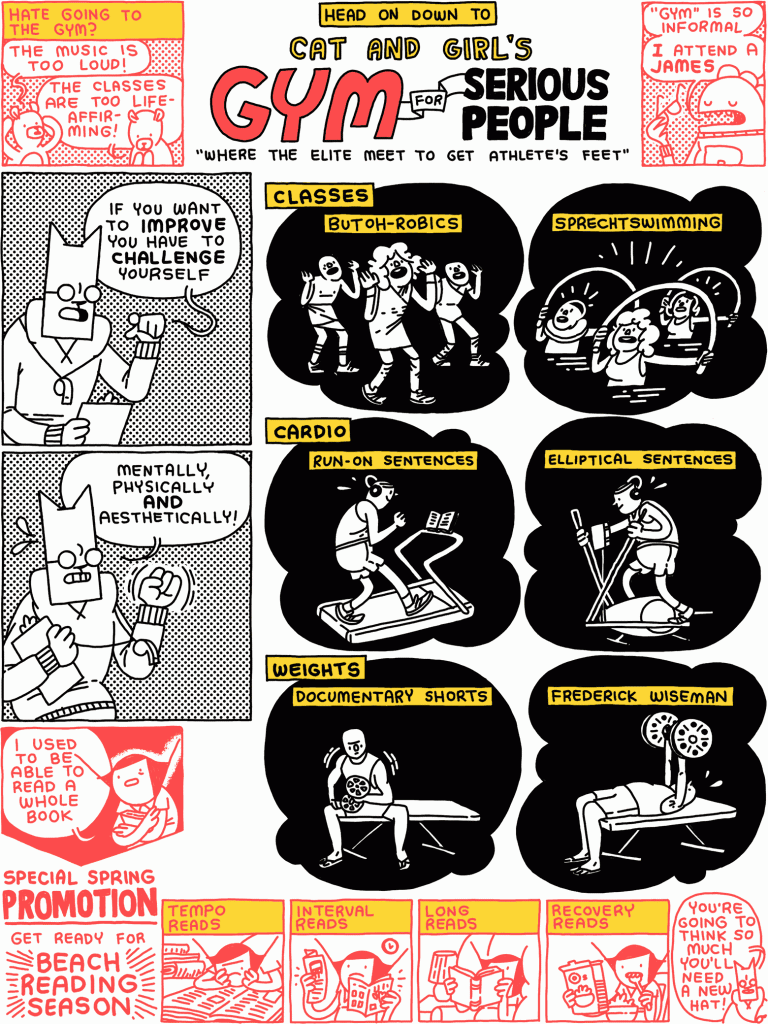
This is a massive LOL, and jam-packed with easy and harder allusions as a sort-of CIDU element. Hey, I’m still struggling to decide if a particular Frederick Wiseman film is invoked. And is Sprechtswimming best understood in relation to Sprechstimme?
Janis is here without her Arlo, but the cartoon is heading for what we’d have to call Arlo territory in the CIDU sense!
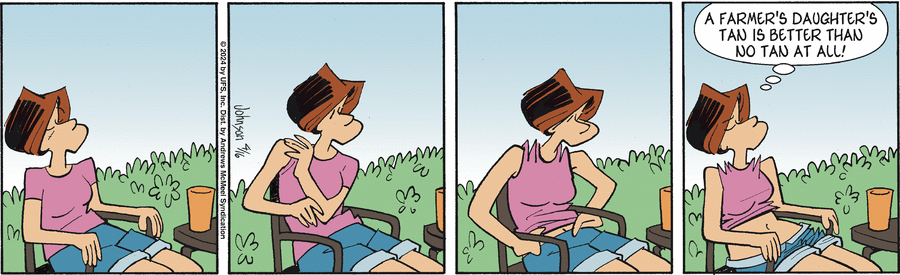
I thought farmer’s daughter’s tan a clever play on the familiar farmer’s tan but wasn’t sure what the intended extended meaning was or whether it has anything to do with farmer’s daughter jokes. But I thought it might help to establish it was a nonce coinage by pointing to many standard dictionary entries for farmer’s tan and the absence of any for farmer’s daughter’s tan. But couldn’t find any of even the former! But at the last minute, at least Urban Dictionary turns up with an entry for farmers tan!
This is a (very) long post, and I hope that it will generate an equally large amount of discussion. Everyone here is of course free to express their own opinions, and while I do not expect that everyone will agree with everything that I have written, I hope that you all will continue to observe the customary standards of decorum that have become a hallmark of CIDU.
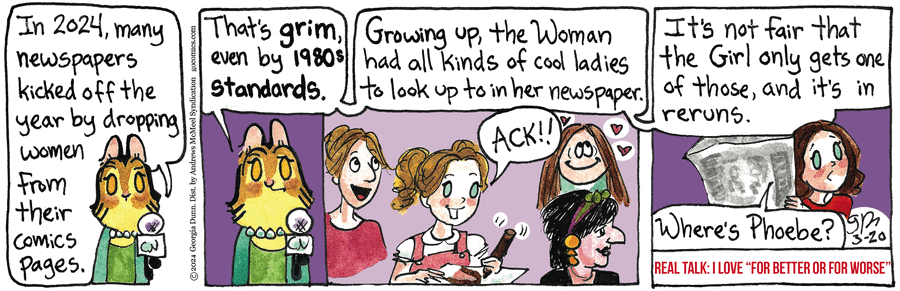
Over the past few months the Daily Cartoonist has reported extensively about the way that Gannett has “restructured” the comics for all of their newspapers. A more recent TDC report theorized that one motivation for Gannett’s microscopic menu was misogynistic chauvinism, and Georgia Dunn adapted this hypothesis into Breaking Cat News:
It is undeniably true that newspaper comics have been a male-dominated business for over a century, but I think it both misses the point (and weakens the argument) to ascribe Gannett’s motivation exclusively to chauvinism. Gannett has simply selected old, reliable, and non-controversial mainstays. The average age of the strips on their “approved” list is approximately half a century, and back then virtually every single comic author was male. Gannett is not discriminating directly against “women”, the company is discriminating against all new authors, no matter whether they are women, men, or transgender.
As I already commented at TDC, “Gannett has selected a tired collection of dull, ancient (mostly zombie) strips, and has presumably negotiated a massive volume discount from the syndicate, because they are in a position to impose this lame collection onto dozens of defenseless editorial offices, in complete disregard of what readers would actually prefer. This is just window dressing for the sake of being able to claim that the Gannett papers still offer a comic section; the corporate leadership doesn’t care one iota whether anyone would bother to keep a subscription to read any of those features, and Gannett would probably prefer if all of their papers dropped the comics entirely.“
In addition, I also do not think that it is fair to assume that only a woman can create a convincing female character. Although female authors have always been in short supply, there are nevertheless a number of strong, positive girls in the comics, each of which goes a long way to dismantle the antiquated stereotypes set by “Blondie“, “Momma“, and “Nancy“, or (even worse) in “Andy Capp” and “The Lockhorns“.
Here’s a selection of some of my favorites. Most are written by men, but there is one woman and one trans author in this collection:
First and foremost, there are both Amelia and Rose in Will Henry’s “Wallace the Brave“:
Then we have Henrietta (Enriqueta) in “Macanudo” (by Liniers, not to mention whoever does those brilliant English translations; his only translator’s name that I was able to discover was – not surprisingly – a woman: Mara Faye Lethem):
Cynthia in “Barney & Clyde“:
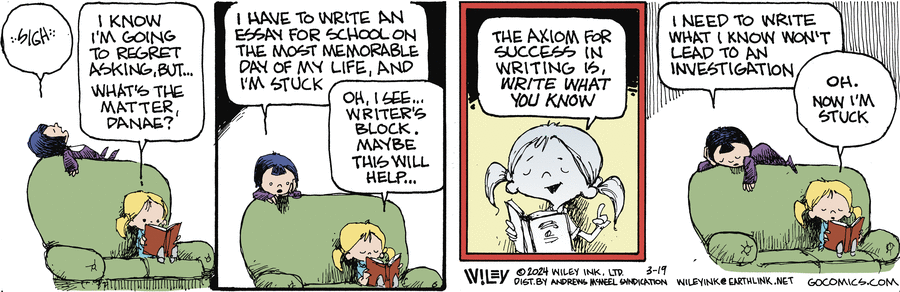
Danae (and her sister) in Wiley’s “Non-Sequitur“:
The last BCN panel shown above refers to “Phoebe (and her Unicorn)”. Personally, I preferred Dana Simpson’s original title (“Heavenly Nostrils“), but I guess it just wasn’t marketable:
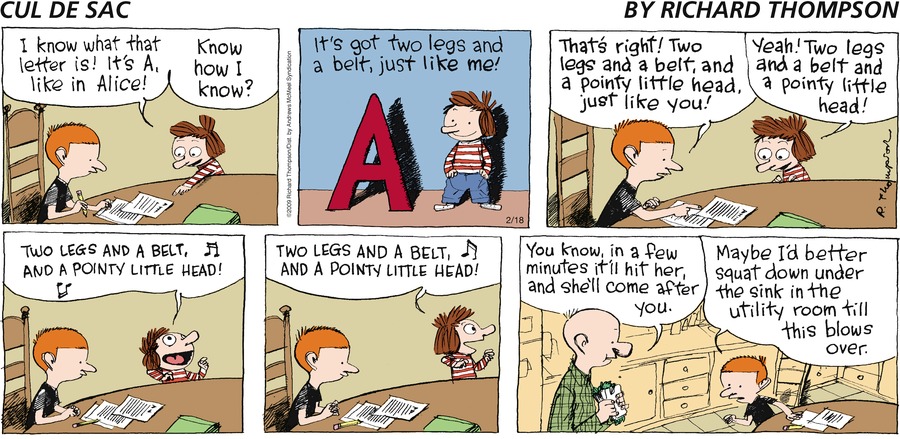
Making an exception for a re-run, there’s Alice in Richard Thompson’s “Cul de Sac“:
Making another exception for a zombie, especially because it was inherited by a woman, there’s “Heart (of the City)“:
P.S. The bottom line is that the only thing that publishing companies care about are their own bottom lines. If we are ever going to get an inclusive (multi-gendered) set of new authors in newspaper comics, it will be necessary for the readership to change their fossilized habits and to start petitioning for papers to drop all the reruns that are currently cluttering (even choking) those comic sections. That doesn’t just mean “Cul de Sac“, it also means letting “Peanuts“, “Calvin & Hobbes“, and a number of other popular “zombie” strips go. I regret to say that for obvious reasons, I don’t think this is going to happen any time in the near future.
Kilby writes: This is another comic that CIDU Bill drafted in 2019, but never actually posted. I think most readers will get it pretty quickly, but I have to admit that it took me a moment before I figured out the point; perhaps the same thing happened to Bill as well.
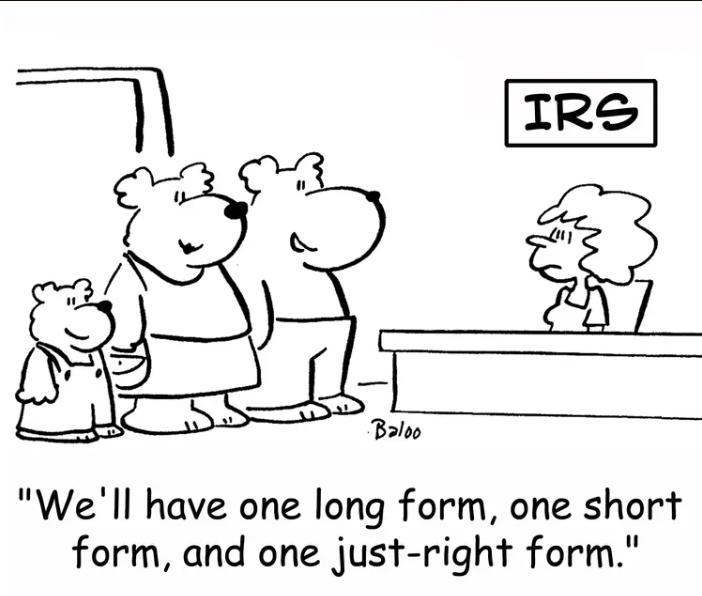
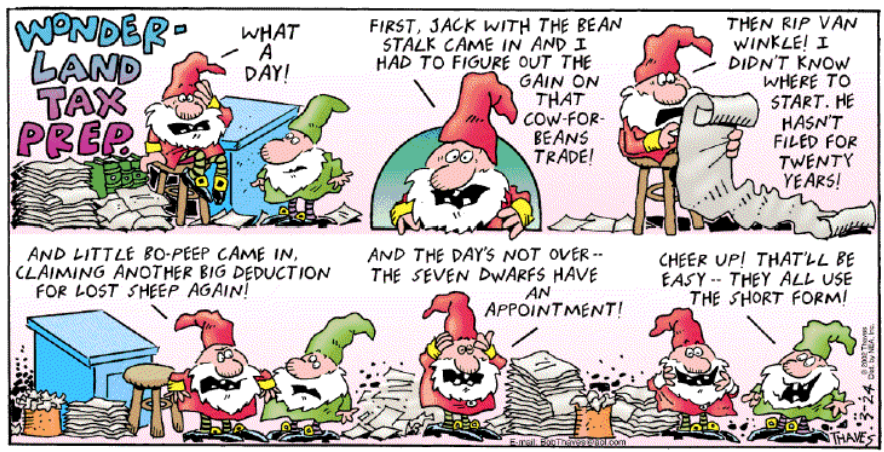
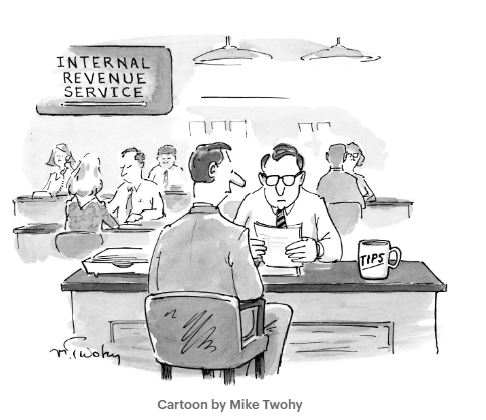
The short form deserves a geezer alert, as it was discontinued years ago. There’s a 1040-SR now for seniors — the only difference is that it’s printed in larger type.
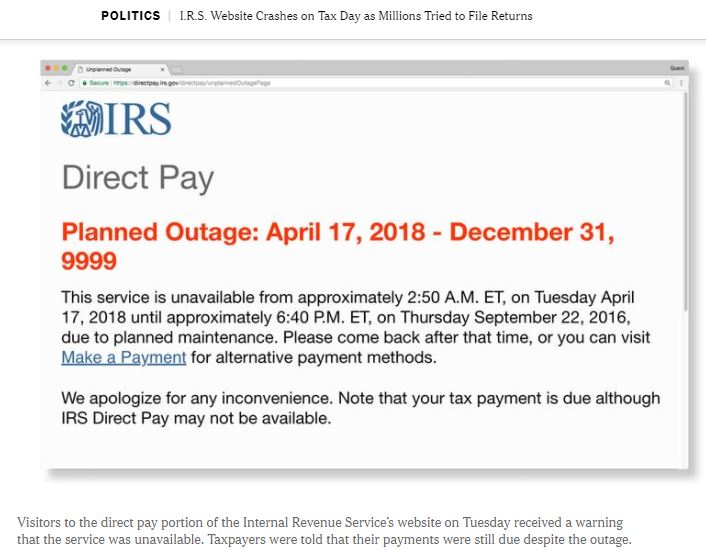
Actual error message from IRS.gov on the day tax forms (and estimated payments) were due, April 17, 2018. Not funny. Note the difference in the set of dates cited for the outage.











 Comics I Don't Understand