This “dogged effort to learn a foreign language” has paid off!
And as my brother recently messaged me: Yo no soy marinara! Yo no soy marinara! Soy carbonara, soy carbonara, soy carbonara — por ti seré, por ti seré, por ti seré.
I thought I *knew*, as an evidence-based origins account and “official” answer, that the term flack for a public relations officer was closely tied to flak “anti-aircraft fire” — via the intermediate occupational descriptive term flak-catcher for their role in deflecting or absorbing abuse and accusation. And that this was popularized in Tom Wolfe’s essay title “Maumauing the Flack Catchers”. (His flak-catchers were local bureaucrats rather than p.r. agents but the idea was closely related.)
But I wanted to check with something besides my own memory, in scholarly sources or some easily-accessible online approximation thereto.
And so, how disappointing that Dictionary.com gives us a story about some guy named Flack, and no mention of flak except a link in a “words sometimes confused with flack” section.
ORIGIN OF FLACK
1935–40; said to be after Gene Flack, a movie publicity agent
Well! At least some support from Etymonline, though they also give precedence to Gene Flack, but give some skeptical considerations against him.
flack (n.)
“publicity or press agent,” in Variety headlines by September 1933; sometimes said to be from name of Gene Flack, a movie agent, but influenced later by flak. There was a Gene Flack who was an advertising executive in the U.S. during the 1940s, but he seems to have sold principally biscuits, not movies, and seems not to have been in Variety in the ’30s.
Have you kept count for how many times this joke has come up this week?
Woops! Turns out this is now the third appearance of this “kerning pun” (as jjmcgaffey called it) on CIDU in one path or another.
This fun Rubes from a few years ago was brought to our attention by Professor Jerry Coyne (a big supporter of ducks) on his Why Evolution is True web site (blog, but he doesn’t like it called that).
As reported by The Daily Cartoonist (but nowhere visible at mutts.com), Patrick McDonnell has announced that he will be taking a six-month sabbatical to work on other projects, and that (almost all of) the strips from now to June will be re-runs (note the absence of any year in the copyright line on this one).
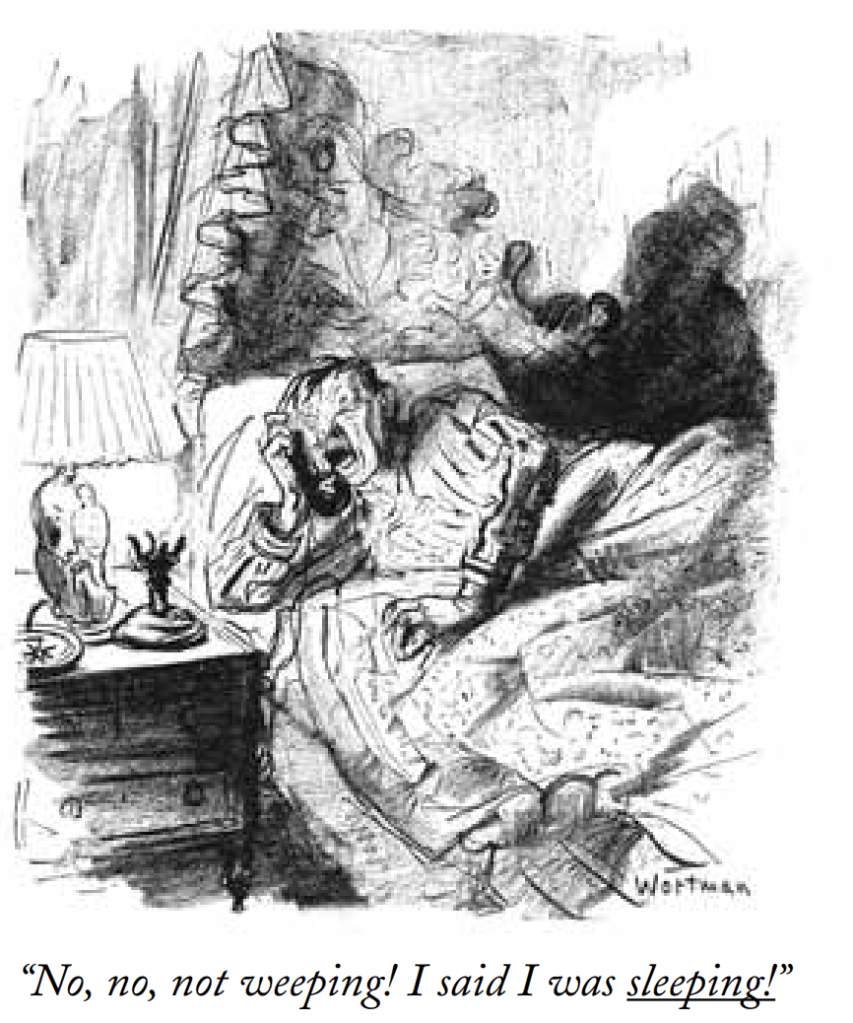
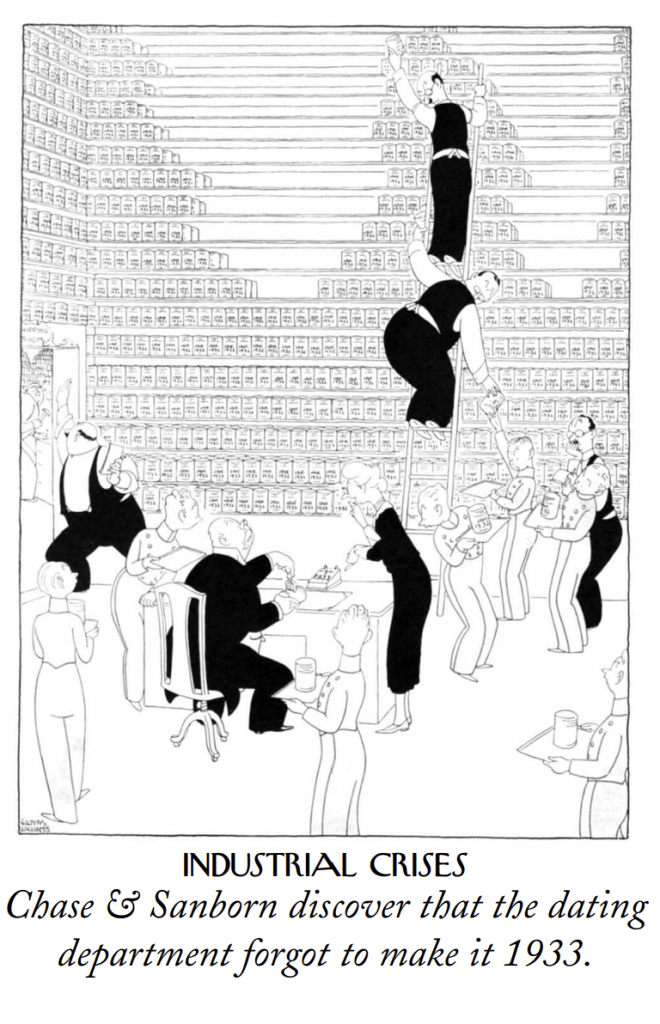
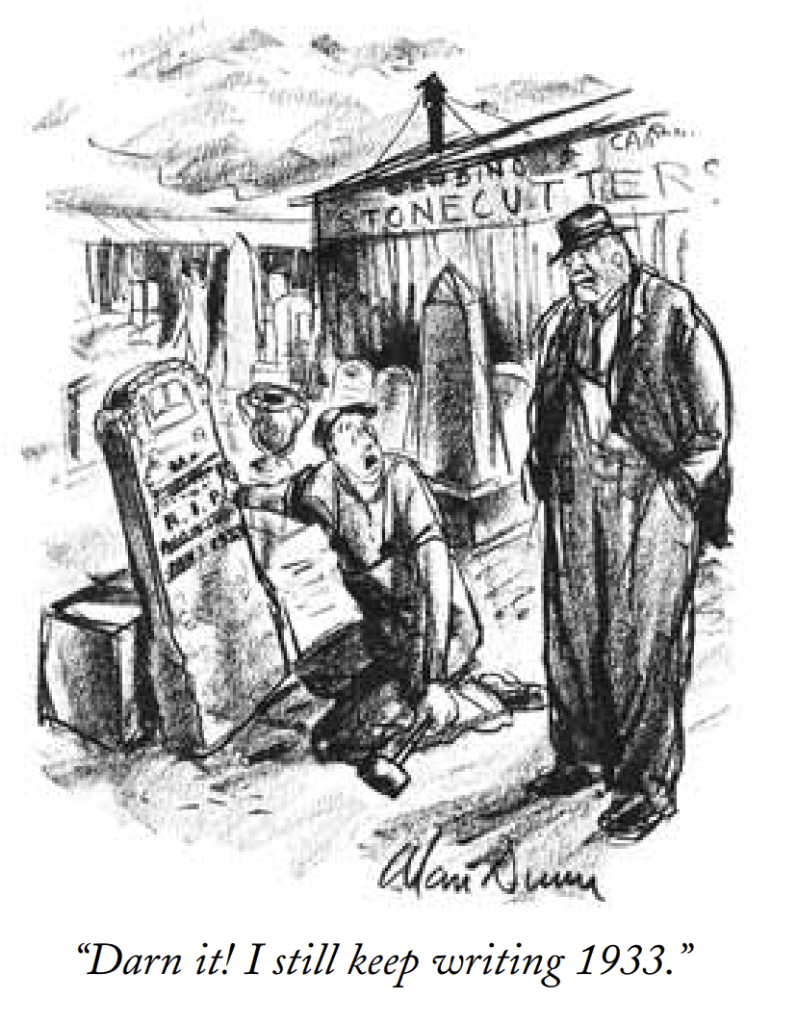
It’s New Year’s Day, 2024, so why not post some New Year’s cartoons from another NY, The New Yorker? Wait. Wasn’t that yesterday’s theme? But this is a theme so nice, we’re using it twice.
1931 (i.e. first issue of 1931): some wake-up bells to start your year
1930
1932: not a cheerful New Year’s
1933: Roosevelt’s been elected, but not inaugurated. The man here is not hopeful.
1933
Similar theme from 1934:
To all our readers, commenters, editors, and cartoonists who make this possible, best wishes for a wonderful 2023 2024!
Reflect and think? Or maybe just do some things appropriate to the season. Change out that furnace filter that should be changed every 3 months. Is your toothbrush getting too long in the tooth? Check your IRA balances if you’ll need to make RMDs. Check the refrigerator for stuff that expired in 2022. Make some Hoppin’ John with those black-eyed peas in the back of the pantry. Feel free to comment on your own ways to mark (or ignore) the day.
Or, perhaps like Mooch, you’re perfect and can just take a nap.
Every so often we see, or are sent, a comic that has something awry in its setup or presuppositions, and are tempted to run as a CIDU because “I don’t understand how we can proceed from a faulty premise” or something like that. But then on the other hand we, on principle, aren’t here to condemn and cast out any cartoonist or their work.
So, as an outlet for the first impulse, here are some collected examples, of cartoons from sources one certainly respects highly, but contain boners that just demand to be called out.
This is actually pretty funny … once you get past the multiple problems in the setup and the text giving the premise.
But this seems to depend on fission being more dramatically explosive than fusion.
Except there are no imaginary numbers involved!
Okay, it’s no doubt just a typo, but maybe today there isn’t a pass for that. The issue is that Argon is almost exclusively encountered as a gas, never an oil. But there is something called argan oil, currently a popular component of skin and hair products.
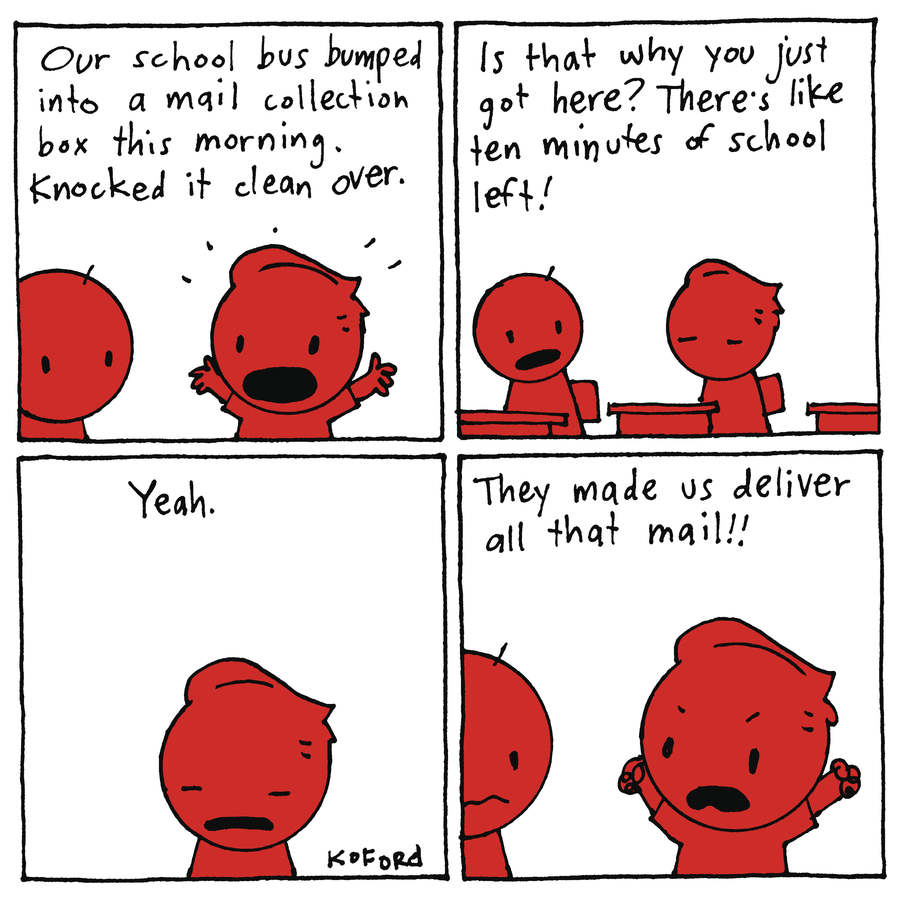
The error here is probably noticeable only to someone familiar with the workings of USPS local operations in urban localities. A collection box is the more commonly seen, the mostly blue boxes we call just “a mailbox”, with some kind of opening where anyone can slide in a letter. They will contain mail for anyplace on earth, or anyhow in the USA, and certainly not limited to local destinations. There’s no way the buskids could deliver all that.
The joke could perhaps be saved by making it a [postal] relay box. These are the somewhat larger boxes, in a khaki-green, with no public deposit latch, only a side door with a lock. When a local delivery carrier with a bike or pushcart sets out from the station to begin their route for the day, it would be awkward to have to carry all the mail for the whole route. So it gets broken into two or three stages, and a truck from the station goes around to the relay boxes in the area and drops off the packets for the later stages of the routes being serviced by bike or hand-cart carriers. If the bus in our cartoon had knocked over one of these, the buskids could plausibly have delivered them. (You don’t need to know the route — just “follow the mail”.)












 Comics I Don't Understand