Dan Sachs sends this in as a partial CIDU, wondering “Is that an asterisk? Where is the footnote?”
So, another upgrade on the GoComics website. It’s a bit mean to post this as an LOL, but it seems like every time GoComics “upgrades” there are problems. I remember after one “upgrade” Comic Sherpa (a showcase for new comic authors) was promised to return “soon”, but never did and was eventually abandoned. In recent weeks, some Barney and Clyde comics have been missing dialogue, even though they show up fine on Arcamax. But we can hope this “upgrade” will be less glitchy.
That email to subscribers mentions that the cost will be going up to $35/yr, although they are holding the price for 1 year for existing subscribers at $20.
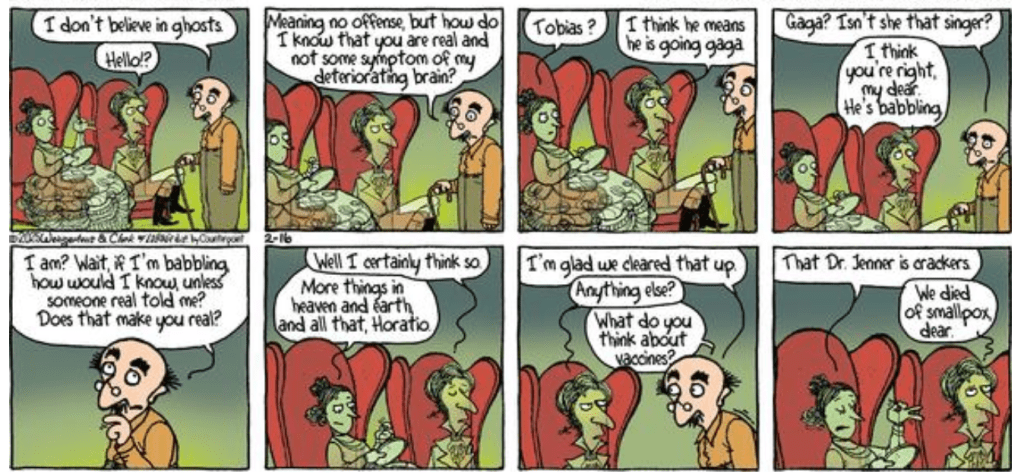
UPDATE: As if on cue, GoComics does it again today (Feb 16):
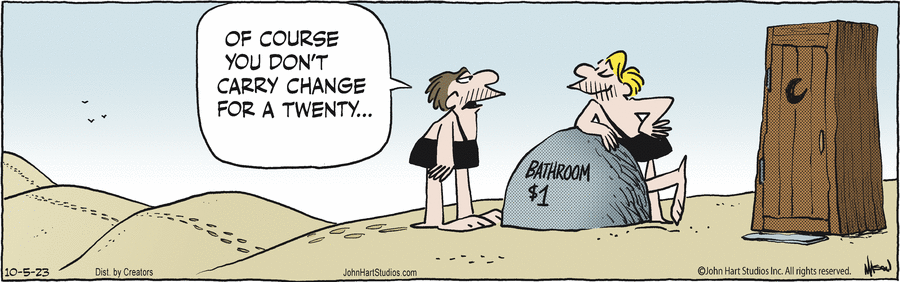
Brian in StL submitted this pair of “classic crescent-moon outhouses” last year, which seemed eminently appropriate for World Toilet Day.
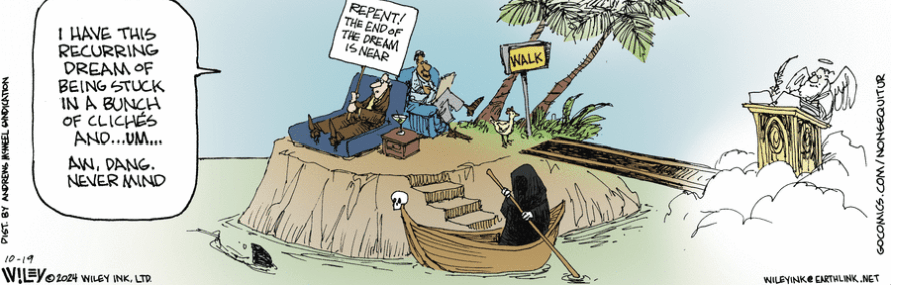
… P.S. Both of these strips were published last year on October 5th, but the Non Sequitur is actually a rerun from 2019, and was embedded into a comment in that year in Bill’s Halloween post about “Outhouses“.
Finally, one bastion of sanity in a lunatic world:
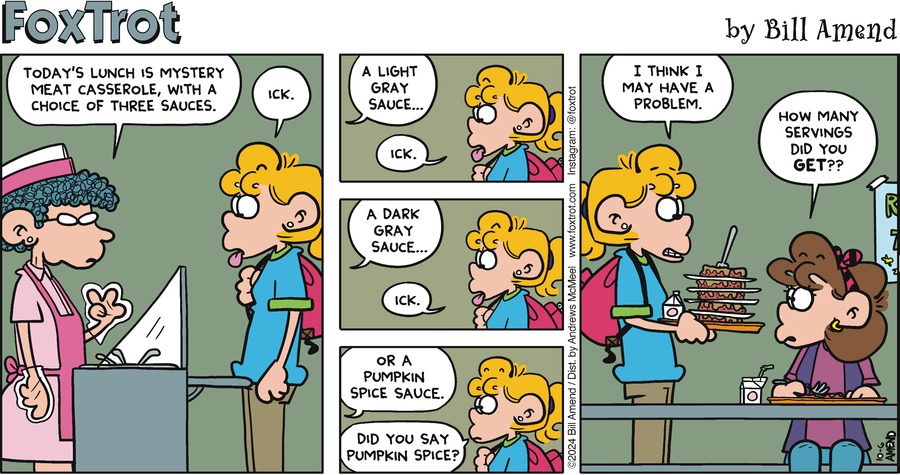
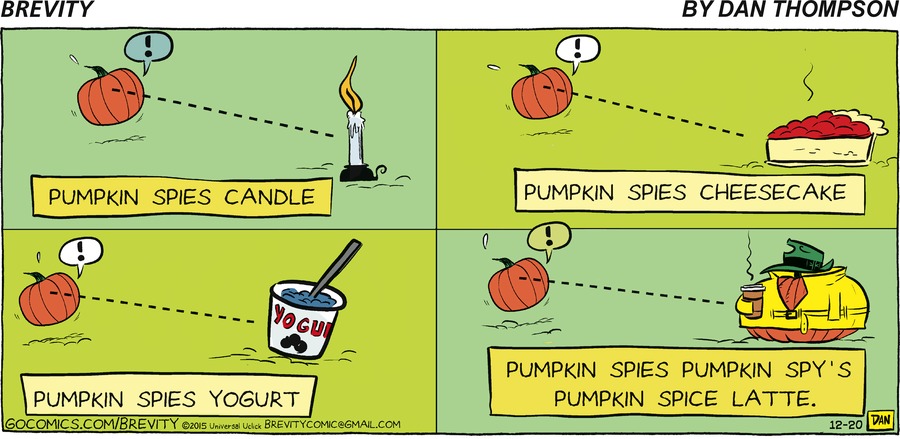
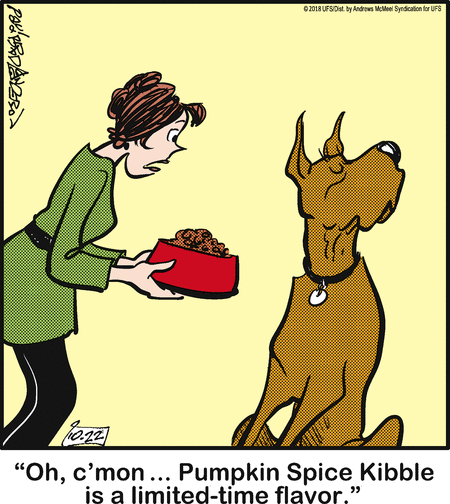
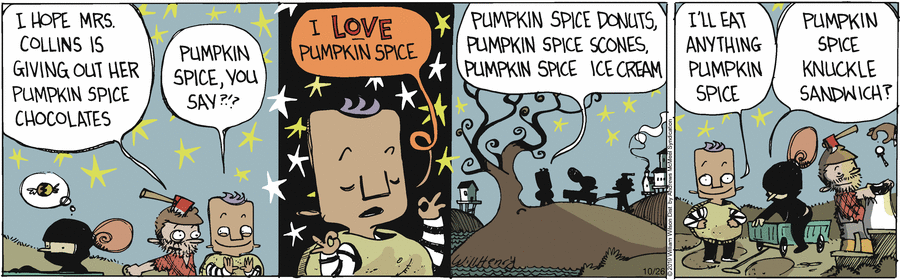
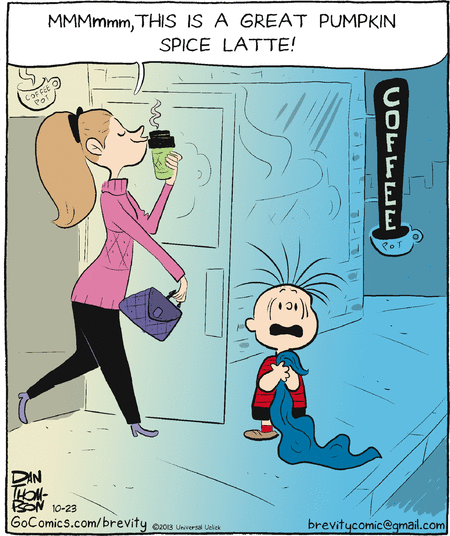
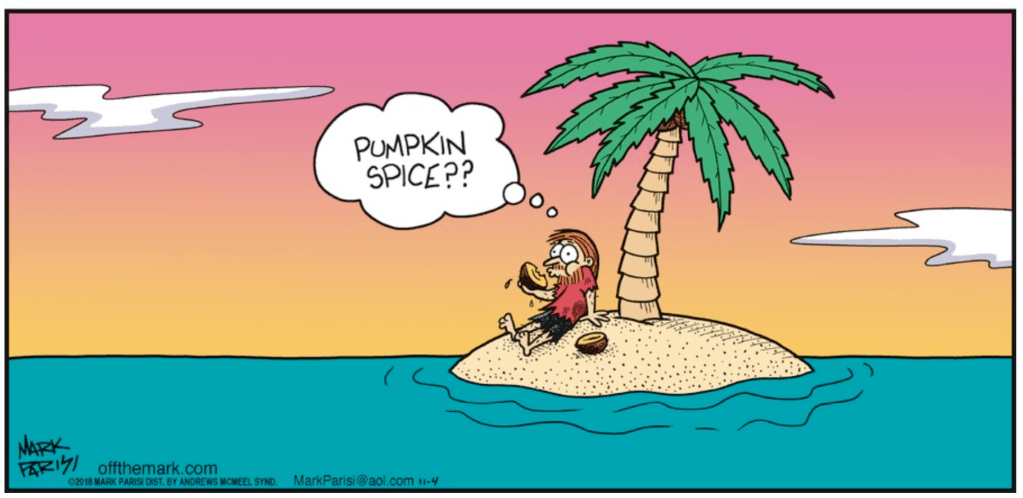
P.S. All of the previous appearances of Pumpkin Spice at CIDU were posted by Bill in the Fall of 2019; three of these presented some fairly hideous pumpkin spice flavored products (some real, some fictitious); click on the link if you are interested in seeing them. (Please note that the whole “pumpkin spice” collection will be presented in reverse chronological order, so you will have to scroll down past this one to get to Bill’s “spicy” material.)
P.P.S. – Edit: both links have been corrected, thanks to deety!
Boise Ed submitted this Cornered panel, commenting: “What a great put-down!“
… P.S. A German flasher would hope she says: “That’s gross!“ P.P.S. To which he would then reply: “Dankeschön!“
F.Y.I.: Is everyone is already prepared for the upcoming holiday(s)?
How to tell a fruit from a vegetable:
… Your attitude towards caramelizing may depend on whether you’re the one who does the dishes. Similarly with dishes such as tahdig, “a beautiful, pan-fried Persian rice that is fluffy and buttery on the inside with a perfectly golden crust, which is the layer at the bottom of the pot.” — if you make it right. The first few times might not produce “a perfectly golden crust”.
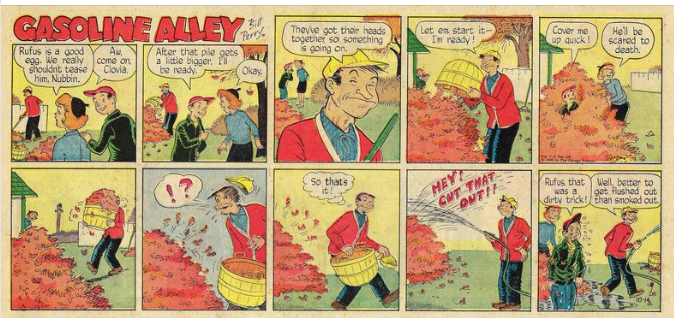
And we couldn’t leave without a couple of nods to autumn.
The character in the leaf pile is Wallace’s mom:
This one’s from 1962, when leaf burning was still a tradition:
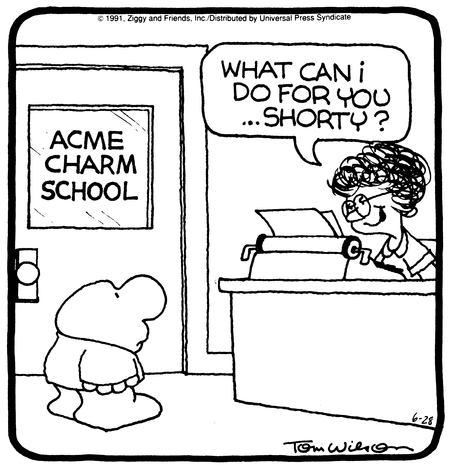
Over a year ago I posted a set of Non-Sequitur comics in which Wiley had repeated the exact same joke (including some lengthy dialog) in three different versions. The following examples from Tom Wilson’s “Ziggy” aren’t nearly as sophisticated, but the identical setups seem to show that the author has either forgotten the own material, or simply doesn’t care (“…just run it again, readers will never remember it…”)
All three of these were created by “Tom II” after his father retired, so it’s not a case of a legacy artist not knowing what the original author wrote: he did these all by himself.
Just three years later, with new artwork, but exactly the same joke, word for word:
Sixteen years after that, a new rendition (and now in color), but it’s still the same gag:
I’m sure that it is difficult (effectively impossible) to remember every single joke over a span of 18.5 years (and over 6800 comics), but insulting Ziggy as “shorty” is something of a running gag (besides these three, I ran into half a dozen other examples), so perhaps reviewing the GoComics archive might have been a good idea. That’s exactly why somebody has been going to all the trouble of making sure that the dialog is included in the GC index.
This is a (very) long post, and I hope that it will generate an equally large amount of discussion. Everyone here is of course free to express their own opinions, and while I do not expect that everyone will agree with everything that I have written, I hope that you all will continue to observe the customary standards of decorum that have become a hallmark of CIDU.
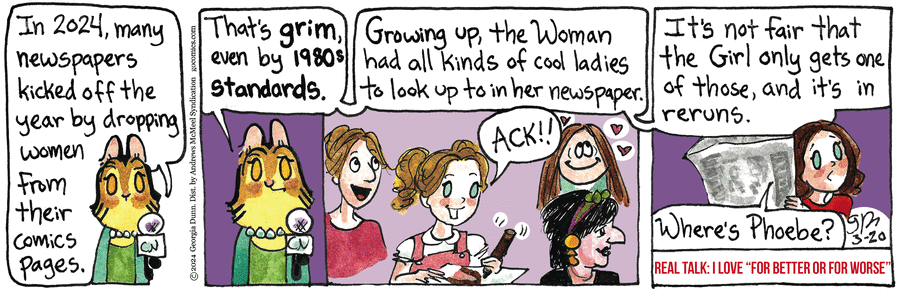
Over the past few months the Daily Cartoonist has reported extensively about the way that Gannett has “restructured” the comics for all of their newspapers. A more recent TDC report theorized that one motivation for Gannett’s microscopic menu was misogynistic chauvinism, and Georgia Dunn adapted this hypothesis into Breaking Cat News:
It is undeniably true that newspaper comics have been a male-dominated business for over a century, but I think it both misses the point (and weakens the argument) to ascribe Gannett’s motivation exclusively to chauvinism. Gannett has simply selected old, reliable, and non-controversial mainstays. The average age of the strips on their “approved” list is approximately half a century, and back then virtually every single comic author was male. Gannett is not discriminating directly against “women”, the company is discriminating against all new authors, no matter whether they are women, men, or transgender.
As I already commented at TDC, “Gannett has selected a tired collection of dull, ancient (mostly zombie) strips, and has presumably negotiated a massive volume discount from the syndicate, because they are in a position to impose this lame collection onto dozens of defenseless editorial offices, in complete disregard of what readers would actually prefer. This is just window dressing for the sake of being able to claim that the Gannett papers still offer a comic section; the corporate leadership doesn’t care one iota whether anyone would bother to keep a subscription to read any of those features, and Gannett would probably prefer if all of their papers dropped the comics entirely.“
In addition, I also do not think that it is fair to assume that only a woman can create a convincing female character. Although female authors have always been in short supply, there are nevertheless a number of strong, positive girls in the comics, each of which goes a long way to dismantle the antiquated stereotypes set by “Blondie“, “Momma“, and “Nancy“, or (even worse) in “Andy Capp” and “The Lockhorns“.
Here’s a selection of some of my favorites. Most are written by men, but there is one woman and one trans author in this collection:
First and foremost, there are both Amelia and Rose in Will Henry’s “Wallace the Brave“:
Then we have Henrietta (Enriqueta) in “Macanudo” (by Liniers, not to mention whoever does those brilliant English translations; his only translator’s name that I was able to discover was – not surprisingly – a woman: Mara Faye Lethem):
Cynthia in “Barney & Clyde“:
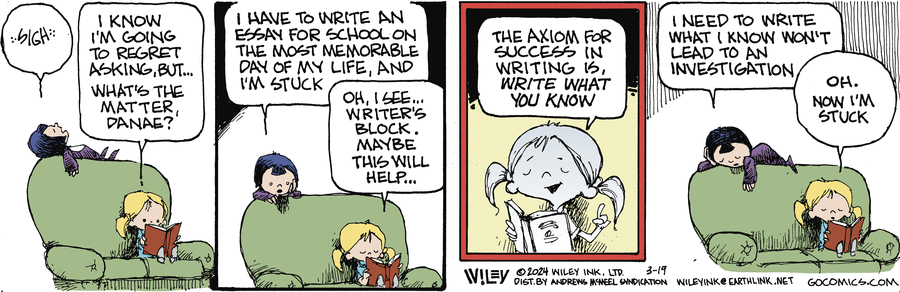
Danae (and her sister) in Wiley’s “Non-Sequitur“:
The last BCN panel shown above refers to “Phoebe (and her Unicorn)”. Personally, I preferred Dana Simpson’s original title (“Heavenly Nostrils“), but I guess it just wasn’t marketable:
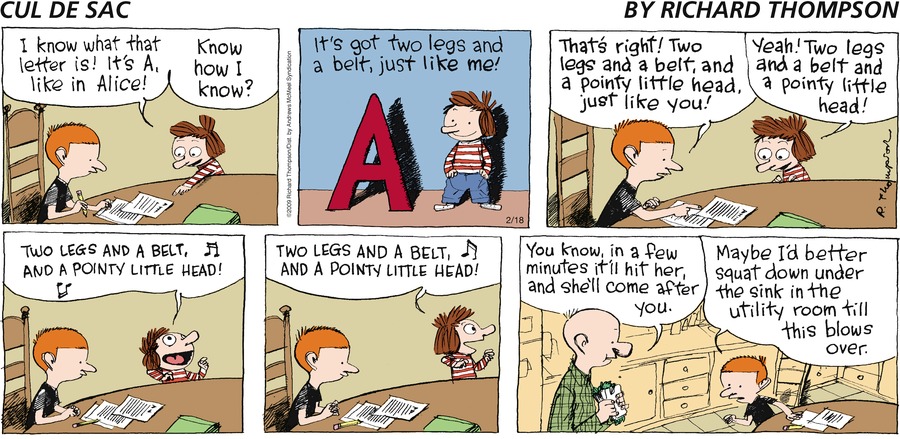
Making an exception for a re-run, there’s Alice in Richard Thompson’s “Cul de Sac“:
Making another exception for a zombie, especially because it was inherited by a woman, there’s “Heart (of the City)“:
P.S. The bottom line is that the only thing that publishing companies care about are their own bottom lines. If we are ever going to get an inclusive (multi-gendered) set of new authors in newspaper comics, it will be necessary for the readership to change their fossilized habits and to start petitioning for papers to drop all the reruns that are currently cluttering (even choking) those comic sections. That doesn’t just mean “Cul de Sac“, it also means letting “Peanuts“, “Calvin & Hobbes“, and a number of other popular “zombie” strips go. I regret to say that for obvious reasons, I don’t think this is going to happen any time in the near future.





























 Comics I Don't Understand