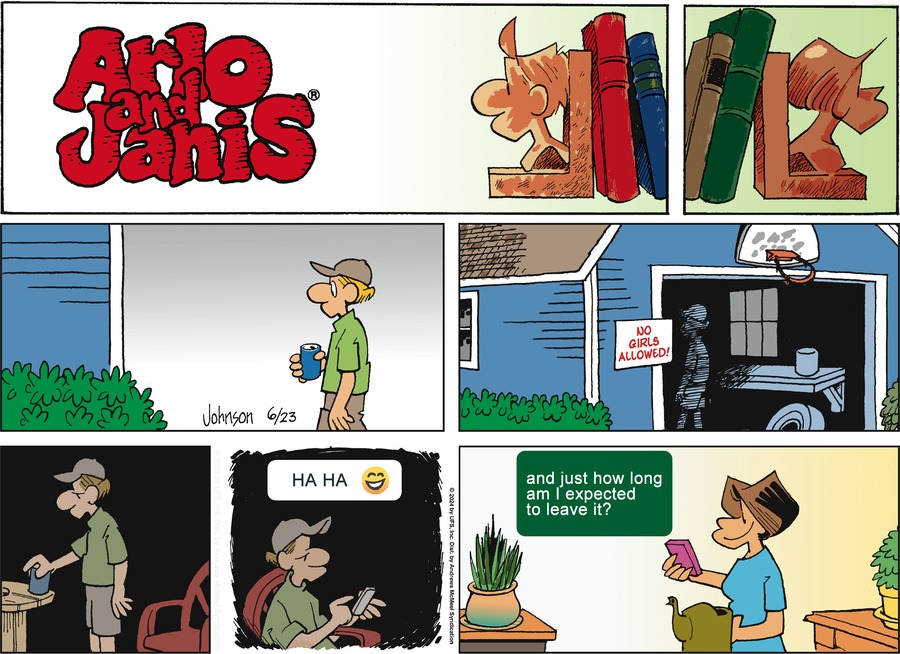
Mark H. submitted this Arlo & Janis, commenting: “I don’t understand the first thing about this one. Arlo retreats to his “man cave” and then what?“
The sign reminded me of this Calvin & Hobbes:

Mark H. submitted this Arlo & Janis, commenting: “I don’t understand the first thing about this one. Arlo retreats to his “man cave” and then what?“
The sign reminded me of this Calvin & Hobbes:
… as a commenter said.
But in what way exactly is the friend Henri-Lee suggesting the mockingbird is responsible?
Also sent in by Chak, who wonders if there might be some pop cultural reference she’s not getting.

Perfectly good comics. But you have the nagging feeling the joke or pun would work just a tiny bit better if this-or-that could be edited a trifle.
(Thus CIDUs by a polite extension — “I don’t understand why this little matter couldn’t be fixed up…”)

Here, for instance, the traditional form uses “get a haircut / hair cut” and always works smoothly; unlike in this strip, where the dialogue in panel 2 is quite unnatural. “Hey Harv, didja get a hair cut?” , “Nah, I got them all cut! Heh heh!”
A good chuckle from Arlo and Janis, sent in by Jack Applin who has a point about “breaking serve”.

As Jack explains, As I understand it, to “break serve” means to score a point in tennis when your opponent serves. However, Janis was serving (“Did you cover the charcoal fire?”), and Arlo neglected to do that, so Janis scored the point on her own serve, right? Even if we consider the entire strip one long volley, Janis still asked the initial question, so she’s serving.
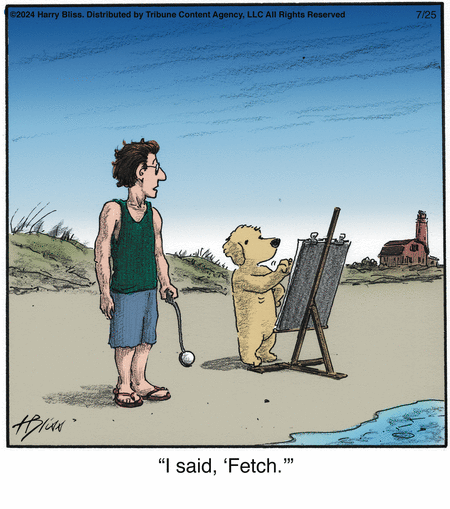
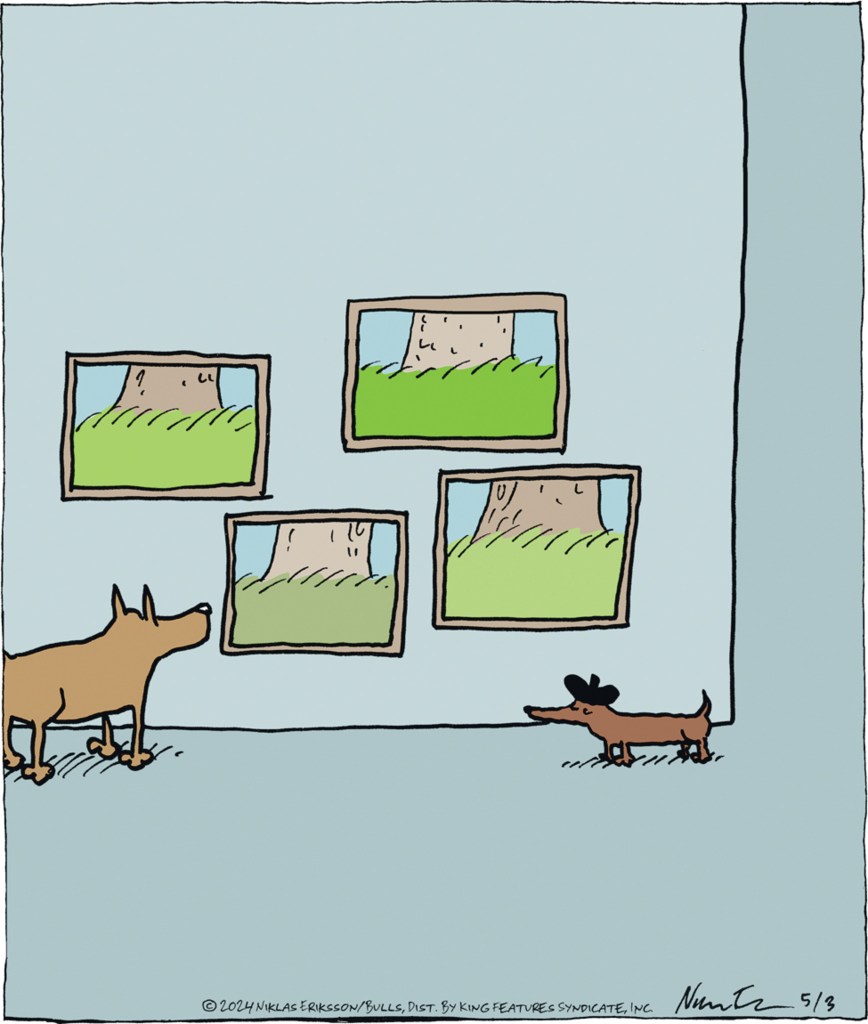
Boise Ed submitted this “Carpe Diem” panel a while back, commenting that “The Dachshund appears to be the artist, with the same picture in two different shades of brown tree bark and four different shades of green grass. Perhaps this is obvious to those who would spend big money on a canvas with only a plain circle or square, but not to me.“
This appearance of “Yes, I’m Hot in This” on 29 July 2024 was a return to GoComics after an absence, with the previous publication marked as 06 September 2023. The GoComics comments for this strip were mostly on the “Welcome back!” theme, but with a few addressing the content. Her Patreon describes activities over the past year including an NBA nomination; but only indirectly talks about getting back into drawing cartoons.
(Marking as “Momentary CIDU” because it was a touch confusing at first, but not too hard to decode in general terms.)

No, she’s not a professional hoopster, you philistine!
Thanks to Boise Ed for suggesting this.

The core for Ed of why this may be problematic is whether to take seriously the appearance of a body of water along the bottom border of the drawing, with therefore some air above it. If that casts the main picture as taking place in the air, well that sort of works for seeing the flying fish as actually performing sustained flight in the air. But it is something of a fail in terms of the human diver (with air bubbles!) and the other species of water-borne life — they can’t be understood as up in the air!
But of course that strip along the bottom doesn’t have to be taken as water below air. It could be just a decorative border. Or better, it could be the seafloor, below a water scene.
Tim Harrod submitted this “Wizard of ID” strip, noting that “…the writer seems to think that Moses was a wizard“. I sure hope that the theology in B.C. isn’t starting to leak over into the Kingdom of Id.
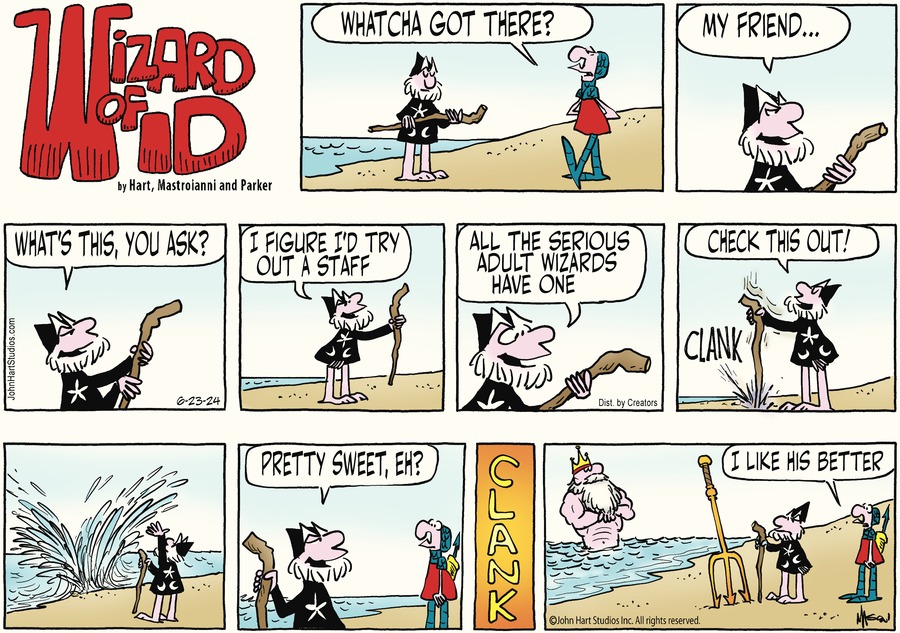
I think the joke in the final panel is clear, but I don’t understand the gag in the second “throwaway” panel, unless it’s a topical reference to some scene in a movie. The part I liked best was the snide adjective in the fifth panel: “adult” appears to be referring to the juvenile wizards in Rowling’s “Harry Potter” books, who all use dinky little wands instead of “manly” staves. On the other hand, the Wizard’s traditional implement has always been one of those wands, as we saw in the “I’m stumped” post just last month:
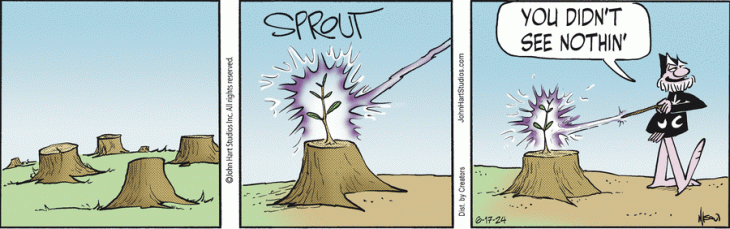
Thanks to Chipper42 for sending this in:
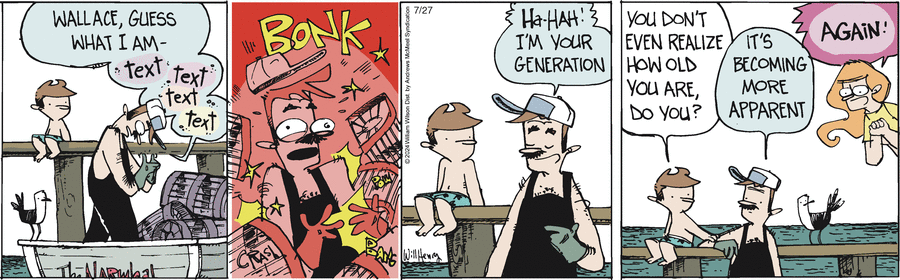
They say “I assume he ran into the lobster traps on purpose. I really don’t follow the last panel.”

As always — but it needs saying explicitly again now and then — we like to think of this as a heavily reader-participation site, and not just for your invaluable (or anyhow amusing) comments, but for suggestions of comics to run and discuss.
Please share your specific suggestions of panels or strips, in CIDU, LOL, OY, and CIHS (Comic I Haven’t Seen) categories, either by direct email to

(that’s “CIDU dot Submissions” at gmail dot com) or by using the handy-dandy Suggest A CIDU form page! Just as Chipper42 did!
Boise Ed submitted this Argyle Sweater as a “total CIDU”. The gag must have something to do with the source of the material in the hypodermic needle, but the apparently obvious anatomical pun doesn’t seem to be present, and wouldn’t automatically qualify as an effective joke, either. There must be a better explanation.