I don’t understand the joke, and I have no idea what the forbidden word is supposed to be:

I don’t understand the joke, and I have no idea what the forbidden word is supposed to be:

What’s the joke here?
Is there a pun in the name Arlo Hoyt?
This is common financial advice (e.g. in the book The Psychology of Money, by Morgan Housel, which I just finished), or, famously, in Dickens novel, David Copperfield.
Annual income twenty pounds, annual expenditure nineteen nineteen and six, result happiness. Annual income twenty pounds, annual expenditure twenty pounds nought and six, result misery.
Or, could the joke be that Arlo Hoyt has claimed that he coined this common maxim himself, and has erected a status of himself in his honor?
For less helpful advice, certainly not what Dickens’ Mr. Micawber would have advised, we have this from Randy Glasbergen:


The GoComics comments provide many more things those initials can mean; but none that make sense in the context.

Should that be Le Croissant de Death?
I guess this was before renting a bouncy castle was the thing for kids’ parties.

Thanks to BillR for sending!


Probably not helpful:

Boise Ed sends this in. “I’m unfamiliar with church practices, but it appears that the customer is envious of the priest’s abundant hair, and has asked the priest about using placebo and “alternative reality.” But then why would the priest have to remind him of his baldness? My question: what’s going on here?”


Can take a second to fill in the backstory.
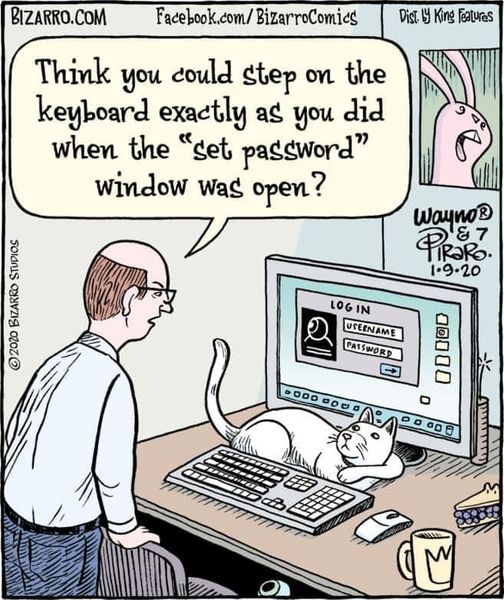


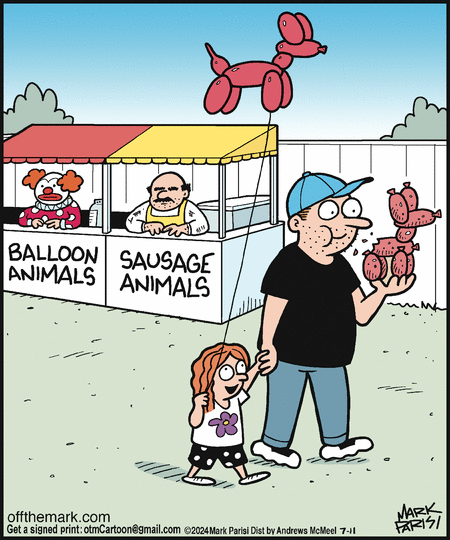


Now marking as a CIDU, for readers not familiar with the yips.

Carl Fink contributes this. “OK, why would the rhino have holes in its cardigan? Its own horn wouldn’t be poking it. Is it a joke about how anthropomorphic animals arms and legs don’t let it move on all fours without its chest scraping the ground, unlike the actual animal? I don’t get it.”
[start of rant] To your editor, this seems roughly like the comic strip analogy to the uncanny valley: “as the appearance of a robot is made more human, some observers’ emotional response to the robot becomes increasingly positive and empathetic, until it becomes almost human, at which point the response quickly becomes strong revulsion. However, as the robot’s appearance continues to become less distinguishable from that of a human being, the emotional response becomes positive once again and approaches human-to-human empathy levels”.
As we move animal characters from being animals acting mostly naturally (the cat Ludwig in Arlo and Janis, for example) to animals not acting much like actual animals at all (Pearls Before Swine) there’s a spot where the jokes just don’t work. There’s so many human characteristics put into the characters that we don’t accept the remaining animal characteristics needed to make the joke work.
Here’s a case where, in my opinion, the use of animals actually gets in the way of the joke. Hippos don’t need sunscreen and don’t sit upright on the sand. But the joke doesn’t have much to do with hippos at all: it’s that there’s a tiny bottle of sunscreen that’s too small for one of them, but the second is complaining there’s none left for them. The joke would be clearer with two normal sized people and a tiny bottle of sunscreen. [end of rant]


