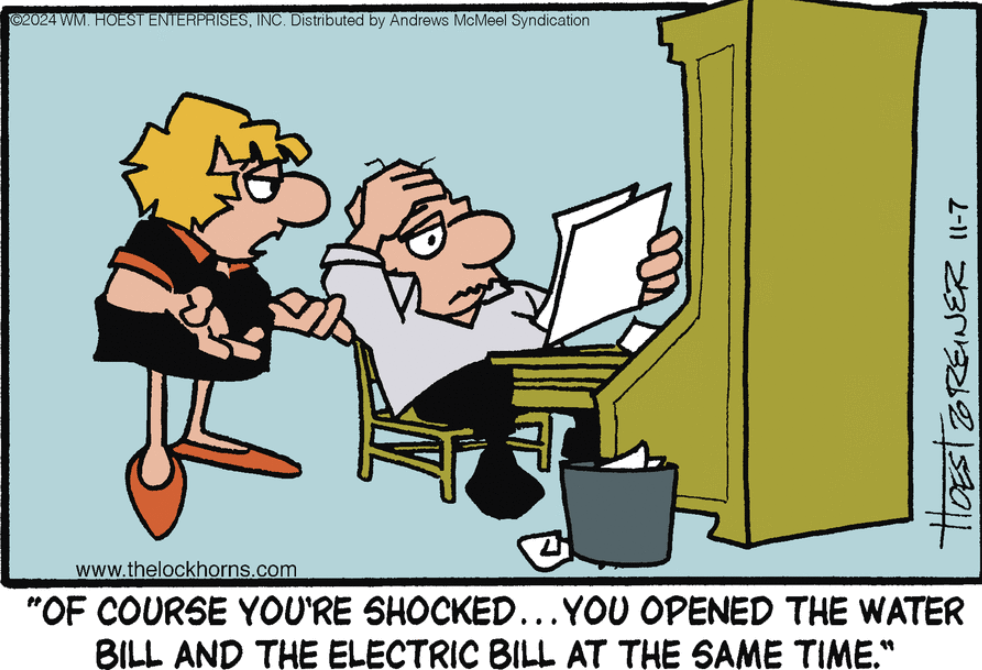
Boise Ed submitted this Carpe Diem as a CIDU, commenting: “There’s a stereotypical guy stranded on a tiny island and a ship passes by. We’re supposed to laugh at this? The boat is labelled ‘United Bananas’, so that apparently has something to do with the apparently intended humor.“
… P.S. At first I was completely puzzled and in total agreement with Ed, but only after I created this post (and examined the comic about a dozen times) did I finally discover the critical detail. Now I feel pretty silly (and I understand why this didn’t get posted before), but I’m still not going to reveal the answer.
The most recent appearance of Zits at CIDU was posted 4.5 years ago by Bill, so it seems like it’s time for a few more.
This first one was submitted two years ago by Dave in Boston, but probably got lost in the shuffle because the Arcamax link had expired(+), and Comics Kingdom (back then) had a very limited memory (something like two weeks for non-subscribers). Since Arcamax links do not indicate the date, it took a bit of detective work to find the comic that Dave had intended:
… Here’s what Dave wrote: “It seems the joke is supposed to be that the teenagers are so glued to their phones that they need to check the weather app to find out that they’re being rained on. But, it’s perfectly reasonable in that situation to check the forecast or the radar to see how long it’s going to last. And then there’s no joke. Or there’s something IDU.“
Coincidentally, Chemgal submitted this recent Zits strip as a CIDU, asking, “Just what is supposed to be in that contract?“
… P.S. I don’t have the slightest clue as to “What?“, but I have a pretty good idea as to “Why?“: Friends of ours here in Germany had photovoltaic panels installed under a “lease to own” agreement that will take 15 years for them to complete.
P.P.S. (+) The moral of the story is not to trust Arcamax links for submissions. Using Arcamax links for embedding images in comments is even worse, because the image will disappear later. If you have no other option, at least mention the publication date.
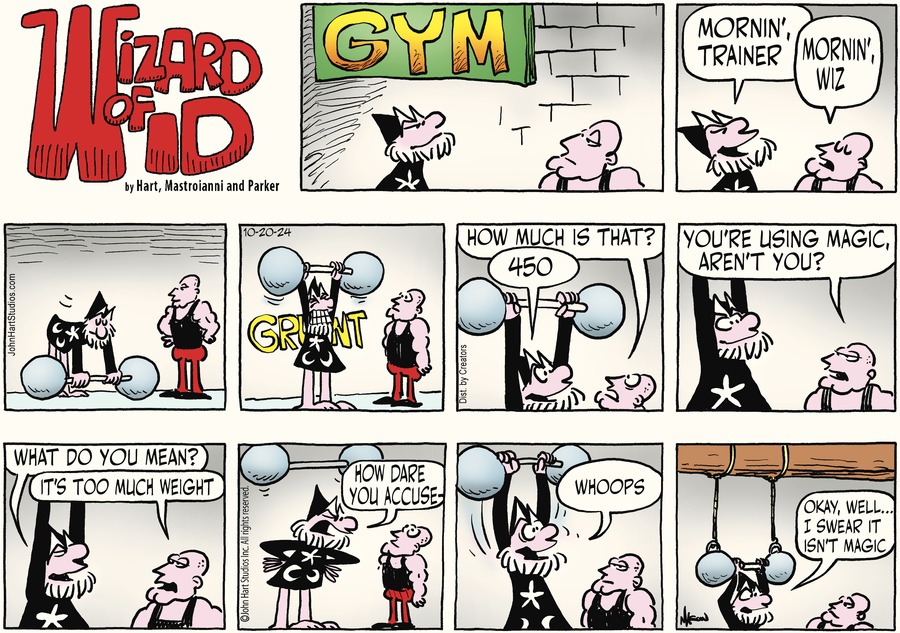
Irv submitted this Wizard of Id Sunday strip as a CIDU, commenting: “The second and third frames in the second row are what IDU. If the Wizard is cheating, shouldn’t the beam and hangers be visible there as well as in the last frame? Otherwise, maybe he is cheating and conjures the beam and hangers to ‘prove’ he wasn’t using magic in the previous frames even though he was? All told, IDU what’s going on here.“
… I agree with Irv: if there is no magic here, then the logistics of the Wizard’s cheating scheme simply do not work, for multiple reasons. The same problem in the second and third panels of the second row also applies to the first, and the hooks would also be visible in the third panel of the bottom row, since the barbell is drawn a little too low. Finally, the Wizard’s arms in the first panel of the bottom row appear to be impossibly long.
… P.S. Perhaps they should join the sheep in that tree just above the strip.
For those unfamiliar with “What the Duck“, the artwork shows a sad duck with its head on the keyboard:
… P.P.S. The Ctrl-S key (for “save“) is in fact adjacent to Ctrl-Z (“undo“).
A sweet little fourth-wall moment with Arlo & Janis:
… As Mark H. commented when he sent it in: “It IS hard to tell they are dancing without the notes.”
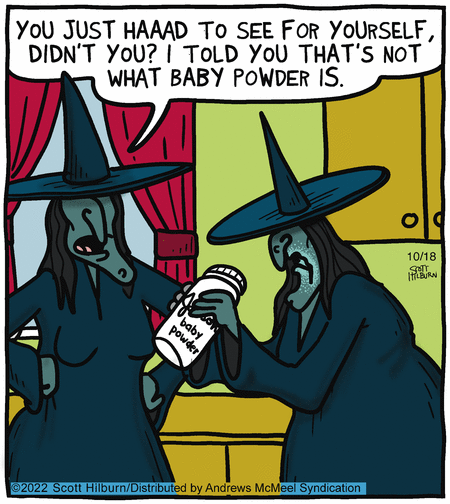
Las Vegas Chasm tried to submit an Argyle Sweater as a CIDU, commenting: “I usually “get” Argyle Sweater each day owing to my modestly demented mind, but today’s is a real stumper. My equally perverse friends also do not understand it. Simply put, yo soy confusado.“
Unfortunately, LVC’s link to the image was broken. Going by the date, it should have been the one on the right, but that seems too easy, so I’m also including the previous day, which seems equally funny, but might have been a little more puzzling:
… The “featured comment” at GoComics gives an explanation for the first one: “Well, if you make corn oil out of corn, and olive oil out of olives, guess what you make baby powder out of” (she tried tasting it).
At the risk of offending some readers, I have decided to post the Cyanide & Happiness comic shown below to demonstrate a point. It was submitted over a year ago as a CIDU by Pandemonium, who noted: “The [explosm] site is sometimes (often) in poor taste.” That is undeniably true. Although Bill posted a number of Cyanide & Happiness comics from time to time, only two of them have appeared at CIDU in the last four years, and this one is an excellent example of why they have been so rare:
… Pandemonium noted that “This [one] doesn’t seem to be part of a running gag, series, or topic“, and he is certainly right about that. The gag is a simple pun, conflating a perfectly normal technical term (in metallurgy, note the damage to the breastplate) with an unacceptably racist epithet (both terms having identical spelling and pronunciation).
The only possible saving grace in this comic is that the word is not explicitly named, and soldier in the background appears to object to the use of the term entirely, but the primary purpose of the comic here is just as a borderline example.
Please note: Since CIDU no longer has access to a separate “Arlo” page to “hide” potentially offensive material, please be aware that it may not be possible to post every comic submitted, in particular when the artwork or language may be unacceptable for some readers.
What’s the line for? Where is Horace at in panel 3, since the gray floor has disappeared? Is he picking up random detritus in panel 3, or something of significance?
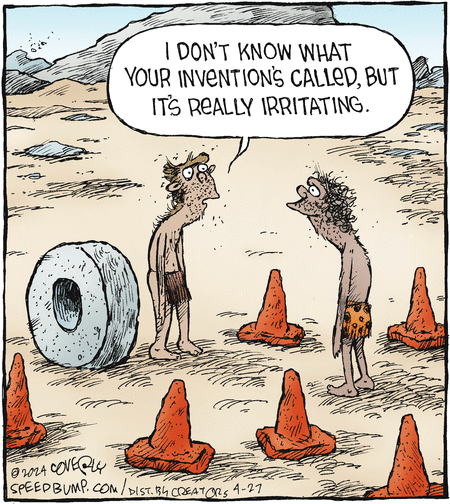
Boise Ed submitted this Speed Bump as a CIDU back in April, commenting: “I don’t get why the cones would be so irritating. I’m assuming the wheel is meant to be for transportation, although it lacks the axle/footrests of the wheels in B.C. If it’s not for transportation, then I have even less of a clue what he’s on about.“
… P.S. Last Saturday (Nov. 2nd) was the 81st anniversary of Charles Scanlon’s patent (US2333273A) for a “Safety Marker“.
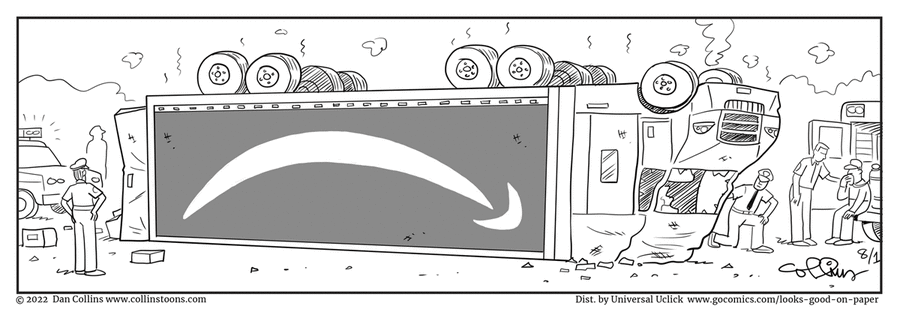
… and it had nothing to do with product placement for Amazon. It’s even possible that he might have been able to use Nike’s logo, instead.
… Boise Ed submitted this “Looks Good on Paper” strip as a CIDU, commenting: “How is a truck wreck supposed to be funny? Maybe if it had spilled something funny, but that’s not the case here.“
I agree that it’s not extremely funny, but it’s still worth a small smile. The author was careful to show that nobody was seriously injured (the truck driver can be seen at the right edge of the strip). The gag is based on “anthropomorphic pareidolia“, or in other words, interpreting an expression on a face that isn’t really there. The trucks wheels look a little like eyes, so that the inverted logo looks like a “sad” mouth. Parallels can also be drawn to the inverted Jeep bumper stickers that we discussed back in July.
P.S. If anyone is interested in discovering a whole series of such “facial expression” effects, I recommend watching Pixar’s short film “The Blue Umbrella“.
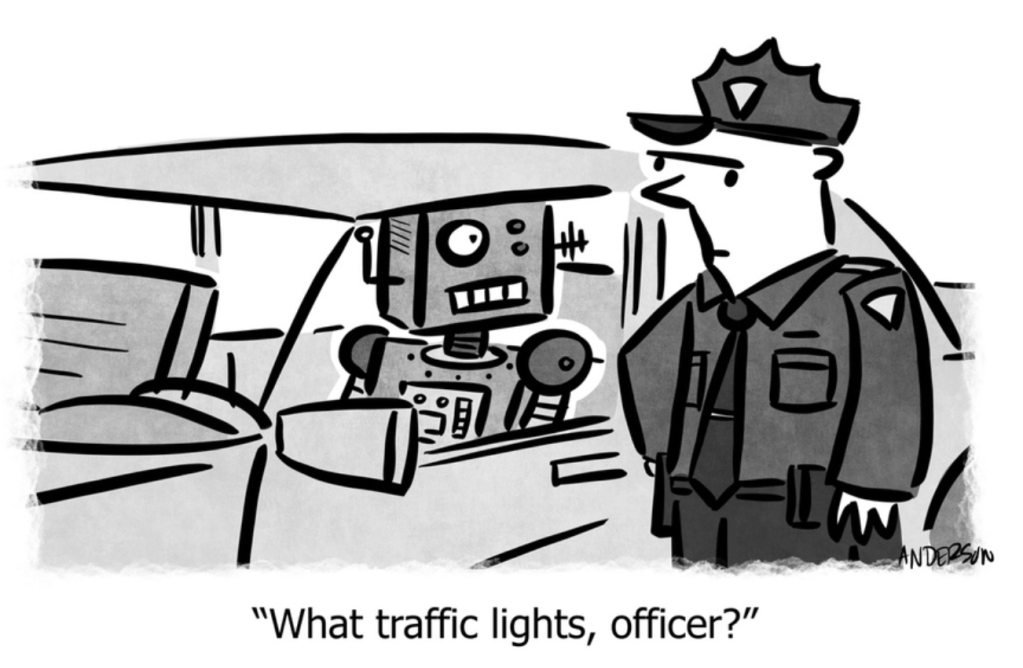
Jack Applin submitted this Andertoons as a CIDU, asking “Is the one-eyed robot unable to see the traffic lights? [OR] Is is programmed to ignore them, giving an advantage to “driverless” cars?“
… Mark Anderson’s original title for his comic #9221 reveals that Jack’s first question was right on the money: The gag is a reference to one of the most common anti-robot user verification tests, typically presented by the reCAPTCHA interface:
Later that same month (in 1967):
The punchline is in panel 5, but for many of us it would be a CIDU. The authors conveniently use panel 6 to make the joke clearer.