Yeah but really, is it just a rat-race joke? Or just an oddly-executed commentary on human family economics?
I have to say I was a little put off from the whole picture by taking the rack of environments to be a bakery display case. But then what is this place? A lab? A pet store? Neither one should be recruiting their subjects from a handy nearby mousehole!
Boise Ed sent this in, and says “We have sometimes chatted about colorists, and this A&J blog is the best illustration of that that I have ever seen. (See the text at https://arloandjanis.com/colorful-explanation .)”
Go to that link for Jimmy Johnson’s full account. But we could stand some explication of his closing remark: “And, no, it was not intended to be dirty in the least.” Does anyone else have some surprise reconciling that claim with the Jack Spratt saying?
And as Phil pointed out, Dan Piraro’s blog and/or newsletter contained long and explicit explanations of this cartoon. So it would be best if CIDU readers who have seen those discussions hold off on correcting too soon the mistakes he explains.
My first time reading the word “defenestration” was in the title of a story by Arthur C. Clarke, “The Defenestration of Ermintrude Inch”, appearing in the collection Tales from the White Hart. Subsequently, I learned the general uses of this funny word, and in particular in the nickname for some historical events, “The defenestration of Prague”.
My first encounter with the word “quantum” in other than a physics sense was in the title of a story by Ian Fleming, “Quantum of Solace”, appearing in the collection For Your Eyes Only. Subsequently, I rarely encounter any use other than something scientific.
My first exposure to the word “squalor” was in the title of a story by J D Salinger, “For Esmé—with Love and Squalor”, appearing in the collection Nine Stories. Subsequently, my foremost exemplar for the concept of “living in squalor” are the cartoons of George Booth.
This one was sent in by Stan, who says “Here’s one I didn’t get…or maybe it’s an, ‘Is that all there is? But what’s the joke?’ kind of thing. Anyway, I’m guessing she made scrambled eggs for dinner. What’s the joke exactly? Also, what is the cat doing? Is that part of it?”
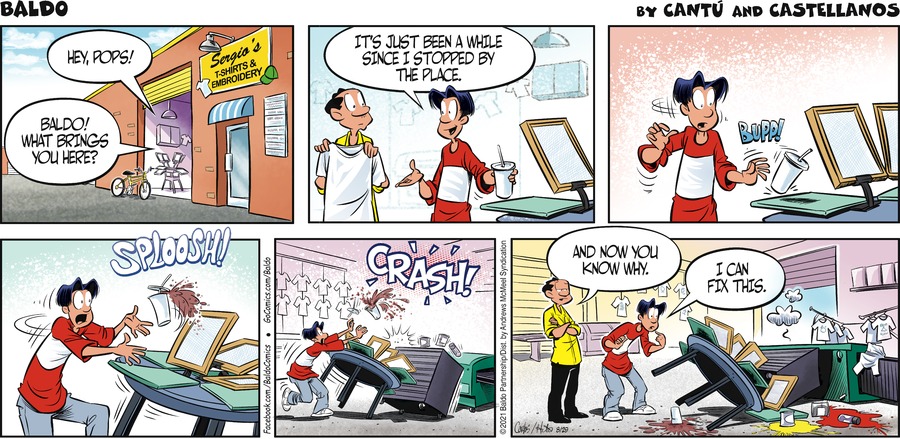
Okay, “And now you know why” — why *what*? Why you haven’t stopped by in a while? No, it doesn’t explain Baldo’s own actions to himself. It could make sense as why he’s been banned from the shop; or more gently, why Sergio has discouraged him from visiting. But neither degree of that has been conveyed in the earlier part of the encounter.
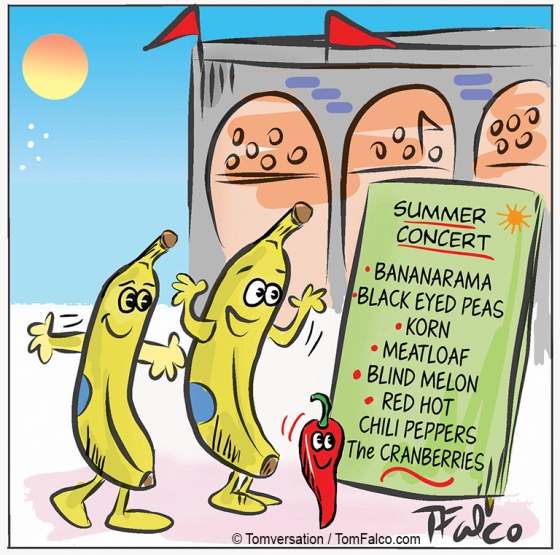
We were calling this a CIDU briefly while trying to understand why it was a Summer Concert but the bands were not notably summer foods. But then quashed the question on the basis that summer is just when there are lots of concerts and particularly the big outdoor festivals.
Jenny also sent this in, and considered it sort of a CIDU, asking “Why is meatloaf on the list, along with the veggies?”.
Thanks to larK who sent this in from the 30 August issue of The New Yorker, and can’t see the sense in the sorting of blames and reasonings in the caption.
We are running short on just about all categories.
Time for you to send some in!
CIDU — most needed! But don’t be alarmed if these are subject to editorial scrutiny and may get some return questions – or an explanation if evident.
LOL & OY – We would like to get away from editors’ curations and more back to CIDU-Bill’s practice of forming these weekly lists from reader selections on an almost no-questions-asked basis. If something strikes you as really hilarious, or excellently punny, send it in on that basis, and it can appear in these lists subject only to questions of appropriateness (in the ‘good taste’ sense). [Don’t forget to sign or mention how you would like the credit to appear – our mental mappings from email address to commenting name are quite subliminal.)
Ewww — Not so hot on these, actually. Okay if there is a level of really-funny or something to make it clever (and thus a LOL-Eww or Oy-Eww), but we’re not looking for examples of “gosh, look how off-putting they manage to get these days!” .
Synchronicities — If really striking. And it helps if one or both is really funny in itself. But don’t be alarmed if we want to break up the pair and just use one on its own.
















 Comics I Don't Understand