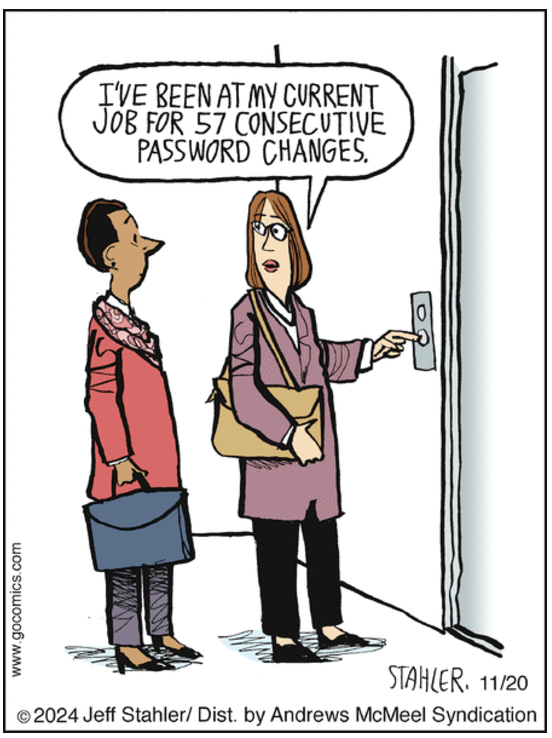
Mark H. sends this one in: “It’s clear that this protects passwords from others, since she neither writes them down nor remembers them. But it would seem like they are also protected from her, hence useless. Maybe she has to use the “forgot password” routine each time, and so the password is never the same?”
According to NordPass, the most common passwords are still the most useless ones:
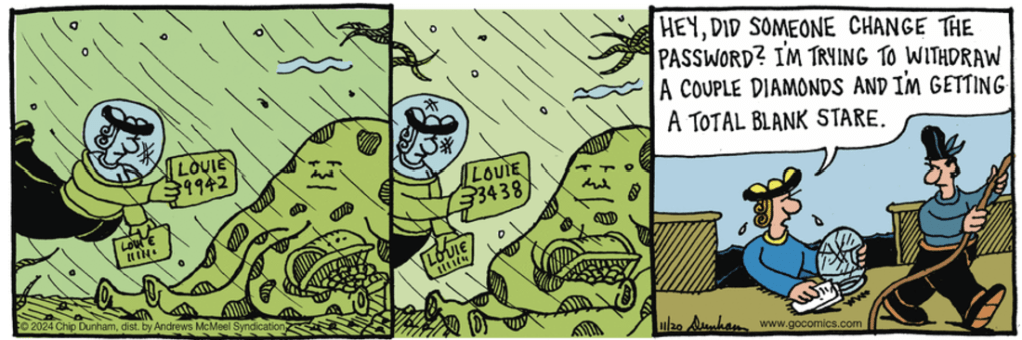
The same day Mark H. sent that in, there were two other password comics in my feed. These aren’t really synchronicities, because the jokes are all different, but why not pretend it’s National Password Day? (That’s actually the first Thursday in May.)
I worked at a company where every few weeks, a new 7 letter password would be automatically randomly generated for you. Well, maybe randomly. A colleague had gotten into a tiff with the head of IT, and his next password ended with 3 letters of his first name. The first 4 letters were an expression not allowed on vanity license plates. He was convinced there was nothing “random” about it. And, knowing the head of IT as I did, I’d bet he was right.
Mark. H. suggested this Mother Goose & Grimm a partial CIDU, commenting: “Grimmy tries to encourage the dog singing the song. But the song is not about the singer – it’s about the one the singer is singing to (‘You ain’t nothin’ but a hound dog…‘). The singer might very well have caught a rabbit himself, but that wouldn’t change the song.“
… Is it really just as simple as Grimmy mistaking the subject? Should I have added this to the Sunday Funnies, instead?
And I still maintain that the ugly Internet phenomenon of “trolling” started being called that from a metaphor on the fishing practice (dragging a baited hook behind a quiet small boat), and not the Scandinavian bridge-dwelling threateners.
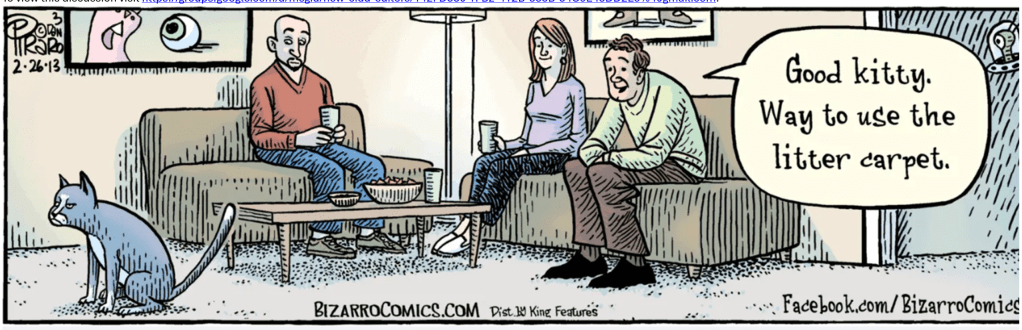
Are we done with Bizarro for this post? Never say so!
I was preparing to protest that the expression is traditionally “strait and narrow” — which would be preferable despite its redundancy. The pattern of redundancy in rhetorical pairs remains hale and hearty, though some may wish it null and void.
But no! The useful sources recognize only “straight and narrow”, with just a nod to the echoes of “strait”. Here’s Etymonline f’ristance [in entry for straight (adj.2) = “conventional,” especially “heterosexual,” 1941]:
probably suggested by the stock phrase straight and narrowpath or way, “course of conventional morality and law-abiding behavior” (by 1842), which is based on a misreading of Matthew vii.14 (where the gate is actually strait); another influence seems to bestrait-laced.
I guess I missed out Part I. This is trying hard, maybe too hard, but deserves to be seen for cheerful persistence even if not really for brilliant OY-ness.
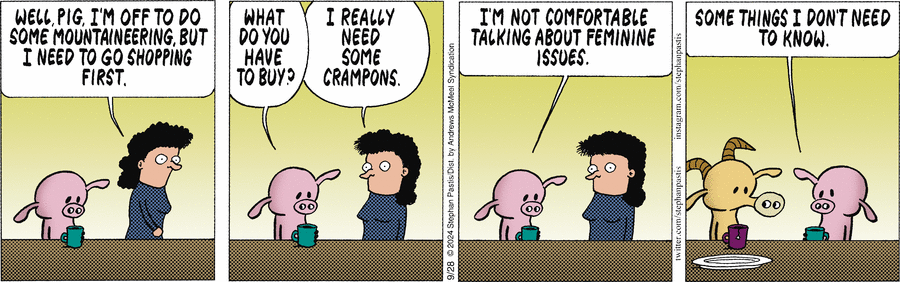
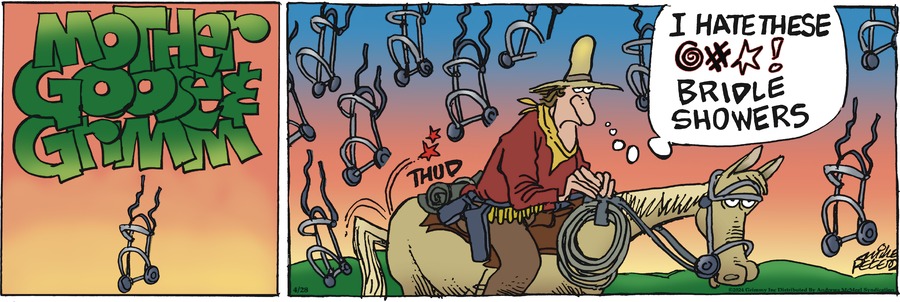
Since this strip seems to offer a pun every day, it is hard not to over-indulge. But this one was immediately right in the OY spirit!

















 Comics I Don't Understand