The Pillsburys on the TWSS trope

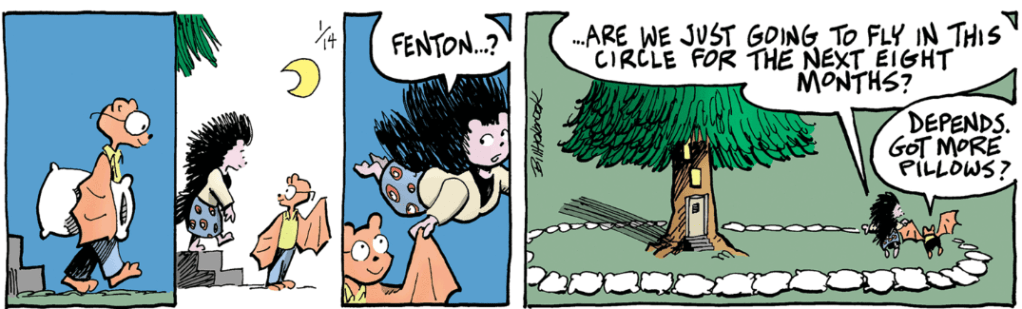
Okay, I get the general plot of how they’re both mutually surviving (or evading) some sort of sincerity tests. But no, what is the role of the TWSS trope? Is it a save? But in panel 2 it seems, on the contrary, to deepen the trouble, since Lucretia seems not to know the trope … or does she? But in panel 5 she provides a perfect set-up line for the trope as comeback, so she must know it. (And BTW what in fact is the bit about Fiddler getting at? What / how much is the supposed quote?)

I was going to attribute the original TWSS pattern to somebody, but didn’t know who. The entry at dictionary.com includes a surprisingly discursive article illustrating the usage and tracing the origins, after providing the basic compact definition: “That’s what she said is a form of innuendo that takes innocent statements out of context and makes them sound lewd or sexual.” They first find it in a 1973 book, which however calls it an ancient one-liner.
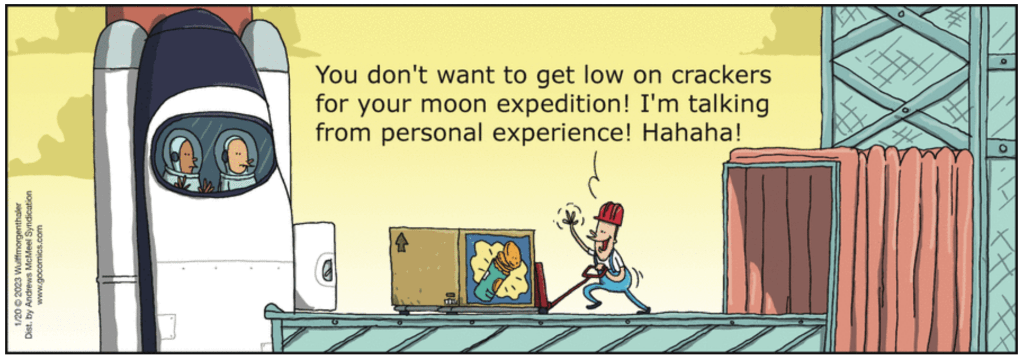
Cracking up, or crackering up?

It doesn’t quite fit into the “moon is made of green cheese” idea, because of the reference to personal experience.

The moon being made of green cheese probably deserves a geezer alert >50 years past the US moon landings, but a day later here it is again, in a non-CIDU.

Where did the green cheese idea even come from? The old theory that birds migrated to the moon made some sense centuries ago, but green cheese?

Checkmate!

Kilby sent in this double puzzler:

“When I wrote Leigh Rubin to point out that one of the three checkers should already have been doubled to form a ‘king’, he mentioned that he had submitted the comic to the syndicate with a caption, but that this caption never made it to the published version.”

Puzzle #1:

Submit a caption that might fit this cartoon.

Puzzle #2:

Assuming the pieces can move (and capture) only according to their own “rules”, which side would win the endgame shown in the comic?

The knight, as white, should have the first move. In checkers, red goes second. Now, if we assume the knight is at a1, then the checker at c1 should have been made a king. So, we need to assume that the knight is at h8, and the red checkers have to start by moving away down the board.

OR, you can assume the red checker has just gotten to c1, and is being crowned as we speak; this puts the knight at a1.

The history of these games can also be discussed in the comments.

By the way, I’m on chess.com as zbicyclist; anyone like a game?

Gourmet comics

Thanks for this to Andréa:

She points out it could be both of the animals, or simply the cartoonist, who aren’t aware the dog *is* a “gourmand”, by the standard way that is distinguished from “gourmet”.

P.S. After we already had this post scheduled, the Comic Strip of the Day site included this cartoon, and had an extended discussion of “gourmet”, “gourmand”, and some related words.

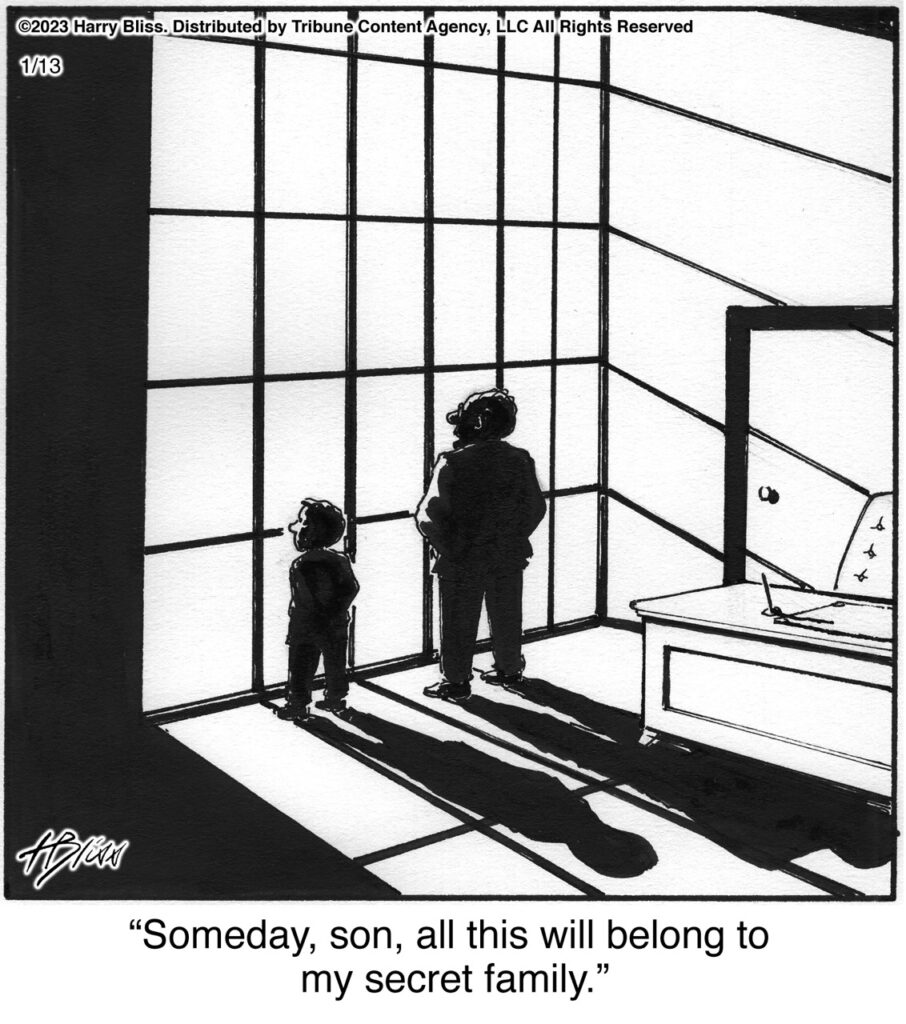
Ooooh, some dark Bliss!

But published on Friday the Thirteenth, which may explain it.

Yes, it’s something of a CIDU, raising unanswered questions, even if they aren’t deep questions. Is the boy from his public family, or his secret family? And either way, what is the point of this conversation? (Besides getting to enact a takeoff on this erstwhile very standard capitalist melodrama scene.)

If you were thinking that the color version might brighten our outlook, let’s give it a try: