Usual John submitted this Barney & Clyde as a CIDU:
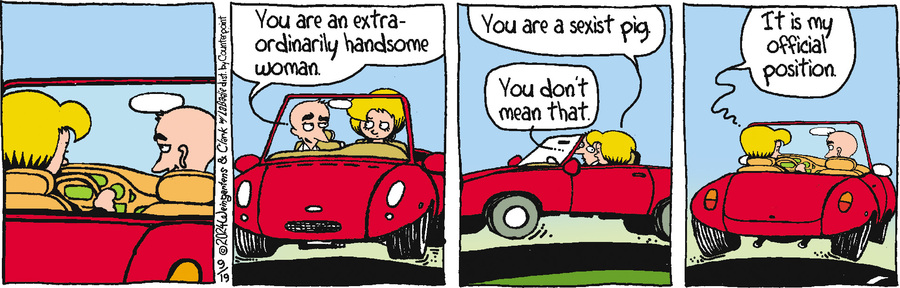
Usual John submitted this Barney & Clyde as a CIDU:

CIDU frequently presents holiday-based material, but virtually all of the holidays we have ever celebrated so far have been American, even if a few of them (such as New Year’s Eve and Halloween) are also celebrated outside of North America. The following collection is presented in recognition of German Unification Day, which just happened to land on October 3rd (in 1990), and has been celebrated on that day ever since.

…
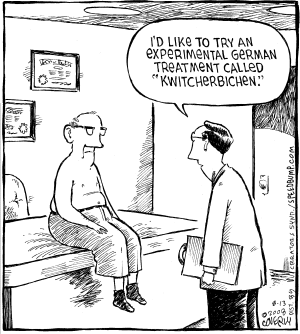
Coverly put a “T” in front of the first “CH”, but neglected to do the same for the second, which would have made the pronunciation clearer, but it might have annoyed the syndicate’s censors.


…
During my first stay in Germany (over 35 years ago), once I had begun to understand and speak a little of the language, I was frequently astonished (and/or embarrassed) by the linguistic abilities of German toddlers, which were often better than my own.
…
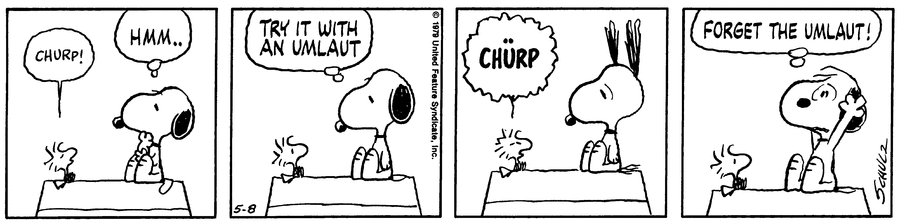
Here’s a classic riddle for students beginning to learn the language:
Q – “What does a German parakeet say?“
A – (in a deep voice): “Billig! Billig!” (meaning “cheap”, of course)

…
As unlikely as it may seem, Hogan’s Heroes wasn’t just translated into German, they actually did it twice, because the first version didn’t get good enough ratings. The scriptwriters for the newer version invented details and even (unseen) characters not found in the original shows, and the dialog (of the “Germans”) was changed from standard (“Hochdeutsch“) pronunciation to more comical (Bavarian and Saxon) dialects.
The American characters speak normal German in the translation, except for “Newkirk” (Richard Dawson’s character), who was changed from British to being a stutterer, which was both unnecessary and is absolutely unwatchable (at least for anyone who is familiar with the original show). I don’t remember whether LeBeau was synchronized into German with a French accent.
P.S. Keith Knight has drawn at least a dozen strips based on interactions with his (German) wife; there are simply too many of them to include them all here. Perhaps later, in a separate “linguistic” post.
There are ten pairs of cartoon feet in this Sunday “Ink Pen” strip from 2010:
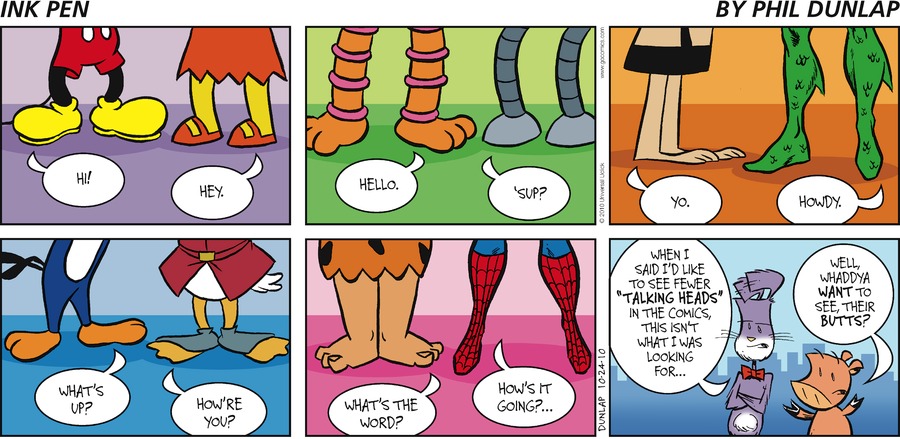
…
Unfortunately, the author didn’t bother to make any of the dialog “characteristic”, which might have helped to identify each figure. I have a positive ID for only five and a half of them. Can anyone match all ten (unseen) talking heads to their correct feet?
P.S. Bonus assignment: Provide an unmistakable (but very short) quote for each character.
This comic made me more than moderately confused:
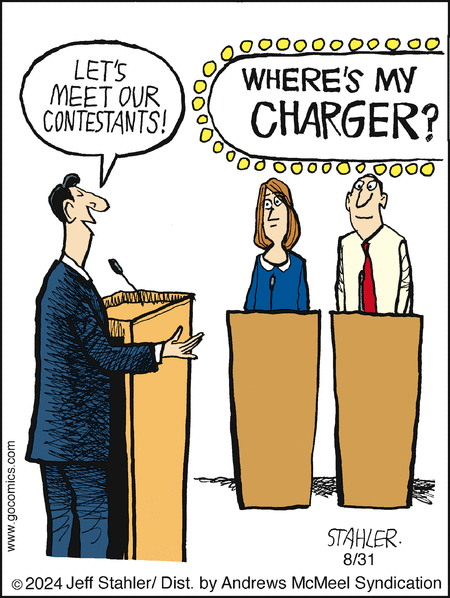
…
I haven’t watched an American television game show in over three decades. I assume that they still exist, but I have no idea whether this comic might be playing on some current development in the genre.

Scott Adams was certainly not the first author to draw a comic featuring an Etch-A-Sketch, but this classic Dilbert strip (correction: from 1995) remains the standard against which all other attempts must be measured:

This Rose is Rose strip was published nine years earlier (in 1986), but to her credit, at least Rose can tell the difference between the devices:
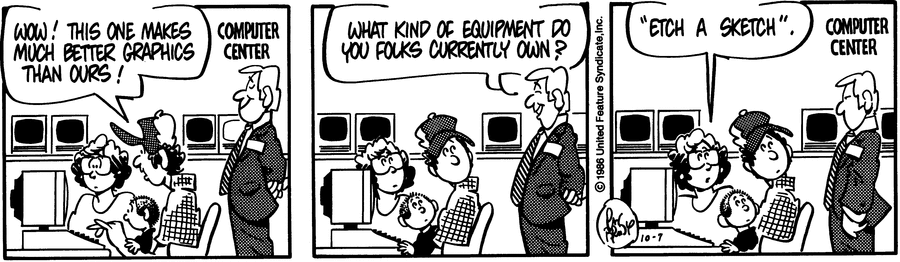
As computer technology progressed, more recent comics were able to use tablets (instead of laptops), which made the misidentification more believable:
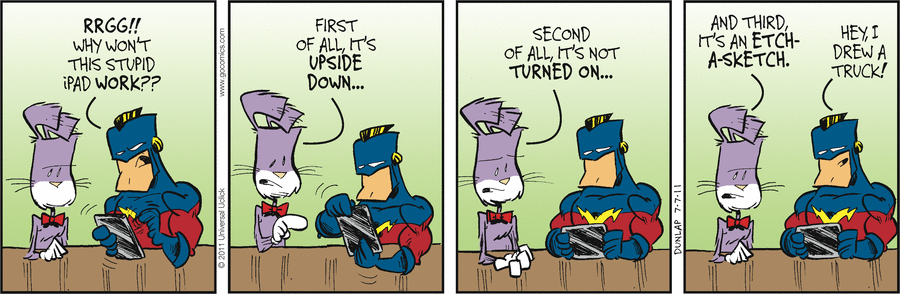
Here’s a handy guide to distinguish between the two:

Of all the strips showing kids using an Etch-A-Sketch as a “real” computer, this Jump Start is my favorite:
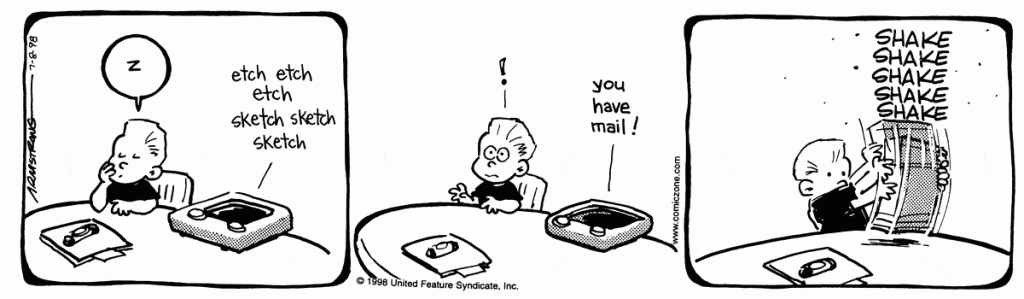
Not everyone is so pleased by the idea of image impermanence:
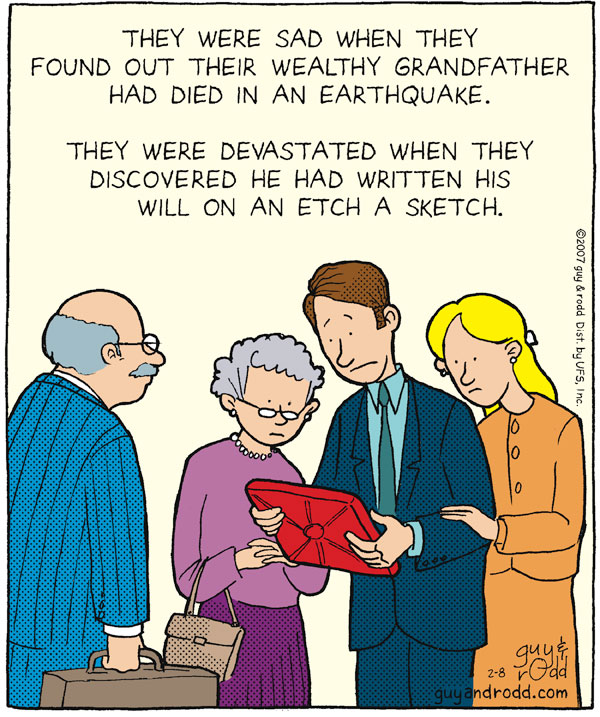
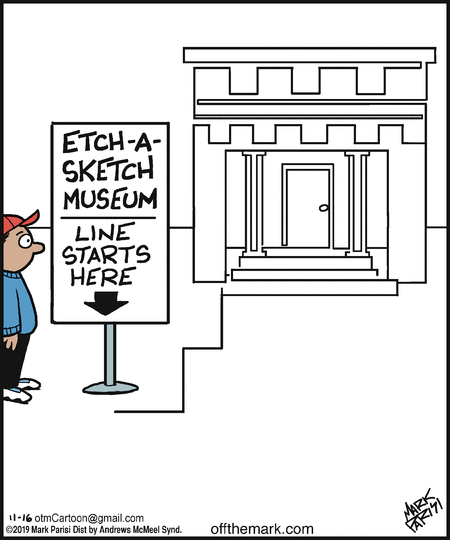
The Off the Mark at the top already appeared at CIDU (on May Day 2023) but Parisi also drew two other comics that are notable for incorporating pseudo-authentic Etch-A-Sketch artwork into the drawing. The first one is truly superb, especially for including the masterful meta-pun on “line”:
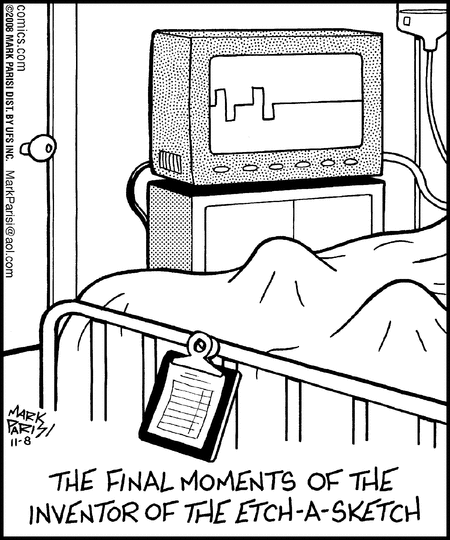
This final Off the Mark comic has a fatal flaw (morbid pun intended). The “sketchy” artwork is actually its best feature, but it would have been even better with a pair of round knobs on the monitor. The tragic defect is that the author did not bother to properly credit (or apologize to) André Cassagnes, who was still alive when this comic was published in 2008 (he died just five years later).
…
P.S. Today (23-Sep-2024) would have been the inventor’s 98th birthday.
I have no idea what Leigh Rubin intended with this cartoon:
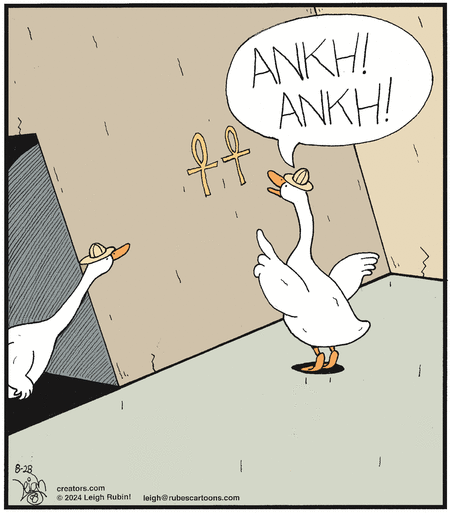
…
The symbols on the wall are indeed a pair of ankhs, but why is it supposed to be funny when a goose says that?
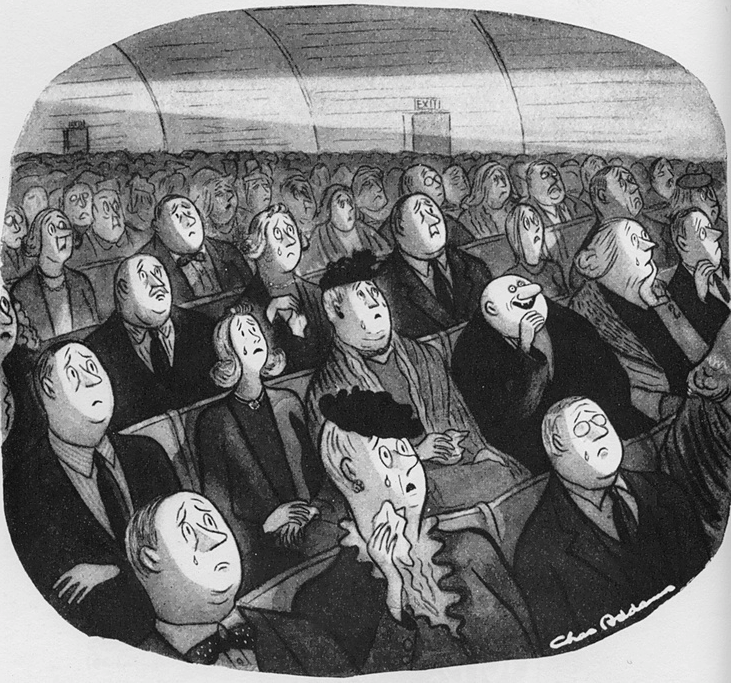
Several years ago, Bill commented upon the unusual frequency of “Grim Reaper” comics, and he even held a contest (called “Deathmatch!“) to prove his point.
For this reason, I suggested scheduling the following comic collection for today, the second (now) fourth anniversary of Bill’s extremely untimely passing, in memory of a dear friend whom we all miss terribly, and who (I believe) would have understood this rather unorthodox memorial presentation in the humorous and good-natured fashion in which it is sincerely intended.
It’s simply a shame that Bill never had a chance to read and comment upon these comics with us all.
P.S. The comments are still open: everyone is welcome to read them and all the comics that were added there (currently seven dozen), and to add new ones.
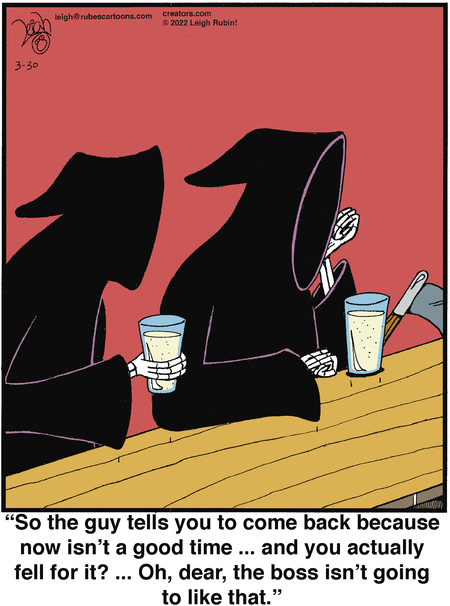
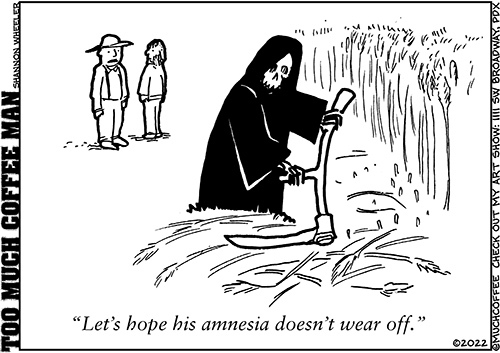
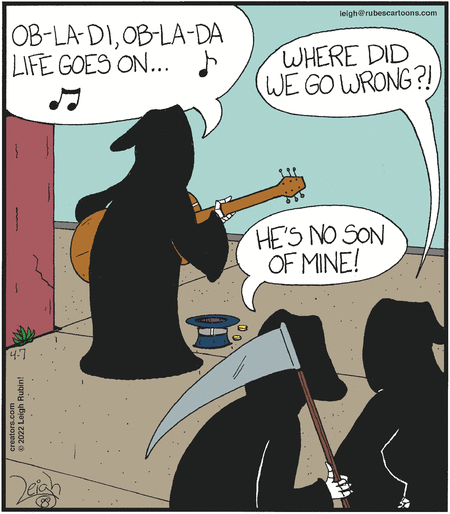
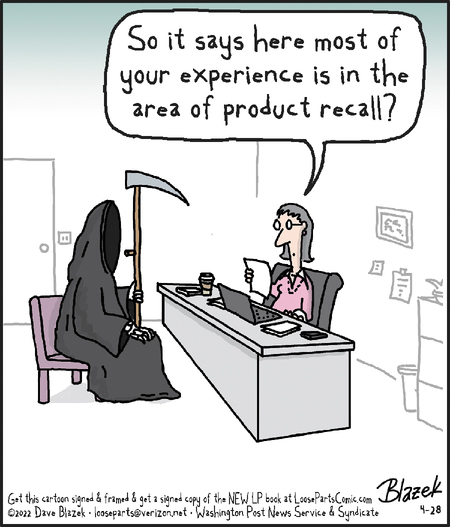
This Strange Brew was contributed by Andréa, originally as an Oy:
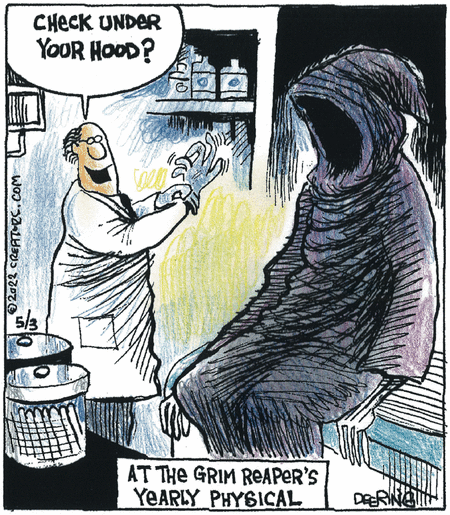
Leigh Rubin keeps on returning to the Grim Reaper theme:
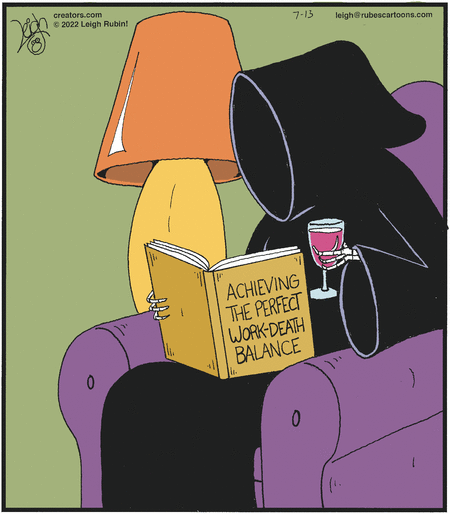
… (actually quite a lot of them).
Today is as good a day as any to crack one open:
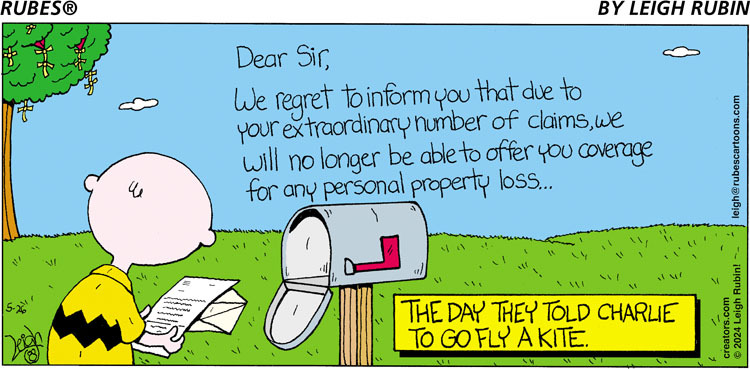
I thought this one would have been even better if Snoopy had delivered the letter (while wearing his signature bowler hat), but that would have dated the action to at least eight years ago.
… this one was rotten:
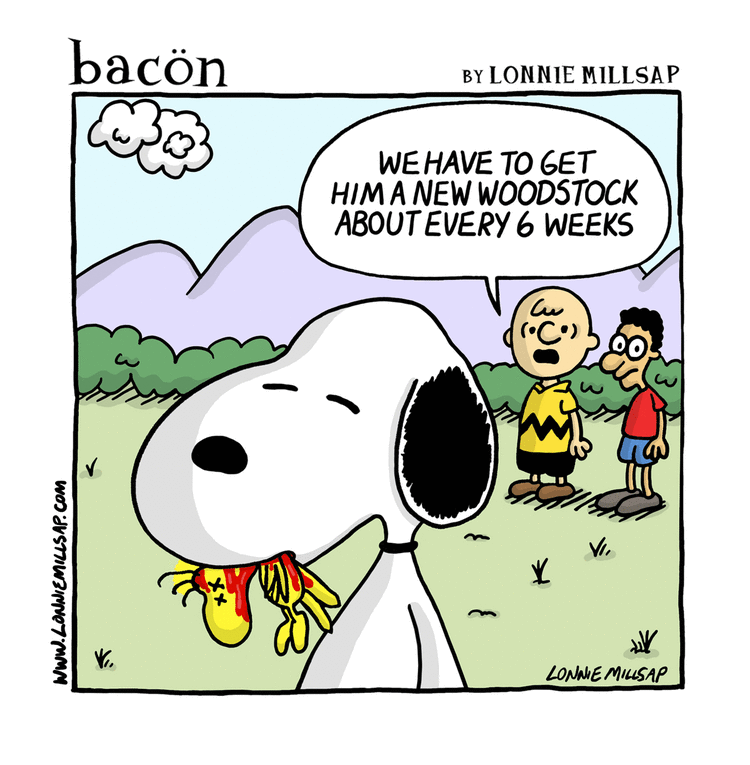
This “Bacön” comic (17-May-2024) was the third Friday in a row that Millsap attempted Peanuts-based satire (the other two weren’t much better). I never really liked Woodstock (nor the haphazard way that Schulz chose names for his newer characters), and it’s not the blood and gore that bothers me here. If a cartoonist is going to “borrow” characters for a gag, then it’s not enough duplicate the artwork: the characters need to retain their personalities, too. Snoopy never showed the slightest bit of hunting instinct in all five decades of Peanuts, so this comic is simply a dud.
… let’s eat these anyway (in no particular order):

Although not sophisticated, the joke is still quite good, in particular because the artwork is truly excellent.
It should be obvious that the gag can be reversed:
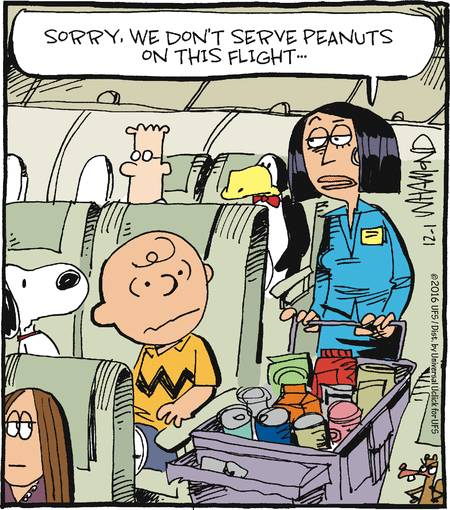
The rendering here is not quite as good as in the Brevity strip, but the motley collection of extras is nice addition, and the anger in the squirrel’s face is much better than having it utter one of those traditionally lame comments.
Then again, “…there was a third possibility that we hadn’t even counted upon…”:
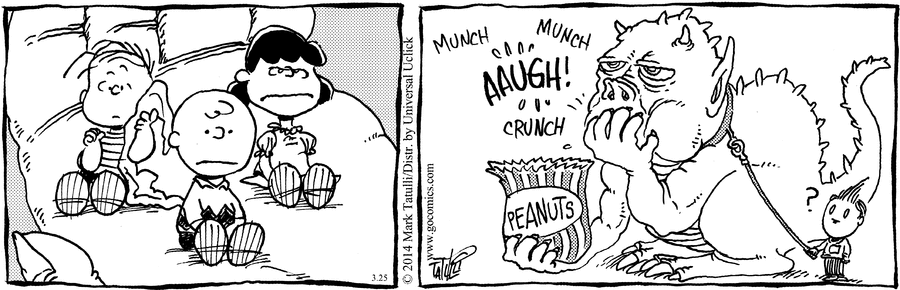
… and they were all immediately eaten. Here again, the artwork in the first panel is extremely good, even if Charlie Brown’s head is a little bit lopsided.
One last crack at a real legume:
…
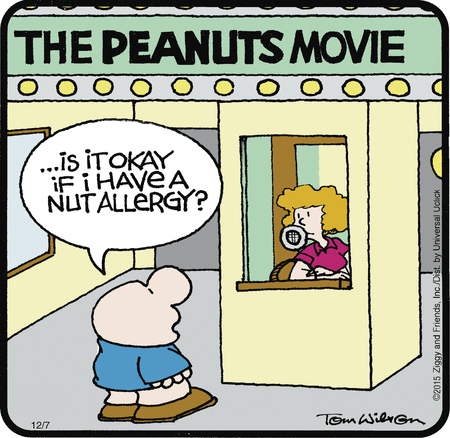
I’ve never had any allergy problems with real peanuts, and I read and enjoyed the strip every day for decades (until it started to lose steam in the mid-1980s), but I had a major adverse reaction to the movie: it played far too much havoc with the character relationships (Schulz was lucky that they didn’t make that thing until 15 years after he had passed away). My kids never read the original strips, so they didn’t notice the alterations: they liked the movie just fine, and have watched it several times on DVD.
… Operations: As we have seen above, cartoonists periodically borrow Schulz’s characters to produce derivative material (which of course would never have worked within the context of the original strip). I have no idea how the executors of Schulz’s estate treat the concept of “fair use”, but they must be reasonably tolerant, since comics such as these keep appearing all the time.
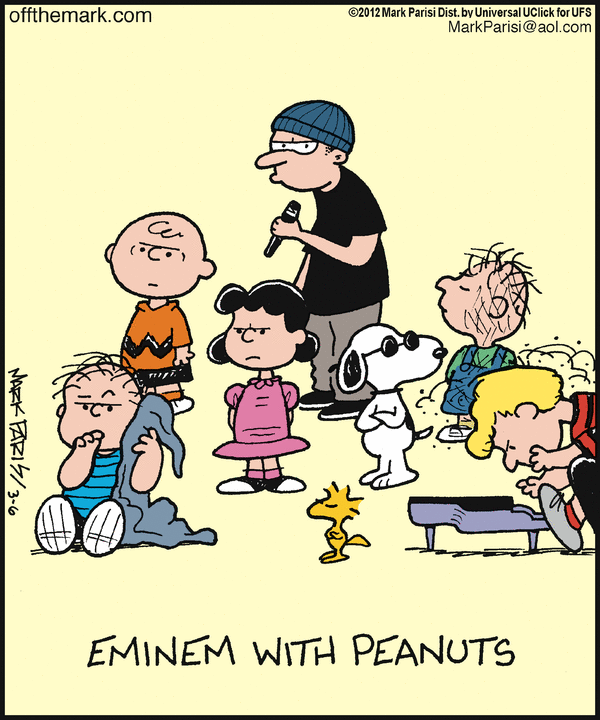
This Off the Mark panel has already appeared at least twice at CIDU, Bill reposted it in December of 2018:
This Foxtrot strip was published while Schulz was still alive:

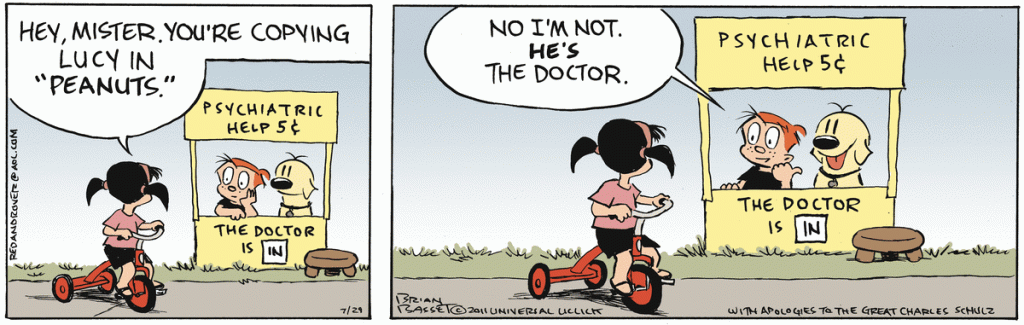
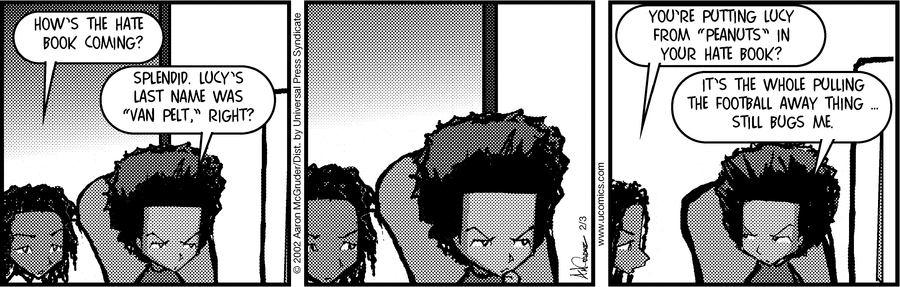
Lucy seems to be at least as popular as Charlie Brown for “guest” appearances and references:

…
The “50” was probably intended as a reference to his birth year.

… now we go to another place: These comics do not “borrow” from Peanuts; instead, they comment on the strip and its characters.

…
Watterson once wrote (in the Calvin & Hobbes 10th Anniversary Book) about how surprisingly melancholy Peanuts was.
…
Some running gags work better than others. Schulz may have occasionally re-used other jokes, but he made a special effort each Fall to ensure that each new “kickoff” strip was different from all the rest.
Even Ted Rall took a break from his usual political commentary to reflect on Schulz’s pending retirement:

I’m sure that Tom Wilson II composed this next comic as a friendly tribute before Schulz retired:

… but since it was published just four days after Schulz died, it was left with a strange aftertaste.
Peanuts in politics: I was very surprised to discover the following two Peanuts-themed gems in Herblock’s archive at the Library of Congress. The first one was published on Oct. 27th, 1967:

In his signature, Herblock describes himself as an “old Charles Schulz fan“.
The second one was published a year later, on Sept. 5th, 1968:

The dialog for “Hubert” Brown reads “All right now, gang — heads up — we can win this old ball game“, and Herblock noted below his signature “You’re a good man, Charlie Schulz“.
It’s worth noting that at the time when these these two cartoons were published, Peanuts was nearing the height of its popularity (and quality), even if its worldwide marketing and financial zenith were still to come. Just eight months after the second cartoon, when Apollo 10 was launched to orbit the moon, the callsign selected for the Command Module was “Charlie Brown“, and the Lunar Module was nicknamed “Snoopy“. If engineering problems had not delayed the fully functional Lunar Module (later used by Apollo 11), Thomas Stafford might have made history by reporting, “Houston… Snoopy has landed“.
Finally (saving my personal favorite for last):

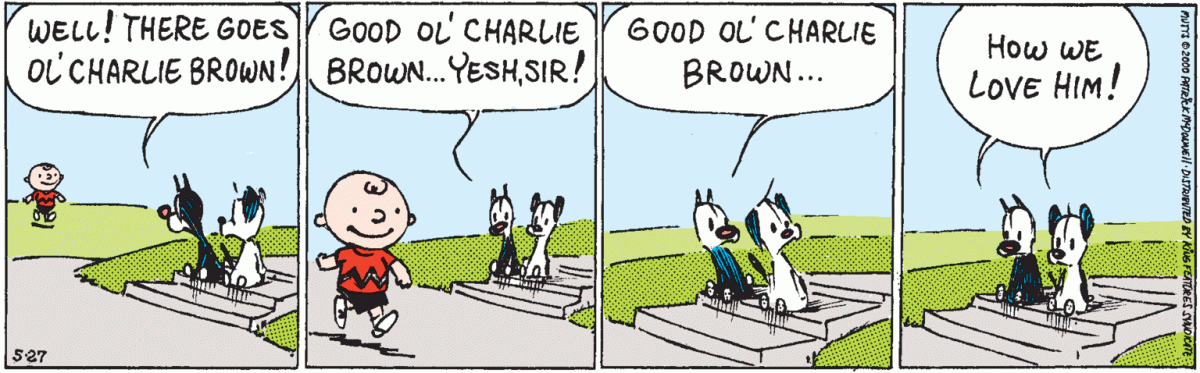
P.S. With the exception of the “Mutts” tribute strip featured at the top of this post, all of the comics appearing here were “spontaneous”: none of them were composed for either of the two major events that were organized in honor of Charles Schulz and Peanuts.
The first of these tributes appeared on Saturday, 27-May-2000 (four months after Schulz’s death). It’s easy to find them: simply navigate back to that date in just about any syndicated comic available online. Alternatively, a footnote in Wikipedia provides a fan’s collection of links to many (but not all) of the tribute strips.
The second tribute appeared on another Saturday (26-Nov-2022), in honor of the 100th anniversary of Schulz’s birth. Simple navigation works here as well, but an “official” collection of these cartoons is available at the Charles M. Schulz Museum‘s website.
P.P.S. Comics Kingdom has an “Editors Dispatch” that offers all of the King Features strips that participated in the centennial tribute (and it also provides the Museum’s link to the non-KF strips).
Not only were these two published just one day apart, the jokes are identical, as is the fundamental physical impossibility. Neither one would appear to be related to a specific incident or place.

Bill Amend currently lives in Missouri, but Foxtrot isn’t tied to a specific location: “I’ve never established where the Fox family lives and I’m not sure the sort of place I depict really exists. It’s sort of that generic cartoon version of suburbia that a lot of strips share where it snows in the winter and is near water when necessary. I grew up in New England and Northern California, and I think bits of that come through, but it’s nowhere specific.“

B.C. takes place somewhere in Generic Cave Man Land, but Mason Mastroianni lives in upstate New York.
Warning: This is probably the first time that an Oglaf comic has ever been posted to CIDU, and it may also be the last. Even though the strip presented below does not contain anything explicit or offensive, please be forewarned that the vast majority of Oglaf strips are (to quote one reviewer) “extremely, extraordinarily NSFW“. Please do not go searching for the Oglaf website unless you are prepared for (and approve of) its signature type of “pornographic sex comedy”.
This strip was published Sunday, 18-Aug-2024; there is one specific aspect that puzzles me:

…
The plot action is perfectly clear, in particular what the younger ruler is planning. What I simply do not understand is why the messenger appears to be supporting this plan, instead of informing the older ruler (who is supposed to be his boss) what the ostrich trap is intended to accomplish.
 Comics I Don't Understand