They both work!

As we have asked before with Baldo, does the joke depend on language, and does it work in both the Spanish and the English versions of the strip?
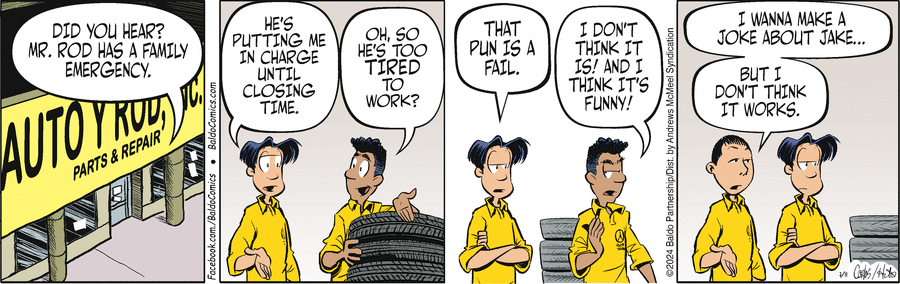
Here there are two loci for our standard questions: In panel 2, the dialog from the second character (who I think must be Jake); and in panel 4, the second part of the dialog from the speaking character.

My take on those two, in short summary: The panel 2 pun works fine in English, and the Spanish also has something of a pun, by substituting a different statement instead of a translation. In panel 4, in the Spanish there seems to be an amusing equivocation, by virtue of a grammatical ambiguity; which does not carry over into English.

In some detail:

In the English, notice the emphasis given in the lettering to the word TIRED. And while Jake says that, he is all over a stack of TIRES; even seemingly pointing to them as though in a sort of illustration.

In the Spanish, Jake’s line translates according to Google as “Oh, so you roll out of here early?” (and I think the “you” is not the only choice — it’s more of an impersonal, and might amount to “we”). So it no longer mentions tires or tiredness, but with the mention of rolling still manages to indirectly bring in the tires and roughly complete a pun. (And as a noun instead of verb, rueda is rendered first off as wheel.)

OK, a bit of background. English (like, say, French) in simple sentences, in at least semi-formal speech or writing, requires an overt subject, even if a person and number could be inferred. Spanish (like many other European languages) allows skipping a subject pronoun if the verb form is enough to determine person and number. You can see this in both of Jake’s sentences in panel 3 — creo is 1st-person singular, but the sentence does not need to say yo creo; same for pienso not needing yo pienso.

Then in panel 4, the third character’s line Pero no creo que trabaje could be But I don’t think it works [it = the potential joke], or But I don’t think he works [he = Jake]. Which is a fairly good joke, or anyway language-amusement. [My point about not requiring overt subject pronoun turns out not crucial here, since if this sentence did use a subject pronoun, él for he or it would still be indeterminate.] But in English we get But I don’t think it works, and no secondary dig at lazy Jake.

Bonus post: Back in the translation shop

Today’s Macanudo, twice:

“It was nice while it lasted.” Okay, I’ll buy the pairing. Both are sweetly regretful but have just a tiny bit of a sting, don’t you think?

But now, today’s Baldo, also twice:

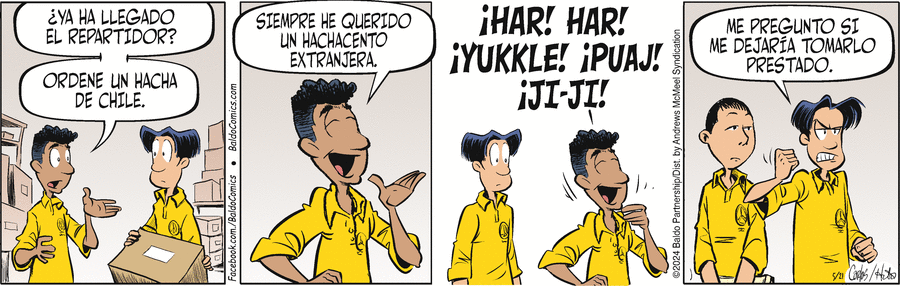
Now at first this looks like something we’ve seen a few times with Baldo: A pun or language-dependent joke in the English version, and then a reduction to a univocal expression in the Spanish version with no attempt to preserve the polysemy needed for the pun.

But not this time!

The key is in hachacento, which does not register as a recognized or translatable Spanish word, at least by Google Translate. But looking at parts:

hatchet ==> hacha
accent ==> acento

So we do get both axe and accent! (But not sent ==> enviad{o/a}. But who cares at this point!)

P.S. Don’t forget to stop and smell the noises in panel 3.

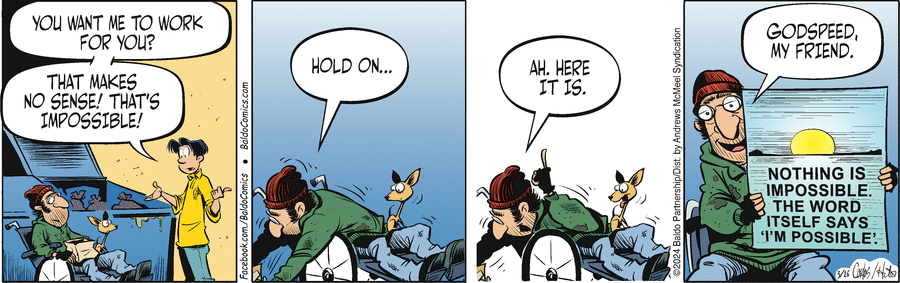
Impossible!

Let’s revisit a topic we’ve seen in different lights at different times: How the English and Spanish versions of Baldo may differ in how a joke works.

Here the joke comes off okay in English, as based in written language (or anyhow spelling). The specifics won’t work in Spanish, so they settle for a less striking point.

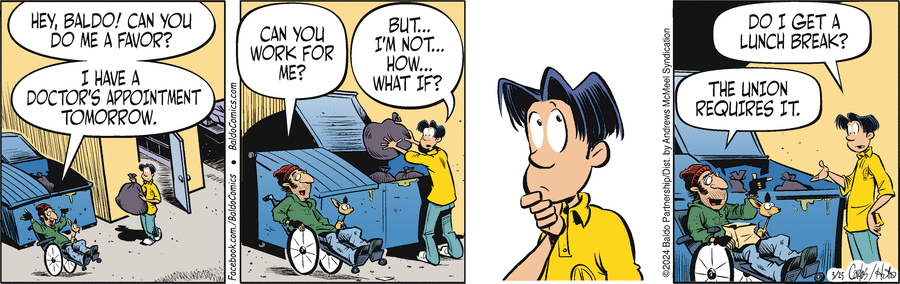
P.S. The previous day’s comic clarifies that “work for me” probably means more like “as a substitute” than like “as an employee”.

Labor-day-published gallery

These are just whatever was at least pretty good, was dated today, and was in some way about the Labor Day holiday or tradition. … A quick survey of which cartoons were willing to be about the holiday and which preferred to go on their own way.

So cool! ¡Muy chevere!

Thanks to Philip, who sent this in and suggested a better wording for the punch line. … Which we’ll print below the cartoon image, so you have a moment to comment with your own suggestion first, if you like.

As Philip asks, Wouldn’t this be better as “Making a cool car is hot work.”?

I think we have established pretty confidently that Baldo is done in English first then translated for the Spanish edition; so missing the pun-portunity in the English is not likely explained as translation problem from the Spanish original . Nonetheless, for whatever light it may shed, here is the Spanish version:

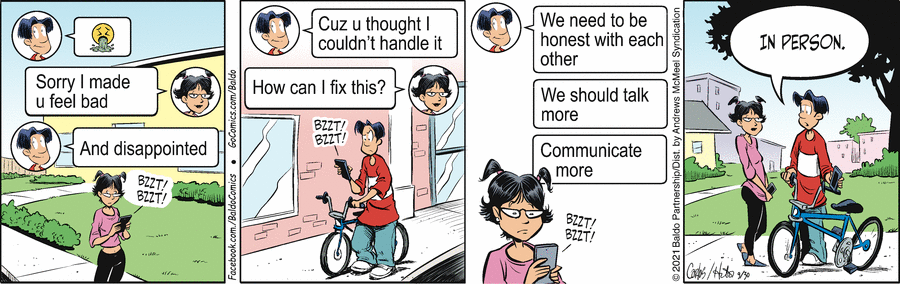
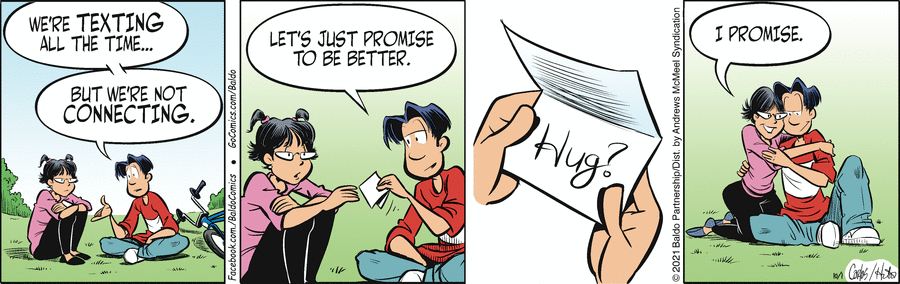
Bonus: Estamos texting todo el tiempo

(Or as Google Translate would put it: Nosotros estamos enviando mensajes de texto todo el tiempo.)

Our recent foray into the Baldo translation mysteries included an interesting subthread on whether the Spanish seemed to reflect any particular national-origin variety of the language (or since the setting is in the U.S. , there might be contemporary U.S.-regional varieties at play ) , or rather a textbook or generic Western Hemisphere compromise variety of the language. Also in question was “official, standard” language versus slang and colloquial.
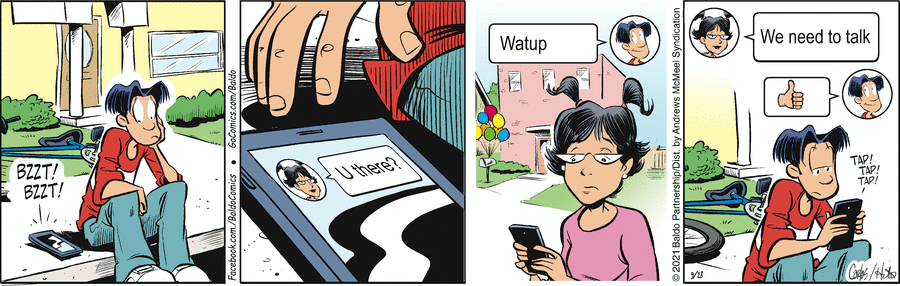
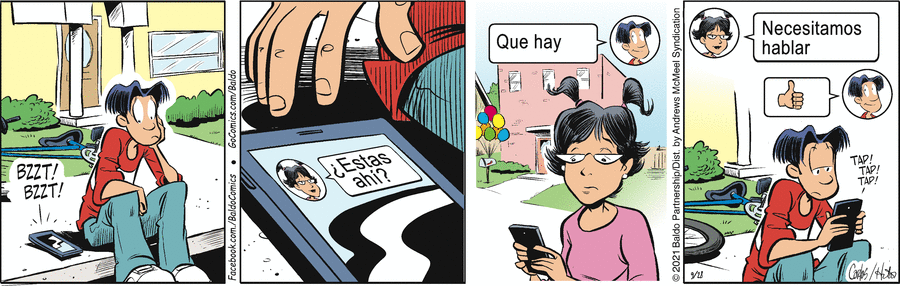
Last week’s and this week’s strips provide a wealth of material bearing on those issues. The teen characters are doing a lot of texting, so we get to see the handling of such matters as: standard texting abbreviations; spontaneous abbreviations or “shorthand”; accidental typos, and bad autocorrect and autocomplete insertions; and intrusion of English terms instead of “official” Spanish. Thus for OMG they stick with OMG in the Spanish context, though I think elsewhere I’ve seen DM (for Dios mío not in this case Direct Message); and “texting” in both English and Spanish versions.


(Two wordless strips depict a deepening of the romantic jealousy crisis.)

(For anyone paying close attention to the dates, there were strips over the weekend that were not part of this series.)


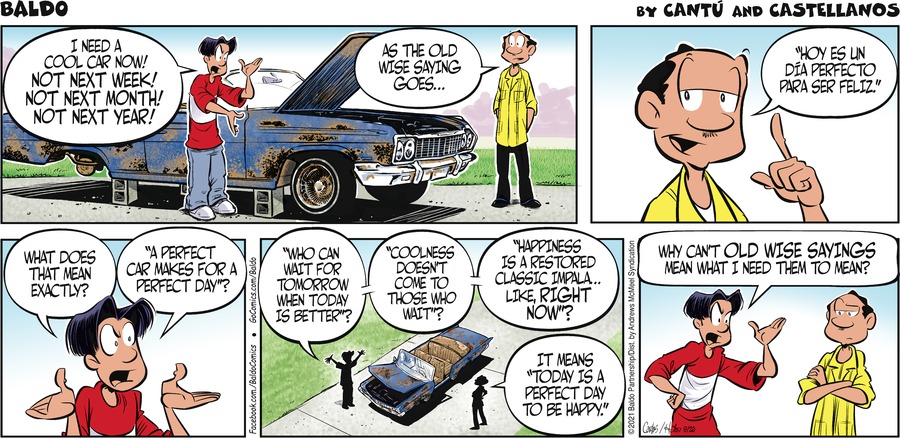
¿Qué quiere decir esta palabra “significa”?

I.e. , What does this word “means” mean? Or maybe What does this Spanish word “significa” mean?

In the Spanish version, Baldo’s question in panel 3 ¿Qué significa eso? he speculatively answers for himself with sort of paraphrases of Sergio’s [Papi’s] saying from panel 2, but tending more toward argumentative applications to his current situation. When Sergio answers in panel 4 by just repeating the saying verbatim and asserting that is the meaning, he is bringing down Baldo’s flights of fancy and special pleading by just repeating the idea, for an “it is what it is” effect. All of this makes easy sense.

In the English version, Sergio’s saying in panel 2 is originally presented in Spanish, then repeated in panel 4 in English translation. So It means … in panel 4 amounts to It would be translated as … . Then when we look at Baldo’s What does that mean … in panel 3, is he still only asking for significance and situational applications (which he then supplies, sometimes ironically)? Or is he in any part asking for help in translation? (Since a translation is what he gets.)

Lying down on the job

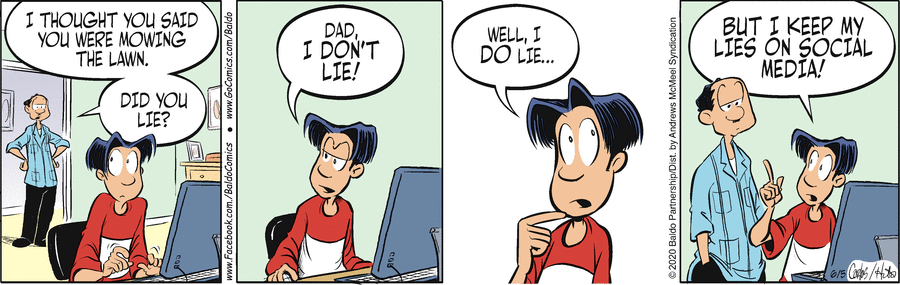
Sent by larK, who points out numerous holes in Baldo’s account. “So, he’s not mowing the lawn, but he said he would, yet he claims he doesn’t lie, at least outside of social media: did he state his intention to mow the lawn on social media? Otherwise: huh? And either way, this is funny why? Ha, ha, we all lie on social media?”

We think we’ve pretty much established that Baldo is written in English and translated to produce the Spanish edition. Nonetheless, here is the same day in Spanish, in case it proves helpful to anyone:

Bonus Baldo: A pun before and after translation

Back in last November, in this “OY collection” post, we discussed a Baldo strip and the matching Baldo en Español where an element of the joke doesn’t come thru in the Spanish version, and combined this observation with other instances, as well as “About” tab type info and external sources, to agree that the strip seems usually to have been first written in English, then translated for the Spanish version.

(In that November post, if you feel like scrolling back, there was also a fun digression stemming from a different comic, on a style of word-play puzzle called by some “Dingbats”, a sort of text-layout rebus.)

In March, Arnold Zwicky’s Blog discussed a related example, with the same conclusion, where the English Baldo was about English language spelling and pronunciation (just pointing out that tough, cough, and dough give different sounds to the -ough sequence of letters) and the Baldo en Español just used the Spanish translations of those words, which really don’t resemble each other in any special way, certainly not rhyming. Zwicky also brought up some possibilities on how the Spanish version could have been handled. (And yes, that’s me popping into the comments.)
.

Now lookit what just showed up on GoComics!


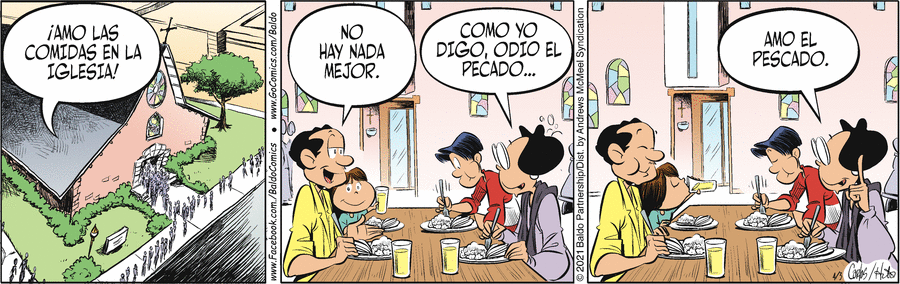
All the Spanish that you really need to know here is that pecado indeed means sin, and pescado means fish (as food).

In the English version, Tía Carmen’s jest is to turn the saying “Hate the sin but love the sinner” into “… love the dinner”. In Spanish she says “… love the fish [we are eating]” which is basically the same idea, but manages to preserve the word-play element because of the resemblance of pecado and pescado.