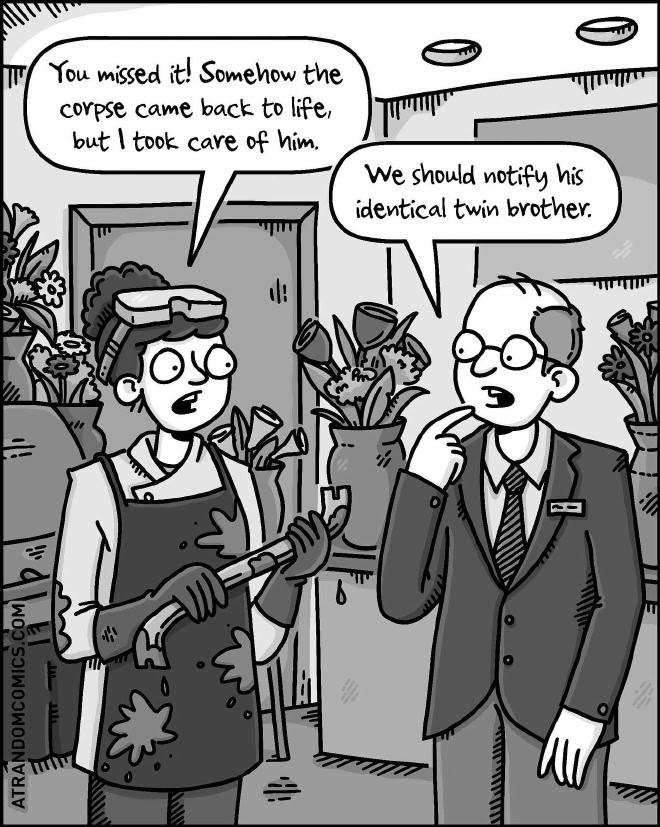
Here’s a LOL/semi-CIDU courtesy of Dale Eltoft – and thanks for the intro to Ryan Mason / At Random Comics.
I had trouble with the premises of the original Topper TV series because I didn’t understand the distinction between when the ghosts would “dematerialize” and when they were simply invisible.
An anonymous contributor submitted this Argyle Sweater, commenting that “adding a Spirit sign would have made this funny. Without that, I’m just lost“, which was a comment that I didn’t understand.
For those who might not be able to intuit the Spanish, she’s saying “But, I am Dora“. Even without that, I thought the point of the joke was fairly clear, since many airlines now charge for all sorts of services that used to be automatic and complimentary. However, it turned out that Spirit Airlines (a no frills company with which I have never had the misfortune to fly) was the first airline to charge for carry-on baggage, even though there now are other companies that have adopted same the odious practice.
P.S. The Argyle Sweater really should get a prize for the MoSt AnNoYiNg FoNt in use by any newspaper comic.
From Bob Quixote, puzzled by a cartoon in the New Yorker — as so many of us so often are!
The quixotic one says: I hope you can help me with this cartoon from the latest New Yorker. I’ve been studying it for way too long but cannot figure it out. Why are the cows cops? Is there a hole under the torn-down fence? Why didn’t the robber just hop the fence instead of taking time to take down a section of the fence? Thanks
Phil of the editorial team adds: That’s a cattle guard, common in the West: you can drive over ‘em, but they stop cattle.
Perfectly good comics. But you have the nagging feeling the joke or pun would work just a tiny bit better if this-or-that could be edited a trifle. (Thus CIDUs by a polite extension — “I don’t understand why this little matter couldn’t be fixed up…”)
Here, for instance, the traditional form uses “get a haircut / hair cut” and always works smoothly; unlike in this strip, where the dialogue in panel 2 is quite unnatural. “Hey Harv, didja get a hair cut?” , “Nah, I got them all cut! Heh heh!”
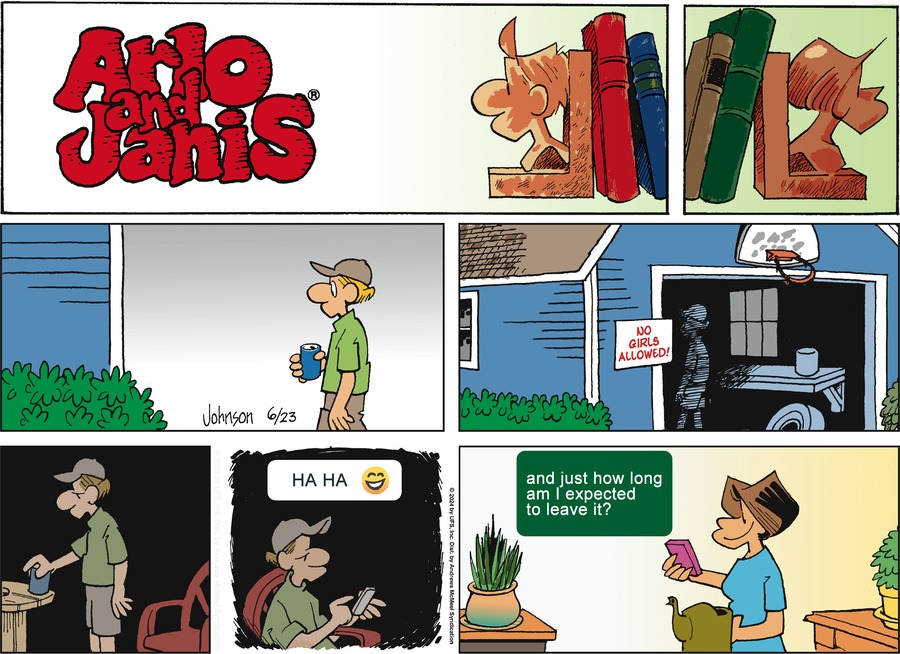
A good chuckle from Arlo and Janis, sent in by Jack Applin who has a point about “breaking serve”.
As Jack explains, As I understand it, to “break serve” means to score a point in tennis when your opponent serves. However, Janis was serving (“Did you cover the charcoal fire?”), and Arlo neglected to do that, so Janis scored the point on her own serve, right? Even if we consider the entire strip one long volley, Janis still asked the initial question, so she’s serving.
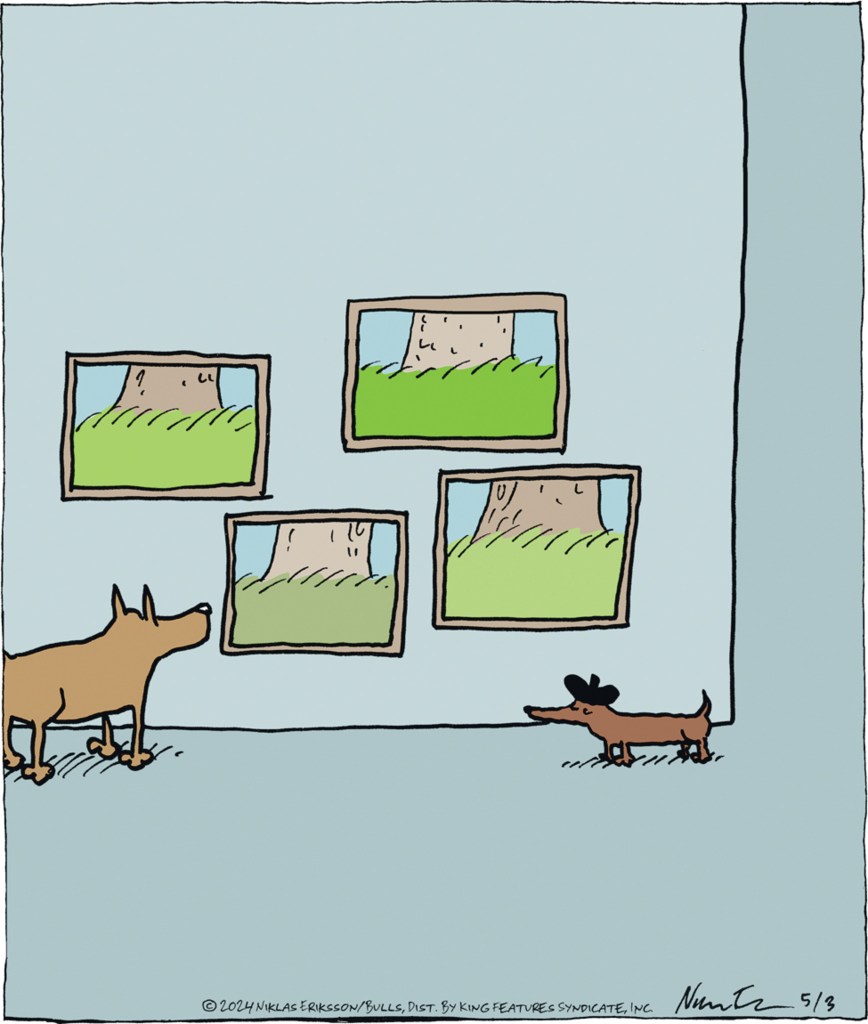
Boise Ed submitted this “Carpe Diem” panel a while back, commenting that “The Dachshund appears to be the artist, with the same picture in two different shades of brown tree bark and four different shades of green grass. Perhaps this is obvious to those who would spend big money on a canvas with only a plain circle or square, but not to me.“
Back in May, Mark H. wrote that “This [Shoe] caught me completely off guard“. Perhaps it will do so again in August?
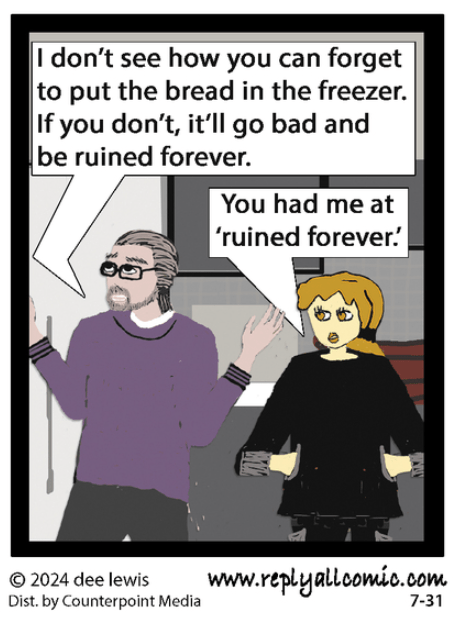
Wait a minute! Doesn’t the “you had me at” trope use something the other party said *early* in their dialogue turn? Here’s the same comic in single-panel format. These get published under the name “Reply All Lite” and have become re-arrangements (sometimes radical) of the same day’s horizontal-format and usually multi-panel strip. The single-panel “Lite” series used to be somewhat more separate, with a less verbatim relationship to the strip version. The new approach strikes me as sensible. Note that it pretty much coincides with her move to distribution via Counterpoint.
Nope, I’m not sure I would have recognized the title characters if they weren’t named.
And it’s remarkable that they were able to hire domestic services from Amazon even way back then!
I had been familiar with the Çedille Records label out of Chicago for quite some time before noticing that one reason for the name is that it would be pronounced much like “CD”.


















 Comics I Don't Understand