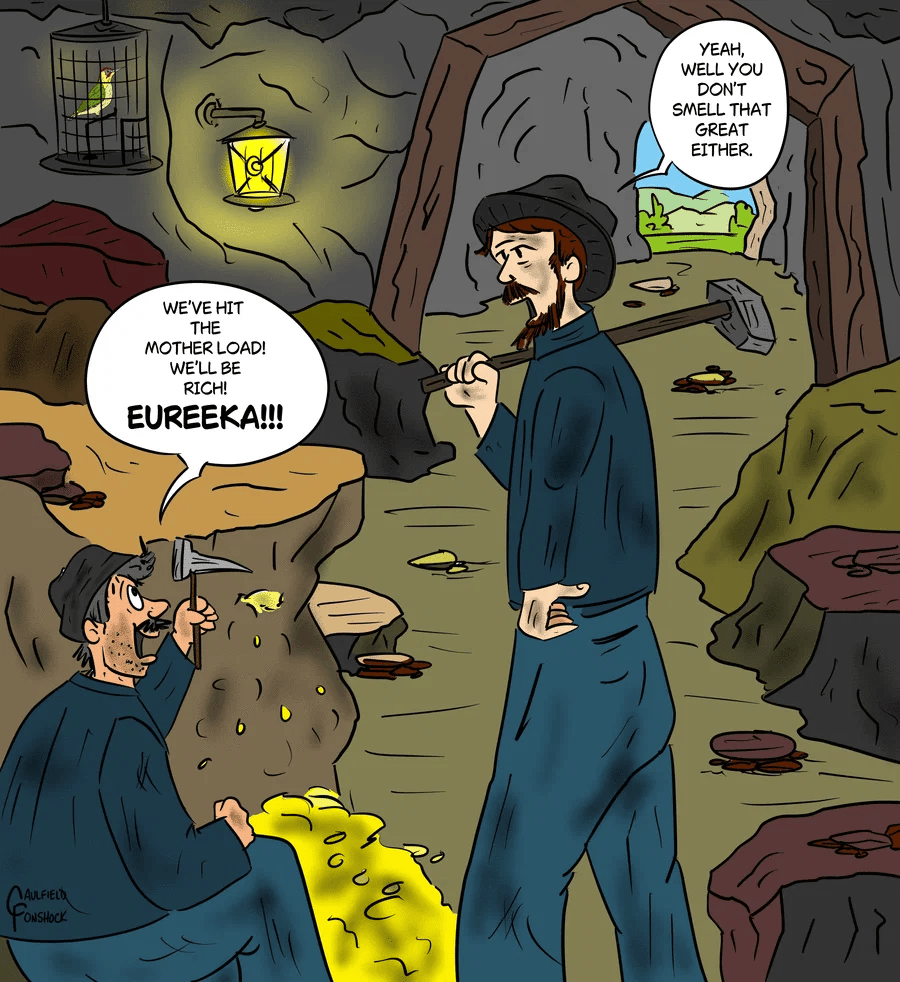
Mitch4 sends in this stinker: “This should really lead into another classic groaner:
You rip-pa deese?
You mend-a deese!”
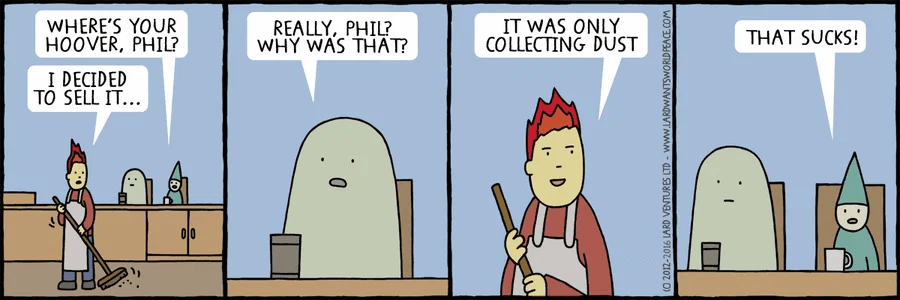
Thanks to Mitch4 for sending this in: “guess it’s not strictly speaking puns, but certainly some kind of word-play. And it did take me a couple panels to see that there was some rule-following going on.”
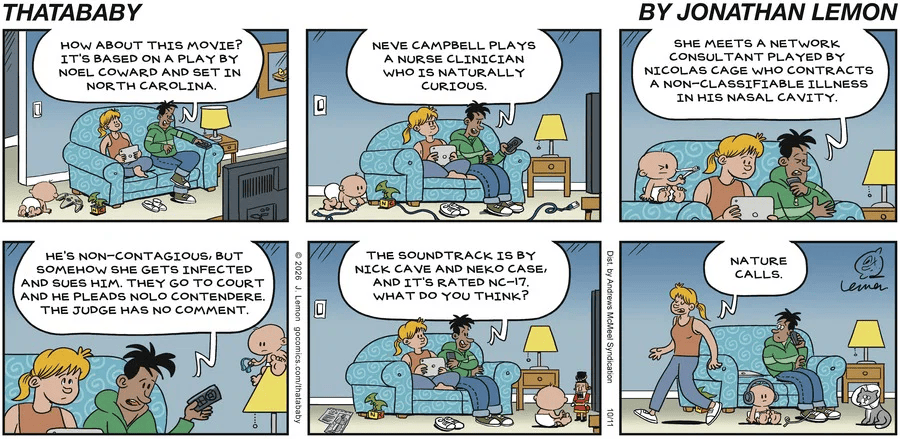
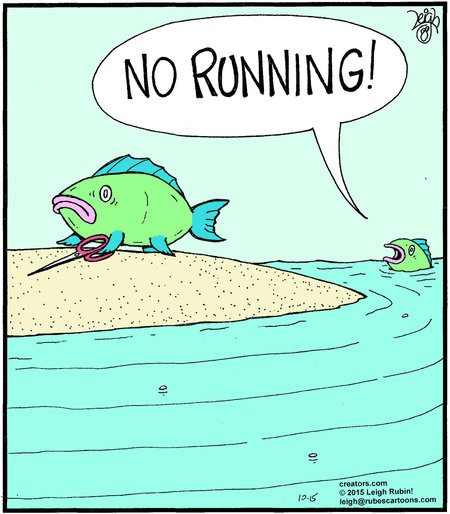



Two addenda on the Yaffle I sent in:
I suppose “mother load” for “motherlode” was an accidental error on their part, and not some subtle joke.
Also, see my comment in CIDU’s Random Comments thread a couple days ago about the term “yaffle” and the comments to the strip along the lines of “I found the yaffle today”. It’s a dialect term for a green parakeet. And the artist does place one in the picture most days, sometimes rather hidden, and sometimes (as in this one) right there.
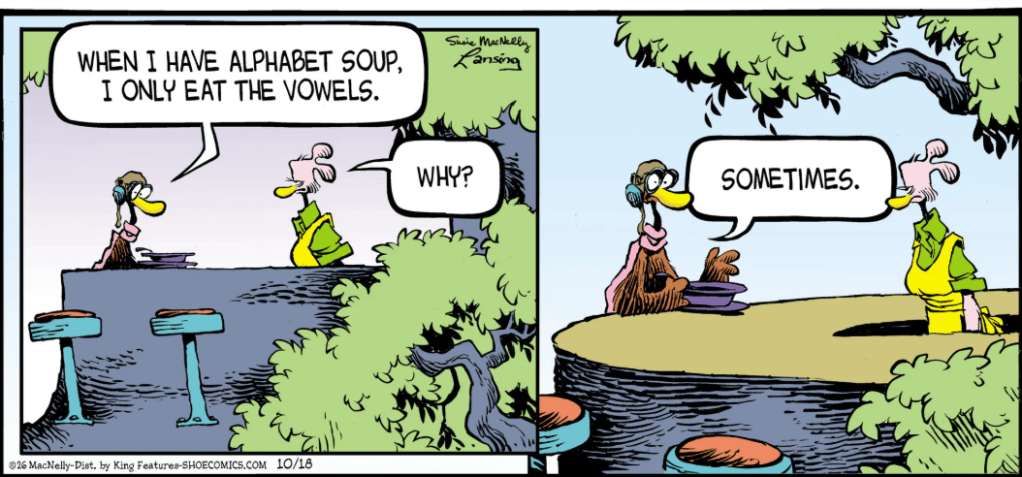
I enjoyed all of these ! Maybe the Shoe most of all, as I have a hobbyhorse about challenging the “sometimes y” part of that familiar list of orthographic letters that count as vowels in English spelling. What examples would you offer where a “y” is written in the standard spelling of an English word and does NOT represent a vowel sound? And what tests are you applying to make that classification?
I was floored when I saw that Peanuts! I do some music programs for my residence (just streaming performances), and the other day was jotting down some plans for future events. For January I listed “And for dessert, some lemon Schubert” and “Another big scoop of Schubert”.
LikeLike
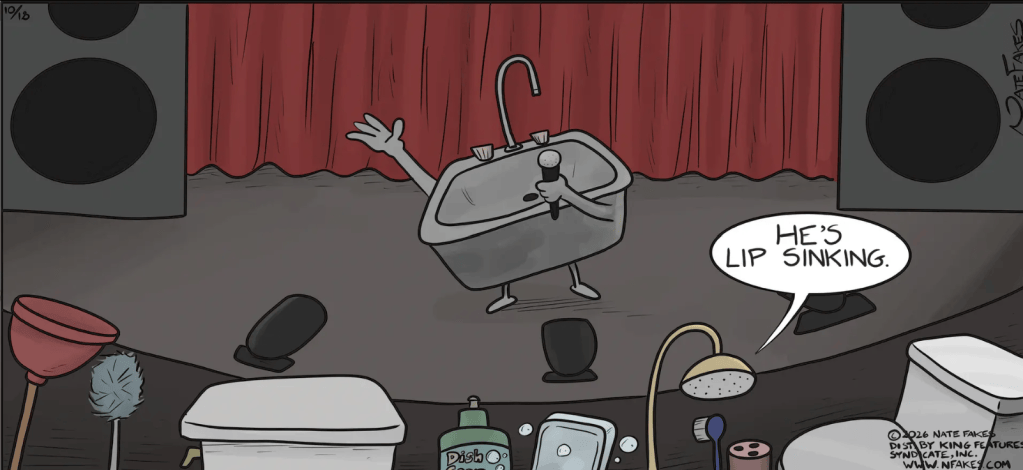
The plumbing comedy act would only be funny if the artist had drawn the sink with lips, IMO.
LikeLike
“What examples would you offer where a “y” is written in the standard spelling of an English word and does NOT represent a vowel sound?”
Yield? Yard? Yuck? Yaffle? But since I included Yaffle, and you sent in that Yaffle, these must not be what you have in mind.
I remember the vowel list as A,E,I,O,U and sometimes W and Y. But examples of W as a vowel aren’t convincing to me. An example might be in the “ow” diphthong, as in “cow”, but do we really need to think of that W as a vowel (rather than as a modifier telling you how to pronounce the O)?
I also found this tidbit: “Additionally, in Welsh-derived words, “W” can serve as the primary vowel. A notable example is “cwm”, pronounced /kuːm/, which refers to a type of valley. Other Welsh words like “crwth” (an ancient musical instrument) and place names such as “Bwlch” or “Pwll” also use “W” as a vowel. In these words, “W” represents a sound similar to the “oo” in “book” or “u” in “buck” ”
But, really, Welsh isn’t English, so dragging Welsh into the discussion seems a bit desperate.
LikeLike
People might not get the “you-rippa-dese” joke unless you used to listen to the Magliozzi brothers on Car Talk:
Tommy: Ray, what do you think of when I mention the great classical author Euripides?
Ray: Euripides pants, I break-a you face!
LikeLike
zb, consider this: The hypothetical word “hownd” would clearly be pronounced the same as “hound,” so either the ‘w’ is a vowel or the ‘u’ is a noun.
LikeLike
Yield? Yard? Yuck? Yaffle?
Okay, that’s the first half of my challenge — those are some examples of English words written with a letter Y, where you consider the Y to not stand for a vowel sound. The second part was: can you explain why you consider the sounds made by the Y letters in those cases to not be vowel sounds?
LikeLike
Thatababy came close, but I only counted NC 15 times. Too short.
And don’t worry if Euripedes pants. My Italian tailor’ll Machiavelli good pair.
LikeLike
@Mitch4: “can you explain why you consider the sounds made by the Y letters in those cases to not be vowel sounds?”
Not really. I’m out of my depth here. The best I can come up with is whether you use “a” or “an”: I’d say “a yard” not “an yard”, or “a yucky situation” not “an yucky situation”.
For example, whether you say “a herbal remedy” or “an (h)erbal remedy” will depend on whether you pronounce that “h” or not.
LikeLike
@zbicyclist: Hey, that’s really a good point.
I’ll forgo the step of saying “But it’s just one test, and here are a bunch more, most of which come out as Yes, it’s vocalic [vowel or vowel-like]”. So as to cut to the chase and ask “What sound is it that the segment corresponding to the orthographic ‘y’ is actually making?”
And the answer would have to be it’s the high front vowel symbolized as /i/ in loose IPA, or potentially spelled out — [especially in scary Halloween mode] — as “EEEeee”.
True, it doesn’t have the duration or intensity it would have if it were the core of a syllable of its own [one of the tests on my list where my account fails!] , but that doesn’t completely decide things. It’s part of a diphthong or glide, but still makes a vocalic sound in its brief lifetime as the on-glide of the diphthong. Analogy: in music a glissando or “slur” goes thru a range of notes, but does have some note that it starts on and some note that it ends on, and those are without much doubt real instances of those notes.
So let’s take “yard”. Say EEEEeee. Then say Ard. Then say them together: EEeeee…ard. Make them closer together and a smoother transition. EEeeee-aard. EEeaard. EEard. E-ard. Yard. Did you let it converge onto “yard” but still manage to hear that the starting place, even in the plain word “yard” was a short-duration version of the EEEEEeee sound?
And of course we should not forget to then ask, What sort of sound is that EEEeee? It’s a vowel, fer shure!
[BTW, here I am arguing that “y is sometimes a vowel” is a bit wrong because in principle it always is. I don’t think that anyone, even if they don’t go along with always, would opt for never. But in the case of “w” I think we can’t quite make the similar case for always and might have to accept sometimes. But in addition I would not be too surprised if someone declared a belief that sometimes was incorrect for “w” because it should be never! Except perhaps for special exceptions like Welsh loans.]
LikeLiked by 1 person
I think the short answer to “Why is Y only sometimes a vowel?” is “Because linguists say so”. Which I realize isn’t very helpful.
A longer answer, gleaned from the web (https://en.wikipedia.org/wiki/Vowel for starters) is that a vowel must not obstruct airflow, and the “yuh” sound in “yellow”, “yield”, et al. does so.
Of course that page goes into it in a ton more detail. While I could buy the argument that it’s always a vowel, the folks in the biz say no, and I’m not about to argue with them!
I do wish (as I so often do) that my dad was alive; as a linguist, he would have had some trenchant comments on this.
LikeLike
Ye olde shoppe… Does “standard” have a time limit?
LikeLike
(I’ve long thought that orthographic Y has been confused with thorn. Especially in the King James Bible.)
LikeLike
@Mitch4
Consider that ‘W’ creates a similar vowel structure to your “EEEeee” ‘y’ example, but with an “OOOooo” sound.
OOOooo-un. OOOooo-elsh. OOOooo-ackadoodle.
It kind of does the same in ‘wrench’, but ‘rench’ would be pronounced the same even without the ‘w’, just because starting the ‘r’ sound requires an implied, momentary vowel.
Can you say “rrrrrr” without wondering if you’re actually saying ‘urrrr’?
LikeLiked by 1 person
If you pronounce “Iago” (the Shakespeare character, or Disney’s Aladdin’s parrot) differently from “Yago” (sangria), then one is a vowel and the other is a consonant.
LikeLike
Nebulous- I agree entirely with your first point, illustrating that initial w is often the on-glide of a diphthong, just as initial y often is — and we can accept these points without getting into whether glides are really-truly vowels. And also, the sound I would notate would be an /u/, but just as I noted y as /i/ but then wrote out the fun version as EEEee, so then you could put w as formally /u/ but fun version OOOOOOooooo (as long as we know it’s an ew not an oh).
You example with “wrench” gets to something interesting … but not about the w , which I’m tempted to say can’t be either a consonant or a vowel, or anything else like that, because it’s just … silent! But what you say about rrrrr being indistinguishable from urrrrr strikes me as right on target. Let me introduce the category “continuant” (both noun and adjective) whose meaning is just what you think — so among English consonants pbtdkg are NOT continuants , but fvmTHthnNG ARE , though I mean sounds not letters. I didn’t mention vowels, because they are all continuant.
Any vowel is a continuant, but not vice versa. I listed a few continuant consonants . Using more category names, in English the nasal consonants and liquids (r and l) are continuants; fricatives also for some purposes, but I’m not going to count them here because they don’t work as easily with the next point.
NOW an interesting point is that, though we often think of a syllable requiring a vowel as its core, a continuant consonant could be a syllabic core. And then that syllable would have no vowel. Thus like your example, the “grrrrr” that we write to stand in for growling MAY be thought of as “gurrrr” or “gerrrr” BUT DOESNT HAVE TO BE. It really can be “grrrrr” without a true vowel , because its second consonant sound is continuant.
What is the vowel in the second syllable of “bacon”? Trick question, because it might be that the second syllable is vowelless, with the n making up the whole syllable. (Or sure, sometimes one does put in some real vowel like a schwa.)
LikeLiked by 1 person
MiB I follow your distinction, and do pronounce them somewhat differently. And I suppose it illustrates how that saying about “sometimes” would treat labeling them. But it doesn’t add anything towards persuading me that the labels are correct.
And as a fun tangent, since you mention Iago, I can never remember the steps in connecting the time of King James with the term Jacobean.
LikeLike
Ready for a radical shift? What if there aren’t just the two categories vowel and consonant, but four such categories, generated from two separate binary features, [+/- vocalic] and [+/- consonantal] …
You can read my Gemini query and their response:
https://share.gemini.google/Ut5V7BdyeVVG
LikeLike
The “Iy” part of Iago (long “e”) is two sounds, short “i” and the consonant “y”. All the “long vowels” of English are actually two sounds. Long “a” is “eh y”.
LikeLike
I made it 16 instances of NC. We have a shortage of acronyms and initialisms. There are only 676 possibilities with two letters; 17,576 with three letters; and 456,976 with four.
We also lack a satisfactory collective noun for those two types of abbreviations – a word that also encompasses truncated words and contractions, including courtesy titles such as Mr(.) and Mrs(.) that usually take a period in North America but not a full stop in Britain, and never take the apostrophe they ought to.
LikeLiked by 1 person
Regarding contractions, Lewis Carroll wrote “ca’n’t” for “can’t” because there are TWO letters left out of “cannot”. He may have been arbitrary as to which “n” was left out. He didn’t write “can”t”.
LikeLiked by 1 person
The hoover “just collecting dust” won Tim Vine the award for the funniest joke at the Edinburgh Fringe in 2014: https://www.bbc.co.uk/news/uk-scotland-edinburgh-east-fife-28838287 .
Vine also won in 2010 with “I’ve just been on a once-in-a-lifetime holiday. I’ll tell you what, never again.”
LikeLiked by 1 person
The “Eureka!
You don’t smell so good either!” exchange is a Three Stooges gag as well.
LikeLiked by 1 person