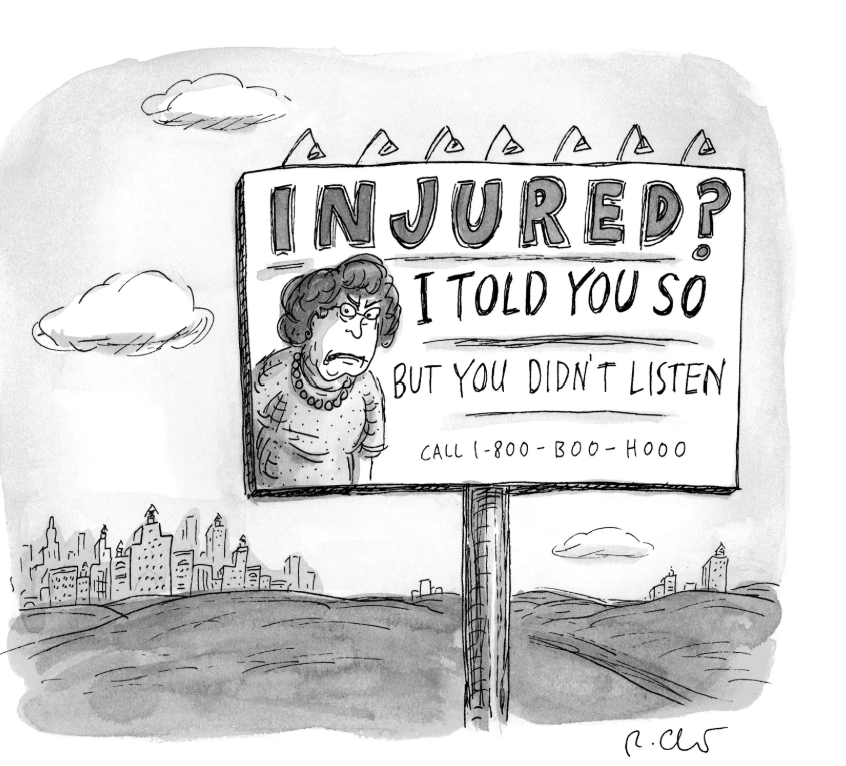
The number to call is 867-5309. Jenny went to law school.
A recent New Yorker Caption Contest winner.
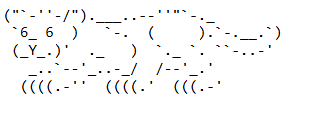
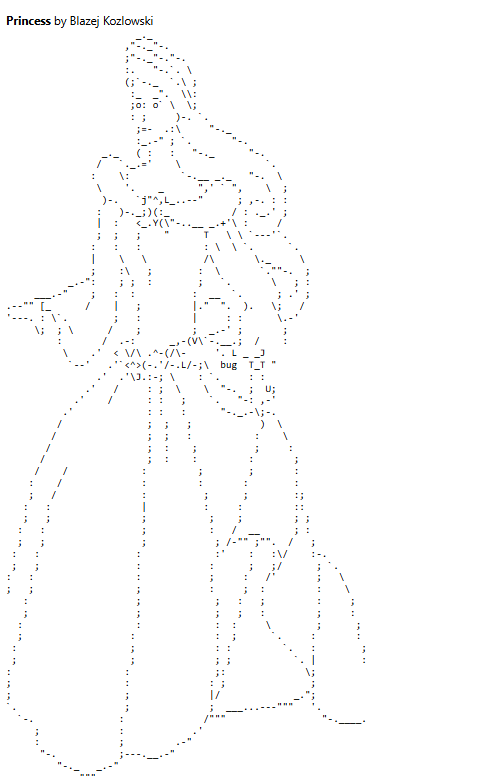
Definitely a Geezer Alert on this one. ASCII art was a big deal in the age of dot matrix printers and fanfold paper: printing out pinups was a rite of passage, along with “Happy Birthday” banners. These are from the ASCII art studio.
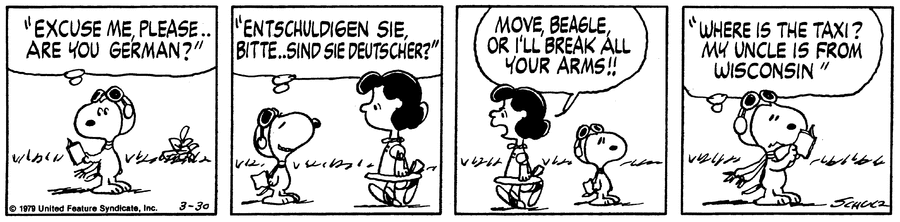
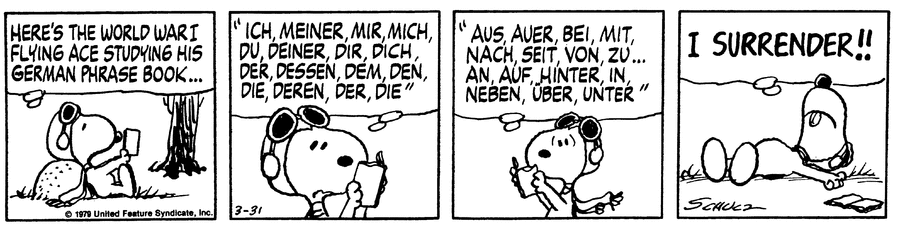
Here are a few Peanuts strips to celebrate the 35th anniversary of the “Tag der Deutschen Einheit“. Even before Schulz invented the incessant running gag about Snoopy being a WWI flying ace, he used German surprisingly often (much more than any other foreign language, Spanish included). The strip shown above was published in 1953; the title mentioned in the second panel is a piece by Bach, called “Sheep May Safely Graze“. The other four strips below are all from a story arc that appeared in March 1979.
… Although the word “Fräulein” is technically correct “textbook” German for “miss”, it has now become severely outdated, and is no longer used in normal German conversation, except occasionally for sarcastic emphasis. The standard German form of address for a woman (spoken or written) is now “Frau“, regardless of marital status; girls (and teenagers) are referred to as “Mädchen“.
… Snoopy should not have addressed Lucy as “Deutscher“, because that is the masculine declination. The correct form would have been: “Sind Sie Deutsche?” Nevertheless, Lucy responding with “…all your arms” seems a little excessive: Snoopy has only two of them, so that “both” would have been sufficient.
… The pronouns in the second frame are “I, You, He, She“, each listed in each of the four German grammatical cases: Nominative, Genitive (possessive), Dative, and Accusative. This is the standard order used in all German grammar textbooks, in which the cases are usually numbered, and thus referred to as the 1st, 2nd, 3rd, and 4th “Fall” (“case”). Yes, Germans are notorious for excessive orderliness.
The 15 prepositions in the third frame can be translated into English as: from/out, except/outside(†), at/by, with, after, since, from, to, at/on, on(top), after/behind, in, next to, over, under. German prepositions are normally followed by the term declined in a particular “case”, but some prepositions can take either of two cases, depending on the situation, or possibly even a choice of three different cases (but only in very rare circumstances).
P.S. (†) The second word in the third panel is an error, it should have read “außer” (optionally capitalized as “AUSSER“). Schulz was famous for doing all of his own lettering, and in any case this strip predates the availability of handwritten computer fonts, so the most likely explanation for the missing letter is simply a slip of the pen, or possibly a transmission error from wherever he obtained the text.
P.P.S. I think it would have been funnier if Snoopy’s exclamation in the final panel had been “Ich ergebe mich!!“, but I admit that nobody reading an American newspaper would have understood the joke.
He has a red eye and he’s waving but how do we know beavers don’t wave anyway?
It brings back memories of the book “And God Bless Uncle Harry and His Roommate Jack Who We Are Not Supposed to Talk About“, a collection of gay-themed cartoons originally published by the magazine Christopher Street.
But there’s nothing in particular about Bruno that implies he is gay. And, of course, if I had a gay uncle beaver named Bruno, I would not be ashamed about talking about him.
Your editor has a different theory here, but presents this for the hive-mind’s analysis. (And if I had an uncle who was a beaver named Bruno, I’d be thrilled!)













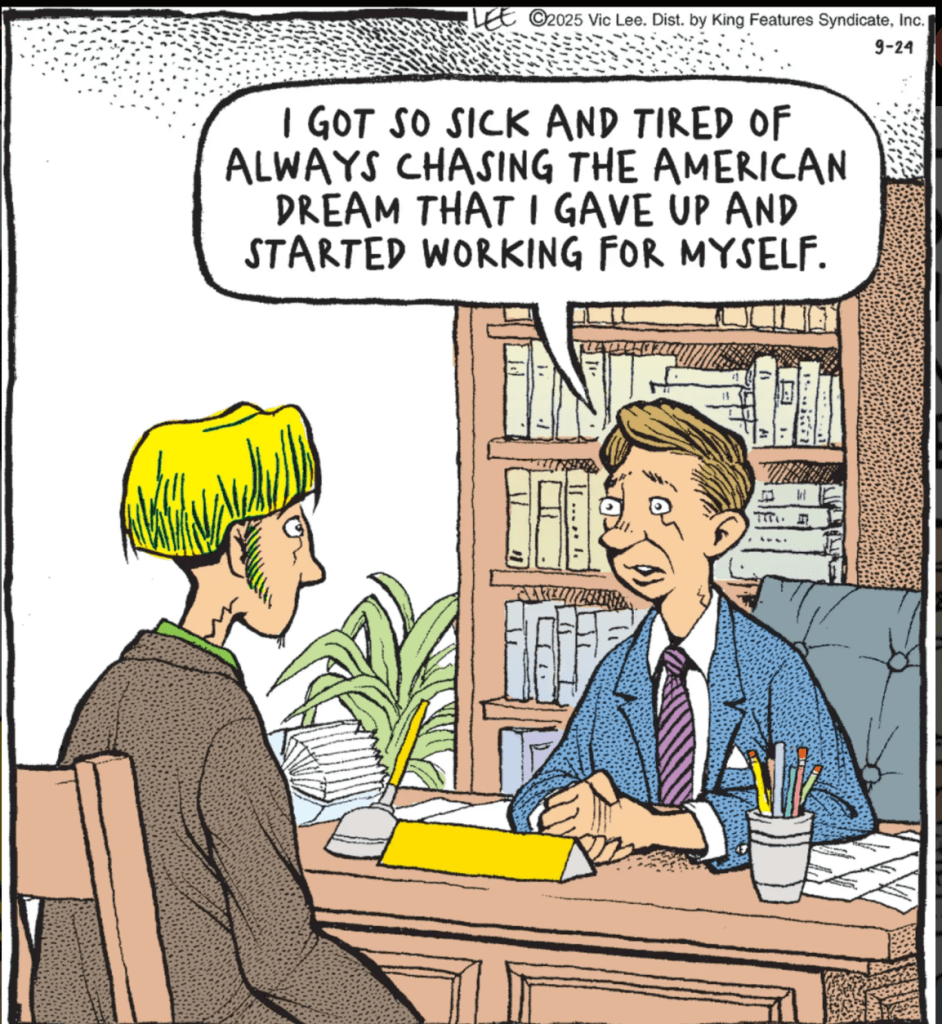
 Comics I Don't Understand