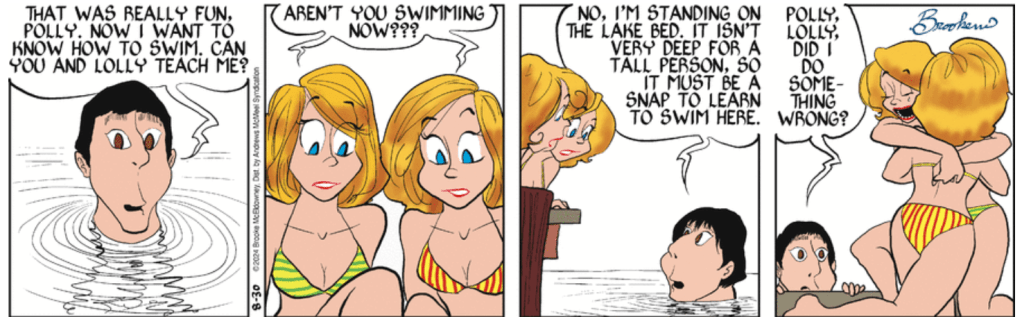
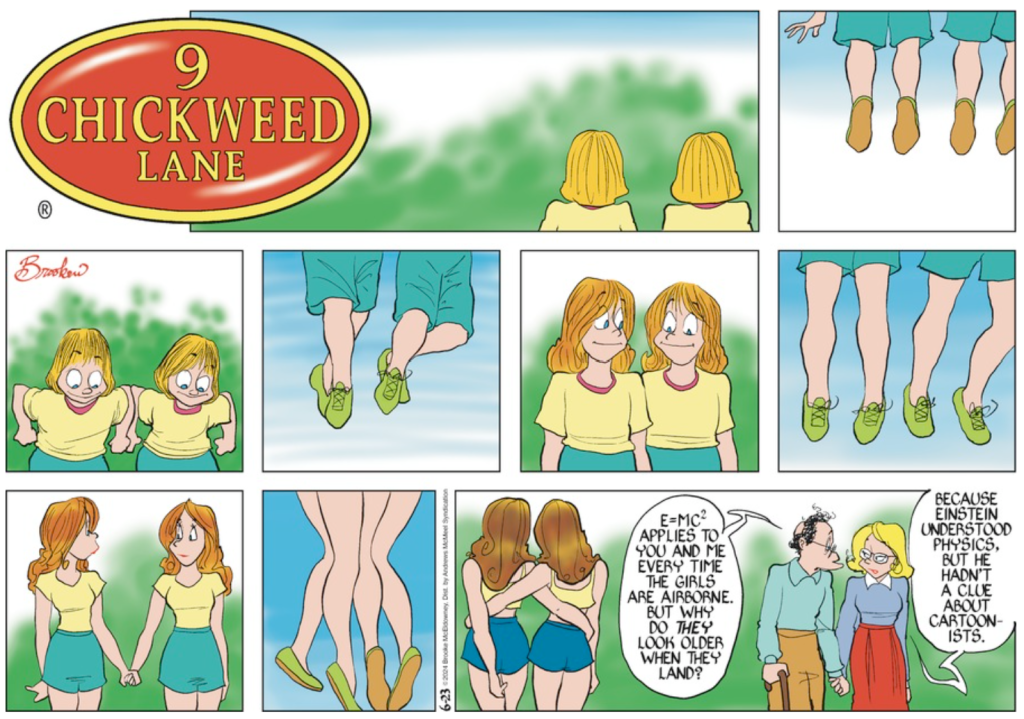
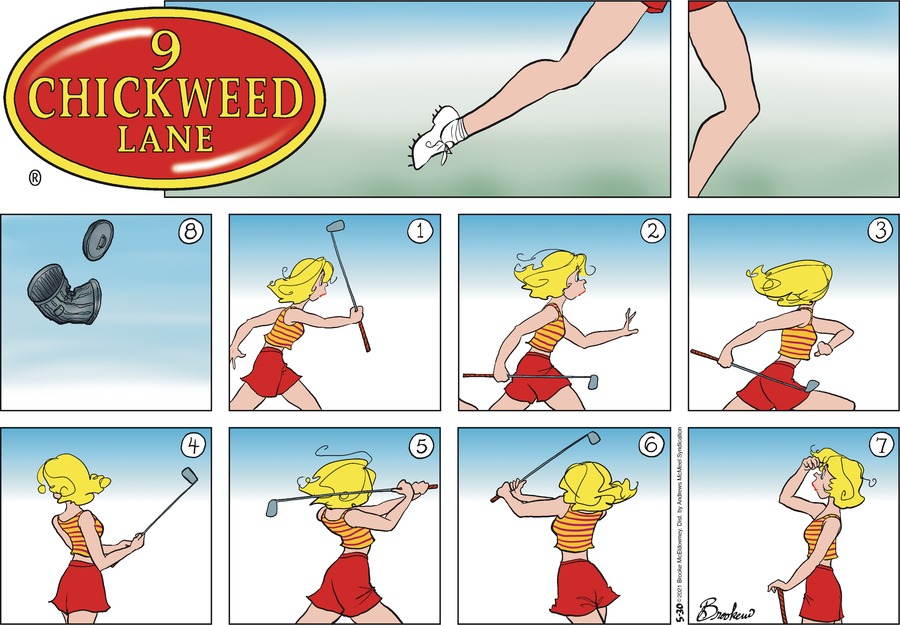
Mark H. sends this in. “An explanation of sorts for the timeline juggling that has been part of 9CL for the last few months. Lately, we seem to have skipped about 12 or 14 years, to where Polly and Lolly are now late teenagers.”

Mark H. sends this in. “An explanation of sorts for the timeline juggling that has been part of 9CL for the last few months. Lately, we seem to have skipped about 12 or 14 years, to where Polly and Lolly are now late teenagers.”

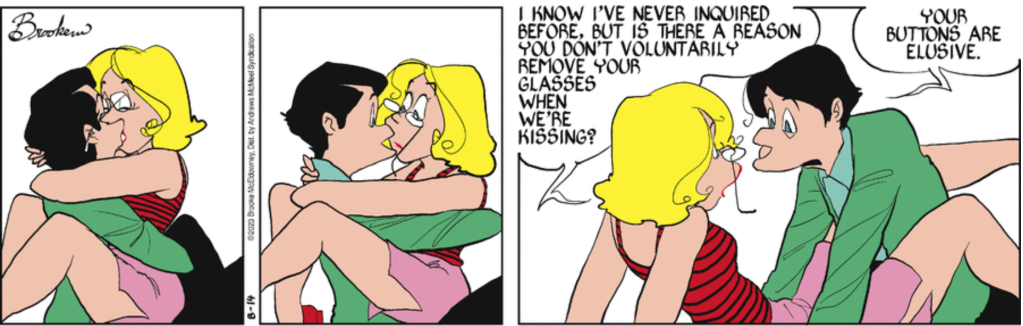
Mark H. notes: If you study the cartoon carefully, you’ll notice that it is impossible in a clinch like that for the glasses to be in that position on Edda’s nose. The bend of the temples would be up, not down.
Unless the clinch was significantly more complex than we were shown…
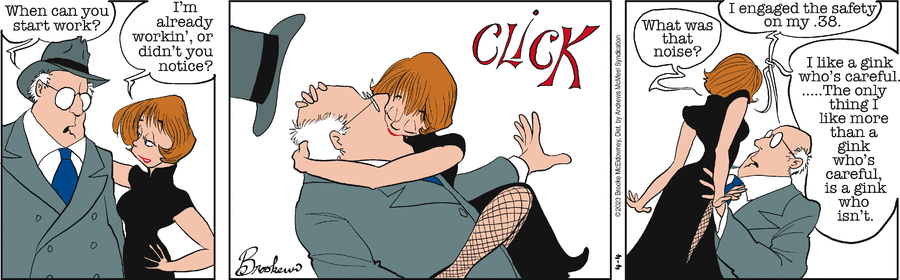
McEldowney’s meaning for gink must be quite different from the one I am most familiar with!

The Urban Dictionary of course gives some dozen unrelated entries of varying plausibility, some of which could work in this cartoon context. (But none of which are exactly mine.) The slang section of dictionary.com is more sober, but the main American entry could work with the cartoon:
noun Slang: Sometimes Disparaging and Offensive.
a person; fellow.
Is that all there is to it? Or do you see a better fit for one of the other definitions?
Sent by Dirk the Daring, who asks “Is this about Twitter? Or about nothing? Damned if I know.”

Yeah, you GOTTA suppose it is somehow about Twitter — even though the repeated “twit” never becomes “Twitter” or “tweet”, and that bird is not the blue Twitter icon bird.

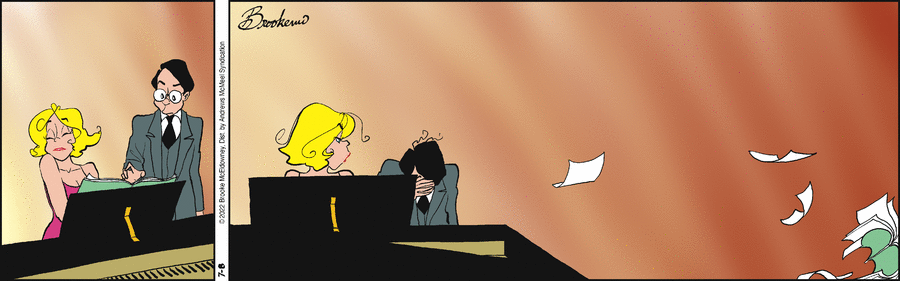
Why did the piano run away? (If that’s what happened.)
Thanks to Brian in STL for also sending this in, and also providing this other pianistic scene:

Brian’s remarks on this one were “I’m not entirely sure what’s going on here, and there are no comments on the strip to help. Amos often serves as her page-turner, but seems to have flung the music book across the room. Did he have some sort of convulsion or horrible miscalculation?”
Hey, maybe the piano remembers this or similar scenes, and has fled once he sees who the approaching performer is…
Thursday’s strip looks like it might be intended as something of a follow-up.

Now that she’s caught up with it, she prepares to attack … and plays a single note, as quietly as possible — marked 5p and with the visual correlative of the miniaturized staff.


From Unca $crooge.
(This was a recent item in “9 Chickweed Lane Classics” but I can’t tell what year the original publication would have been.)

So, what on earth is that “Tod and Verklarung’s” doing there? As Tod und Verklärung it is the title of an 1889 tone poem by Richard Strauss, always called in English “Death and Transfiguration“. Brooke McEldowney, the cartoonist, certainly intended the allusion — but in what way?
But what is it doing in Edda’s dialog? Is that supposed to be the fictively-actual name of a store in this universe? Or is it her parodic version of a different name, which her mother would recognize? And for the cartoonist, is it coming from “Abercrombie & Fitch”, or some other real store, or thin air? And are we meant to reflect on death and transfiguration?

Here is a performance of that piece:
Or if you’re feeling very studious, here is a dissection of the music in detail:
To the Arlo Page with ye!