Sometimes “translation” means moving to a different place

Here are two more instances of creative translation in “Macanudo”.


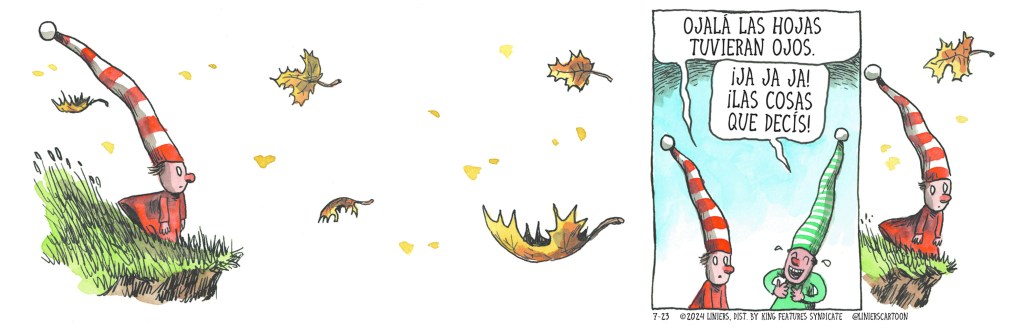
The Spanish dialog means: “I wish the leaves had eyes.” – “Ha ha ha! The things you say!

In both cases the gag is a simple (auditory) pun: in English twofold on “leave(s)” (noun/verb); in Spanish threefold on “ojalá“=”wish”, “hojas“=”leaves”, and “ojos“=”eyes” (one verb and two nouns; all three words sound very similar).


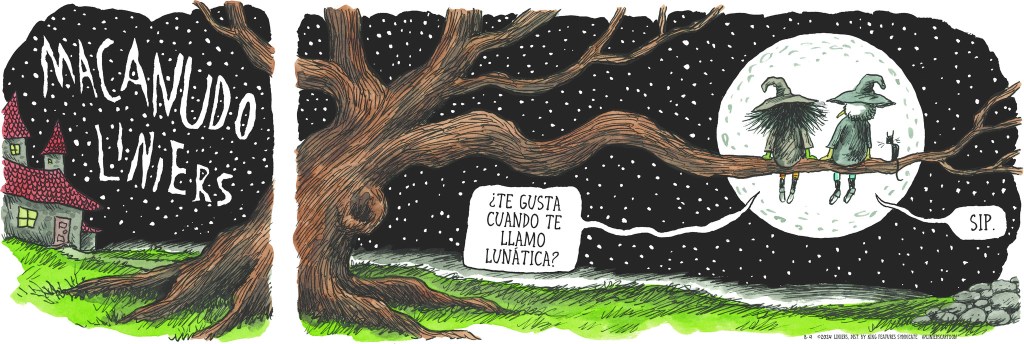
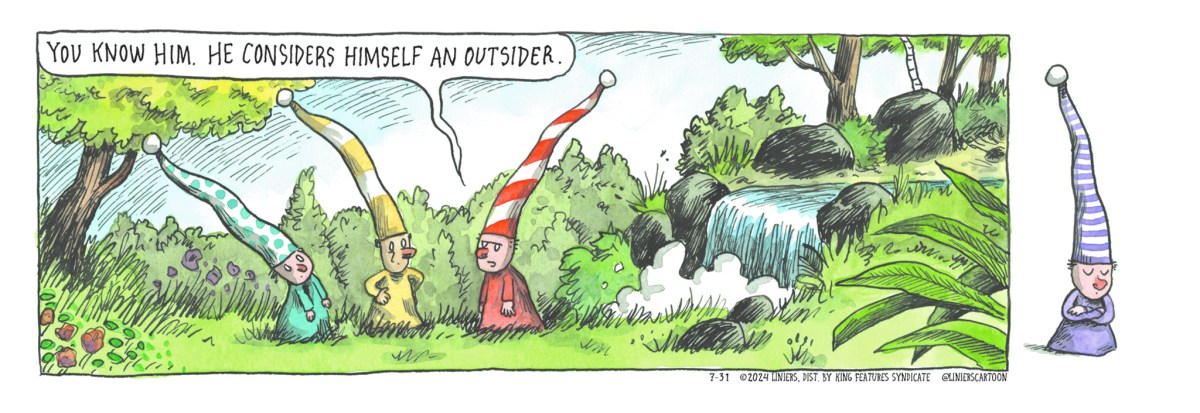
In this second case the difference between the two language versions is more extreme:


In Spanish: “Do you like it when I call you a lunatic?” – “Yup.

Perhaps the translator did not trust English-speaking readers to recognize the “lunar” etymology of “lunatic”, or maybe she simply loved the song lyrics more.


P.S. Several months ago I looked up the meaning of the name “macanudo“, discovering that it meant “a person or thing considered admirable or excellent because of its positive qualities“. Besides being an eminently appropriate name for the comic strip, this also explains why it is the name of a cigar brand. I was in Copenhagen (on vacation) just a few days before I created this post, and just happened to run into this shop:


They both work!

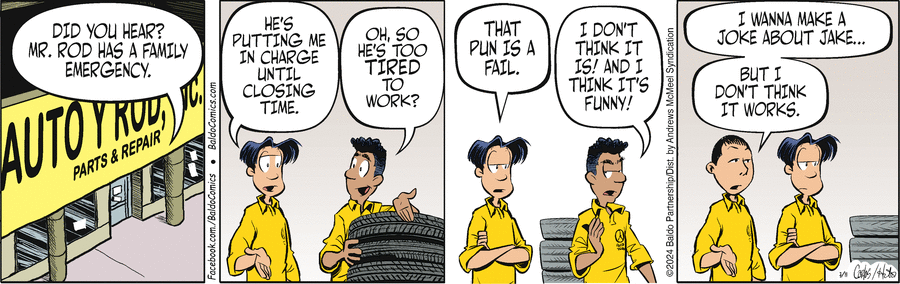
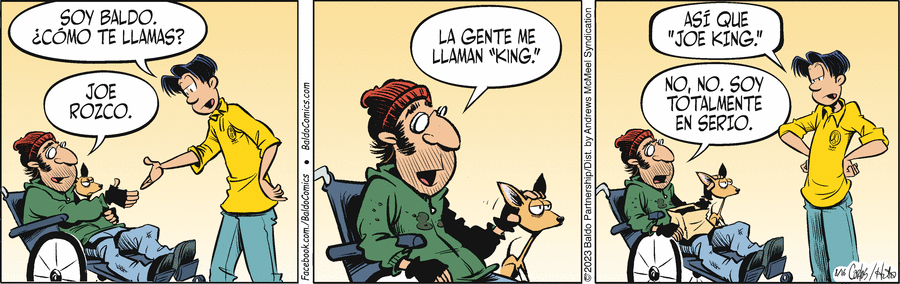
As we have asked before with Baldo, does the joke depend on language, and does it work in both the Spanish and the English versions of the strip?

Here there are two loci for our standard questions: In panel 2, the dialog from the second character (who I think must be Jake); and in panel 4, the second part of the dialog from the speaking character.

My take on those two, in short summary: The panel 2 pun works fine in English, and the Spanish also has something of a pun, by substituting a different statement instead of a translation. In panel 4, in the Spanish there seems to be an amusing equivocation, by virtue of a grammatical ambiguity; which does not carry over into English.

In some detail:

In the English, notice the emphasis given in the lettering to the word TIRED. And while Jake says that, he is all over a stack of TIRES; even seemingly pointing to them as though in a sort of illustration.

In the Spanish, Jake’s line translates according to Google as “Oh, so you roll out of here early?” (and I think the “you” is not the only choice — it’s more of an impersonal, and might amount to “we”). So it no longer mentions tires or tiredness, but with the mention of rolling still manages to indirectly bring in the tires and roughly complete a pun. (And as a noun instead of verb, rueda is rendered first off as wheel.)

OK, a bit of background. English (like, say, French) in simple sentences, in at least semi-formal speech or writing, requires an overt subject, even if a person and number could be inferred. Spanish (like many other European languages) allows skipping a subject pronoun if the verb form is enough to determine person and number. You can see this in both of Jake’s sentences in panel 3 — creo is 1st-person singular, but the sentence does not need to say yo creo; same for pienso not needing yo pienso.

Then in panel 4, the third character’s line Pero no creo que trabaje could be But I don’t think it works [it = the potential joke], or But I don’t think he works [he = Jake]. Which is a fairly good joke, or anyway language-amusement. [My point about not requiring overt subject pronoun turns out not crucial here, since if this sentence did use a subject pronoun, él for he or it would still be indeterminate.] But in English we get But I don’t think it works, and no secondary dig at lazy Jake.
Bonus post: Back in the translation shop

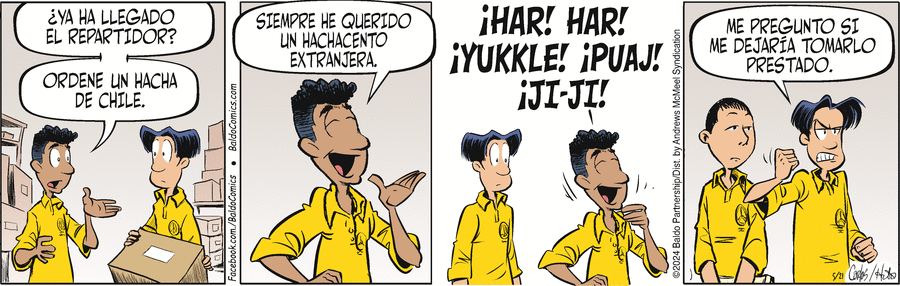
Today’s Macanudo, twice:

“It was nice while it lasted.” Okay, I’ll buy the pairing. Both are sweetly regretful but have just a tiny bit of a sting, don’t you think?

But now, today’s Baldo, also twice:

Now at first this looks like something we’ve seen a few times with Baldo: A pun or language-dependent joke in the English version, and then a reduction to a univocal expression in the Spanish version with no attempt to preserve the polysemy needed for the pun.

But not this time!

The key is in hachacento, which does not register as a recognized or translatable Spanish word, at least by Google Translate. But looking at parts:

hatchet ==> hacha
accent ==> acento

So we do get both axe and accent! (But not sent ==> enviad{o/a}. But who cares at this point!)

P.S. Don’t forget to stop and smell the noises in panel 3.

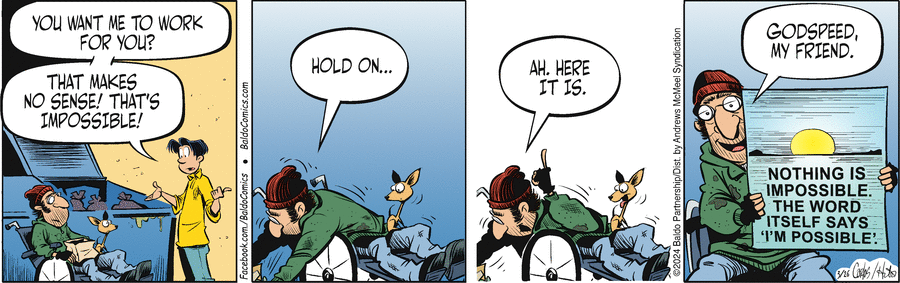
Impossible!

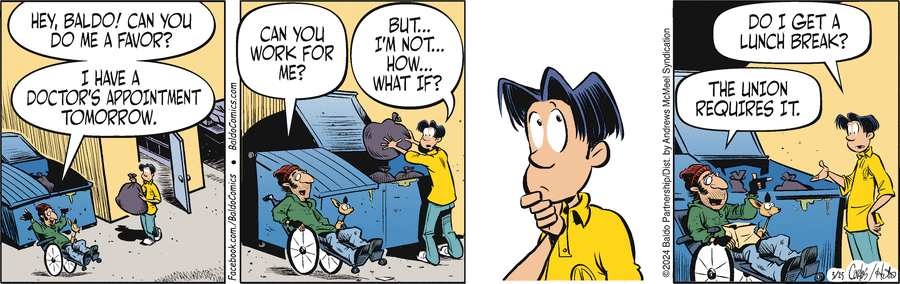
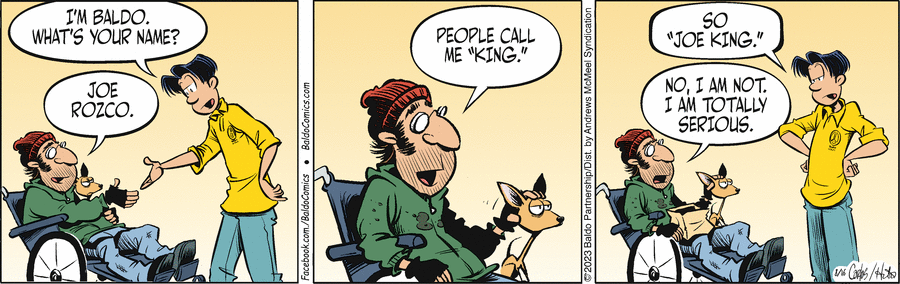
Let’s revisit a topic we’ve seen in different lights at different times: How the English and Spanish versions of Baldo may differ in how a joke works.

Here the joke comes off okay in English, as based in written language (or anyhow spelling). The specifics won’t work in Spanish, so they settle for a less striking point.

P.S. The previous day’s comic clarifies that “work for me” probably means more like “as a substitute” than like “as an employee”.

Creative alternatives to translation

I recall a memoirish article by someone who had been a simultaneous-translation officer at the UN. They recounted most proudly the occasion when they were doing the key Russian-to-English translation for a top Soviet official, who made a point using a very familiar (to Russians) quoted phrase from Pushkin [I’m guessing at this memory], and our protagonist came up with a Shakespeare phrase covering much the same idea, which they substituted! On the fly! [Or maybe they saw a written text just before going on?] Gosh, I hope it wasn’t That one may smile, and smile, and be a villain.

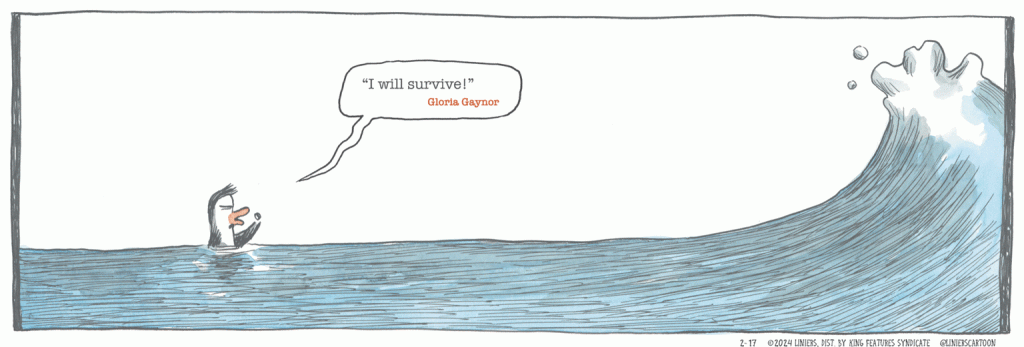
Well, whatever issues that sort of thing may present for literalist fans, there is no problem if an artist or writer is doing their own translation; or, indeed, preparing versions in different languages without picking out an “original” and a “translation”. And since these paired Macanudo strips give the sources for the quotations, this is a fine thing.

I didn’t know anything about Charly García, but here’s Wikipedia to the rescue.

Oh, and with some help from Google Translate, the Charly García line put in English could be “This is endurance”, and the Gloria Gaynor line put in Spanish could be “[Yo] Sobreviviré”.


CIDU QUEUE REMINDER

As always — but it needs saying explicitly again now and then — we like to think of this as a reader-participation site, and not just for your invaluable (or anyhow amusing) comments, but for suggestions of comics to run and discuss.

Please share your specific suggestions of panels or strips, in CIDU, LOL, and OY categories, either by direct email to

(that’s “CIDU.Submissions” at gmail dot com), or by using the handy-dandy Suggest A CIDU form page!

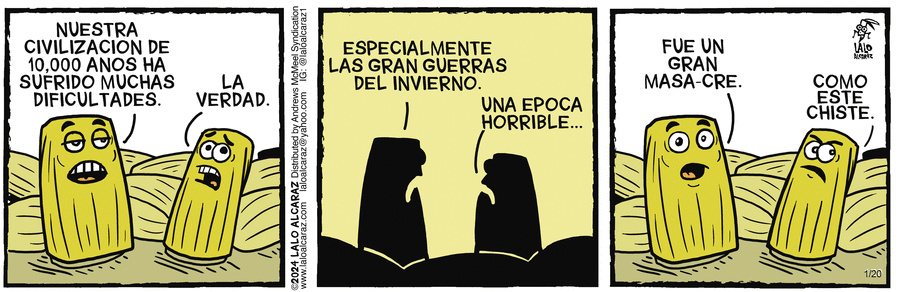
“Please help with understanding the Spanish”? — No, please help with understanding the humor!

Very considerate of the English captioning to inform us these are tamales, which is not mentioned in the Spanish, and may not have been that obvious. In panel 2, invierno means winter, but I’m glad to learn that it might be a way Spanish speakers refer to what Anglophone North America calls “the holidays” or “the holiday period”. 

But the crux of the puzzlement is in the final panel. We have the material for a pun, in partial split meanings: masa by itself can mean dough, and masacre written solid would be the obvious massacre, or as Google Translate for some reason prefers, slaughter. But we have to ask, if there are fluent or native Spanish speakers here, does this work for you as a joke?

Bonus – cómica extra

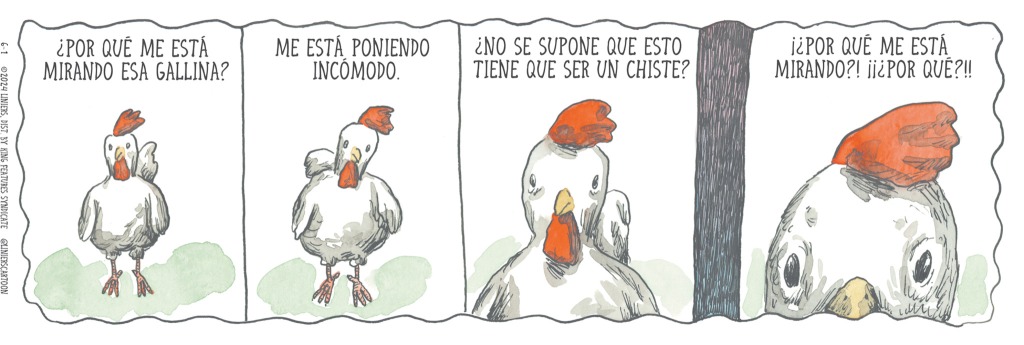
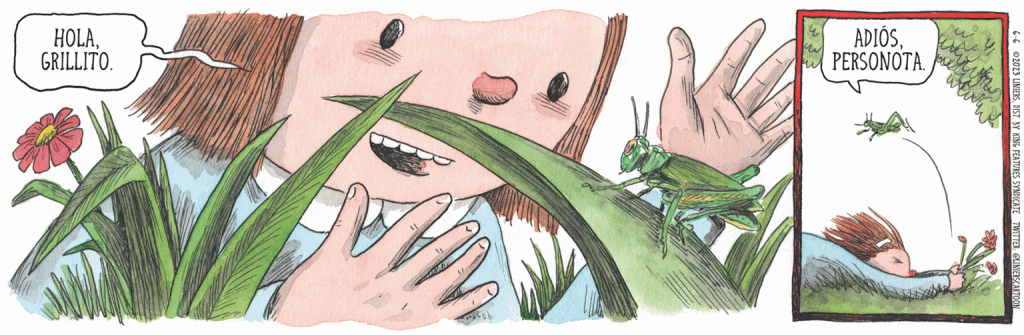
Parallel to our question for Baldo, but probably with opposite conclusion, this pair suggests confirmation that for Macanudo the Spanish version comes first and the English results from translation.

The humor is from, well first of all the behaviors of the two species, but after that the creative way the suffixes are used in the Spanish. (I don’t think the -ota is entirely standard. but is creatively deployed to convey “large”. Comments welcome from experts and fluent or native speakers!)