Parallel to our question for Baldo, but probably with opposite conclusion, this pair suggests confirmation that for Macanudo the Spanish version comes first and the English results from translation.
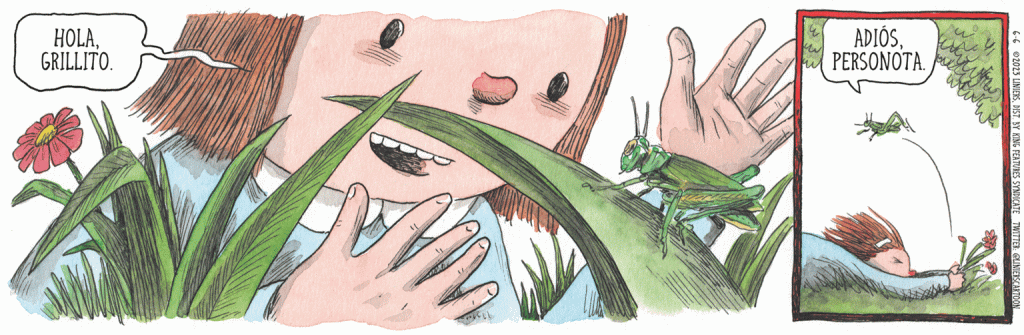

The humor is from, well first of all the behaviors of the two species, but after that the creative way the suffixes are used in the Spanish. (I don’t think the -ota is entirely standard. but is creatively deployed to convey “large”. Comments welcome from experts and fluent or native speakers!)


We know from extrinsic evidence that Macanudo was produced in Spanish long before the English version began, and that it is produced by a native Argentinian cartoonist. So it would be remarkable if the English text came first. Baldo is produced in the United States by a Latino-American writer, so the extrinsic evidence, at least, at that level of detail, does not tell us which text comes first.
I do not speak Spanish, but Google Translate translates “personota” as “little person,” not “huge human.”
LikeLike
Standard Spanish would have been “(la) personita“, the “o” in the suffix of “personota” may be Argentinian dialect, or it may be a simple typographical error. The English version is hand-lettered, but the Spanish version appears to use a “handwritten” computer font.
P.S. The author’s real name is Ricardo Siri, and the Macanudo strips have been translated into English (at least for the books) by Mara Faye Lethem, which may explain why the dialog sometimes feels like it has a “feminine” touch. For a long while I wasn’t sure whether the pen name “Liniers” had a man or woman behind it.
LikeLike
Shoot! I should know better than to type a long or complicated comment on my iPad at night! It finally did get lost, after scaring me twice but allowing recovery. Will try again.
Thanks, Usual John, for summarizing so clearly the external evidence that Macanudo originates in Spanish. I didn’t mean to understate how firmly we know that. But I wanted with this post to appreciate the clever creativity of the writing. Not only is it more compact in Spanish with the -ita and -ota suffixes where the English translation is stuck with separate full-word adjectives. But I think it relies humorously on human readers / hearers to correctly understand the non-standard -ota as “large” in the presence of the contrasting -ita “small” plus reliance on “phonetic symbolism” [more in a later note].
But that is something Google Translate won’t readily do, and I think it came up with “small person” because it thought it was correcting -ota as a typo to -ita (I had indeed earlier made the same check you carried out).
LikeLike
No, “personota” is not an error, nor a typo, it’s a creative non-standard invention.
And the human translation as “large person” is perfect in capturing the intent of the invented word.
And the Google Translate as “small person” is an understandable mechanical overreach to thinking “personita” must have been intended.
LikeLike
This “phonetic symbolism” phenomenon (or in fancier terminology “sub-morphemic sound/meaning regularities”) has been getting attention lately. But I have seen it discussed as far back as 1956 – Brown, Black, and Horowitz, J of Abnormal and Social Psychology. (The paper has been reprinted in collected Roger Brown Psycholinguistics book, which is where I ran across it.)
If you took a classroom of English speaking undergrads, not familiar with the details of Gulliver’s Travels, and told them the first two Books dealt with stories of tiny little people, and giants, and that the places where they lived were called Lilliput and Brobdignag, would they have any difficulty saying which is which?
That 1956 study used natural language word lists, from related and unrelated languages, in various ways such as antonym pairs. There were two kinds of results. The English speaking subjects agreed with each other, to a significant level; which may show something about their associations formed by their shared experience of English. But then second, they also were guessing accurately aboyt the Hungarian antonyms, significantly above chance, suggesting something universal.
Later studies mapped out specific association patterns. So for example, front high vowels tend to give associations to ideas of sharpness, quickness, highness, smallness, while back or low vowels associate to the dull, slow, low, and big.
Which fits with the invented term “personota” suggesting “large” person, especially when appearing in close proximity to a word witn standard suffix -ita for diminutive.
LikeLike
@ Mitch – I respectfully disagree. In this case the translator deserves credit for recognizing that the punchline can go either way: the girl can be described as “huge” (in comparison to the cricket), or “small” (in comparison to adult humans). The original intent (in Spanish) is almost certainly the latter. English doesn’t have any standard “diminuitive” suffixes†, but nouns in Spanish can be resized in either direction. If Liniers had wanted to make her appear “big”, the suffix would have been “-isima“, so that “la personisima” would mean “the BIG person”. I still think that “-ota” was a typo: there just aren’t any existing references for it (“No se han encontrado resultados por personota.“)
P.S. † – German has two diminuitives: “-chen” (as in “Mädchen“, meaning “girl”) and “-lein” (as in “Männlein”, meaning “little man”). Some German words can take either suffix, but many terms are habitually associated with just one of the two, and not the other.
P.P.S. A friend of mine in Oregon (with unspecified Celtic roots) would sometimes refer to a toddler as being “a small child-een”. Another “occasional” diminuitive suffix is “-ette”, but this is also used to denote femininity.
LikeLike
P.P.P.S. Relevant examples for the suffix “-ette” include “cigarette” (diminuitive) and “bachelorette” (femininization).
P.P.P.P.S. Back when “Frau Dr. Bundeskanzlerin” Angela Merkel was leading the German government, I used to make sarcastic reference to the (mandatory) feminine suffix in her German title by calling her the “Chancellorette” in English.
LikeLike
There is considerable cross-lnguistic observation that “diminutive” formations carry a variety of senses added to a base noun — of course “small” as per that label, but also “endeared” (fondness), and “gentle”. Maybe “feminine” but that is complicated for languages which already have grammatical gender.
Kilby, I’m not sure what the conclusion part is in your disagreement. Are you saying the translator made a mistake (or we might say, not the best choice) in putting “huge person”, and it should have been something else? Then what would have been the better choice?
LikeLiked by 1 person
That makes sense. However, sometimes cartoonists will create words to add a double joke, which I don’t see here, or simply because there are no other words that mean quite what they want to convey. My translate app says ‘Adios personota’, means simply, ‘Goodbye Person’.
LikeLiked by 1 person
@ Mitch – My hypothesis is that the author’s original intent was that the cricket was belittling her small size (as a child), just as she had belittled the cricket. The translator recognized that without a built-in diminuitive suffix in English, referring to her as a “little person” would not carry the same linguistic weight, so she decided to reverse the reading with a “maverick” translation, making the gag a comparison of the difference between cricket and human dimensions.
While it is theoretically possible that Liniers was trying to create a neologism with the “-ota” suffix, I don’t think that a reverse reading of the translation is sufficient proof of this interpretation, and I think that a minor typographical error is a much simpler explanation of the otherwise unknown suffix (“O” is right next to “I” on every keyboard).
A careful inspection of the Spanish dialog indicates that the font shows all the typical characteristics (i.e. identical letter shapes) of a computer font. It is entirely likely that Liniers does not apply the dialog lettering himself, and that this typo simply slipped through. We’ve seen any number of worse examples of lettering failures in other strips.
LikeLike
You certainly may call your grandpa abuelito without regard to his actual size. Nonetheless, the -ito is a diminutive. That’s just the term.
LikeLiked by 1 person
I think of -y as a kind of diminutive or nickname-y suffix for English.
LikeLike
Italian has endings like that. Tortelloni is a kind of big pasta and tortellini is the little version. Trombone is “big trumpet.”
English has a few endings for something little. One of them is “ling”. Baby goats are kids if you don’t care about the sex and doelings and bucklings if you do. Sometimes “let” is used, as in “applets”, miniature application programs. I can’t think of an ending for something large like an extremely large bear or car or truck, except for a few humorous ones like “truckzilla.”
LikeLike
Trombone is “big trumpet”? We’ll let that slide.
LikeLiked by 2 people
Yes. “Tromba” is trumpet, “trombone” is big trumpet. In Latin, “tuba” is trumpet. Clearly the inventor of the tuba was messing with us.
LikeLike
Tuba Mirum Spargens Sonum
LikeLike
I got distracted before finishing up that idea — I was going to post a link to a clip of the Tuba Mirum section of Verdi’s Requiem Mass, but didn’t finish deciding whether to insist on one that did not start with the preceding (and quite gloriously astonishing) Dies Irae section.
If it’s something you have not yet done in your life, do make a point of some day going to a performance of the Verdi Requiem in a large auditorium or theater or church with balconies or lofts or boxes. There is something they do with the Tuba Mirum which sounds like a bit of a gimmick, but in practice is astonishing, overwhelming. Some of the trumpeters will be stationed in the balconies, and the series of trumpet calls at the beginning of the Tuba Mirum will come from those trumpeters above or behind you, and get answered by brass in the orchestra. (And then you realize there are words and he knocks you over with the full-blast orchestra and chorus intoning Tuba Mirum Spargens Sonum!)
This clip shows that happening, and is quite good musically — but I have difficulty trying to enjoy watching Barenboim.
(Volume up!)
LikeLike
@ Mitch – “Tuba Mirum Spargens Sonum” – My first guess (before your followup comment appeared) was going to be something like “look at the loud cylinder of asparagus“, but Google corrected that to “the shrill sound of the trumpet“. :-)
P.S. At some point before the turn of the Millenium, I attended a concert at the Kennedy Center in Washington. I have no idea what the first piece was, but as you described, they had placed a number of brass musicians at various spots in the balconies, all the way up to the rafters. However, they instruments that they played were not made of brass: each one of them was blowing into a large conch shell. It was both beautiful and very impressive.
LikeLike
Well, I can suggest one notable appearance of asparagus in concert music. “Das Himmlischen Leben” (Uh-oh I don’t have a German spellchecker) (The Heavenly Life), a song with orchestral accompaniment by Mahler, used as the finale of his 4th Symphony, describes the reactions of a young boy waking up one day to find he is now in heaven, and a feast is being prepared. One section brings up the vegetables, including “gut Spargel” (good asparagus).
LikeLike
For the asparagus
Gut Kräuter von allerhand Arten,
Die wachsen im himmlischen Garten,
Gut Spargel, Fisolen,
Und was wir nur wollen,
Fine herbs of every description
Are growing in heaven’s garden,
Fine asparagus, green beans
And everything we desire,
From Das himmlische Leben
by Gustav Mahler From Des Knaben Wunderhorn (1899) 1892-99, revised 1901
LikeLike
@ Mitch – My snotty “translation” was nothing more than a series of silly cognates, such as between (Latin) “spargens” (“scattered”, or “shrill”) and German “Spargel” (asparagus). As for Mahler: the adjective “gut” does (generally) mean “good”, but in the context of those verses, the intended meaning has an additional connotation of “plenty” (meaning “lots of”).
LikeLike
Kilby, yes I did follow just how your joke worked — because as it happens, my very limited German recognition vocabulary does include the low-frequency word “Spargel”, and that is precisely because of this occurrence in that Wunderhorn song.
LikeLike
@ Mitch – Over here, at least from early spring to June 24th, the term “Spargel” is definitely not a low-frequency word: Germans are crazy about the stuff. Unfortunately, they vastly prefer asparagus that is grown “underground”, meaning that it is almost completely white. My wife is no exception, so I’m already looking forward to the end of the season.
LikeLike
I don’t think I’ve ever had (or even seen) white asparagus. Does it have a different taste and/or texture? (Say, wasn’t there a song in Sound of Music like “SpargelWeiss, SpargelWeiss, Every morning you greet me …”? 😜)
LikeLike
If you read that poem in Des Knaben Wunderhorn you have to feel sorry for Martha. She was mentioned by name in the Gospels and probably thought fame would be a good thing until she found out that she would be the one doing all the cooking in Heaven for all eternity.
LikeLike
Not all Germans are crazy about the stuff: my (German) grandfather famously said about asparagus that if he were living on a desert island that only grew asparagus, he would never have come upon the idea that that plant might be edible…
LikeLike
(Huh, WordPress must have done another “refresh” of the avatars or whatever they are… I noticed yesterday when reading back some older posts that the avatar for me was different, and I thought it must have been because they were old posts, but now I see that they are different everywhere… Drives me crazy when they do that — the whole point of the avatars is to give you a visual association, so you get to become familiar with various posters with a visual aid, an advantage that you totally throw under the bus if you universally update the damn things every so often…)
(Yes, Kilby, I see you cleverly saved you pattern avatar and use it as your picture, and so it stays the same as it was two generations ago… but I don’t log in…)
LikeLike
I used to hate asparagus, because I had only had the wilty canned crrap. Many years ago, a co-worker led me to a field of wild asparagus, where we plucked some and nibbled on it. I was amazed. Much later, I learned to sauté the stuff in a ton of butter. Yum!
LikeLike
@ Boise Ed – The only reason that “white” asparagus stays white is that they build up an extended “berm” of dirt over each row of plants. The stalks grow up, and are harvested just before they break through the surface of the dirt. It is a different variety than the typical green asparagus sold in America (just like various types of apples have different characteristics). White asparagus has a (much) harder (and inedible) outer skin, and must be peeled before you cook it. Afficionados claim that it has a more delicate flavor than green asparagus, but like larK’s grandfather, I don’t really care for it. If I have to eat asparagus, I much prefer the green stuff, and I would never even consider touching anything canned (of either color).
P.S. The “official” date for the end of the asparagus season in Germany is June 24th. There’s no law or regulation enforcing this, it’s simply a very strong custom that both farmers and consumers follow. After that date, the farmers let all the stalks grow above the ground, so that the plants can gather enough energy to build up for the next season.
LikeLike
It’s not bad raw. When I snap the end, I take a bite on the aft part to see if there’s any good stuff left. Then I usually stir-fry it to a tender-crisp stage.
LikeLike
@ larK – If you view the image, you will see that it isn’t a pattern avatar from wordpress. It’s an oriental “name” stamp that I received as a gift in college. The stylized characters are supposed to spell out “Kilby”, but I have no idea from which region or dialect the phonetic assignments came. I scanned it and used the result as a “Gravatar” icon ages ago. I think that’s independent of logging into wordpress, as long as you use the same e-mail address as was used for the Gravatar.
LikeLike
I don’t believe this is either a typo or a nelogism. Here in San Diego at least, the ending -ote/-ota is commonly used to mean a larger something. Sometimes it has a negative connotation but not always. A student could call me “amigote” just because I’m taller and older than they are. In this case I think the cricket does intend it pejoratively. “Hello, cute little cricket!” “So long, gross person!”
LikeLiked by 1 person
Thanks, Ken the Tutor!
I was letting the point drop, but had been wanting to clarify that I thought the “typo hypothesis” was badly in need of a shave, from Ockham’s Razor — first because it required supposing this cartoonist we admire so highly was just careless — but even more because accepting this meant accepting a second but countervailing hypothesis, that the translator (a) understood that the author actually meant -ita (small), as the typo hypothesis would have it, but (b) decided to ignore that and override the author by saying “large” [that is, “huge”] in the English edition.
That is in essence just an epicycle. So much simpler to accept that the author wrote -ota to suggest “large” and the translator accordingly gave us “huge” as an accurate translation.
Also thanks for pointing out that the bigness can be a source for denigration, not only admiration. So the friendly but somewhat sharp banter is nicely captured by your summary of the dialogue “Hello, cute little cricket!” “So long, gross person!”
LikeLike