
Yes, Virginia, there’s … what, exactly?
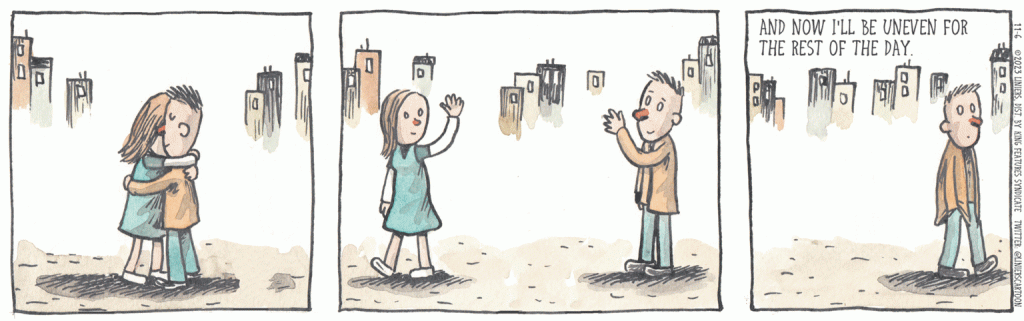
Angel and devil on the shoulders is a familiar setup, but the idea is to have contrasting ideas. Here we have synonymous phrases. I didn’t get the joke and had scheduled it as a CIDU for a later date.
But, here in the US, it’s the weekend where college football conference championship games are played, and the 4 teams who will play for the national championship are picked. Last night at dinner, while our joint grandson opened presents for his 10th birthday, his other grandfather had the Florida State – Louisville game on his phone at the table — and it was only a scoreless first quarter. This made me realize that lots of people are committing all their angels, good and bad, to this sport.

Possibly a translation issue. What’s meant here?
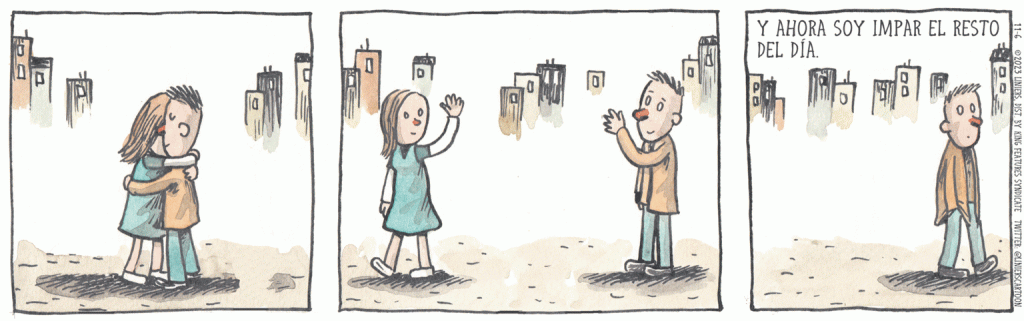
Here’s the Spanish version (thanks, Mitch), in case that helps.
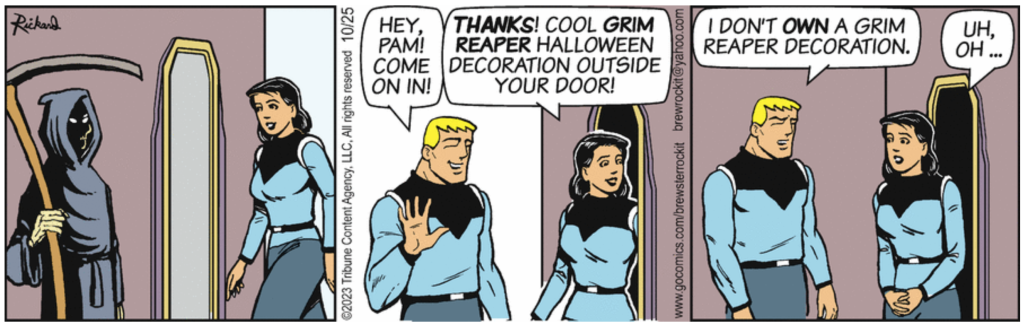
It’s Halloween! It’s one of the set of similar days with very different tones: There’s the Day of the Dead, with reverence for the departed. There’s Halloween, where in theory the evil spirits have power, but has evolved into a chance to meet the neighbor kids, if only briefly. There’s All Saints Day on November 1, a day of celebration. Following that, on November 2, is All Souls Day, which I remember in particular for that scary sequence in the old Latin liturgy:
O wrath, O day of mourning,
O hear the fateful prophet’s warning,
Heaven and earth in ashes burning. …
When the Judge his seat attaineth,
And each hidden deed arraigneth,
Nothing unavenged remaineth.
What shall I, frail man, be pleading?
Who for me be interceding,
When the just are mercy needing? …
The general tone is aptly captured in Verdi’s or Mozart’s Dies Irae, from their Requiem Masses.
Of course, you might also mistranslate “Dies Irae” as “Day of the Iras”, and listen to Ira Glass’s This American Life, or some of those great songs from George and Ira Gershwin. Or not.
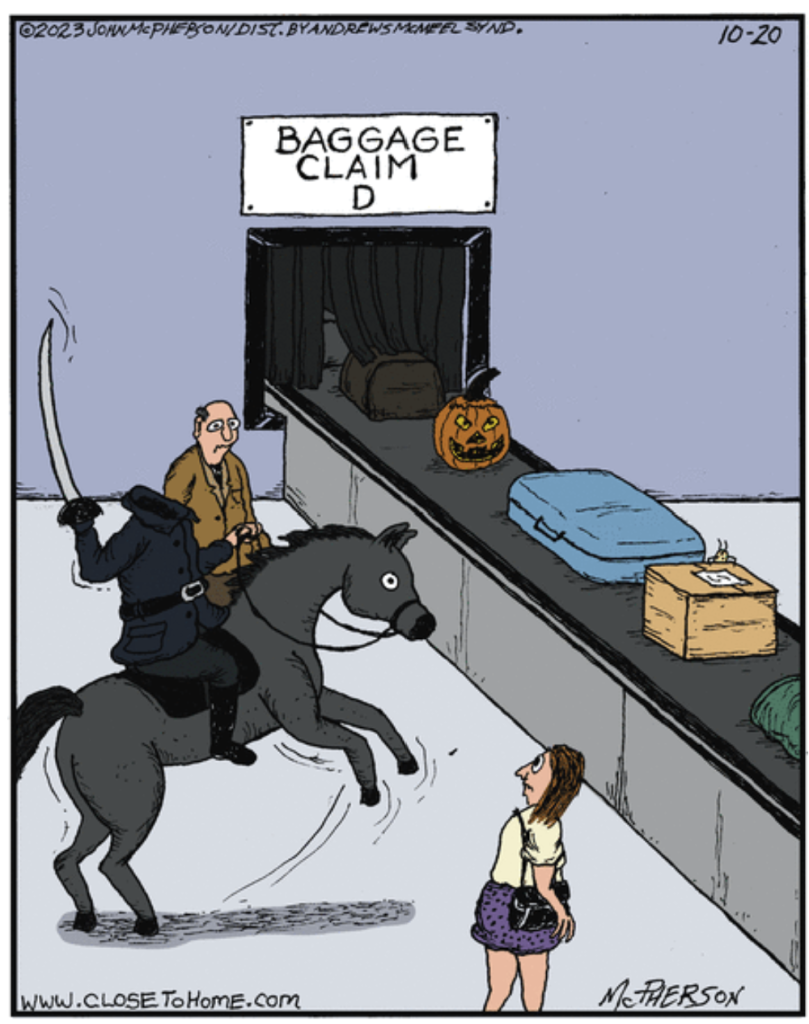
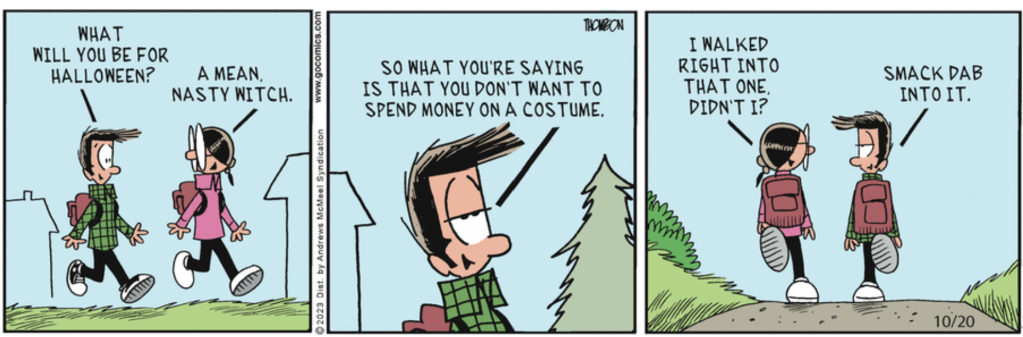
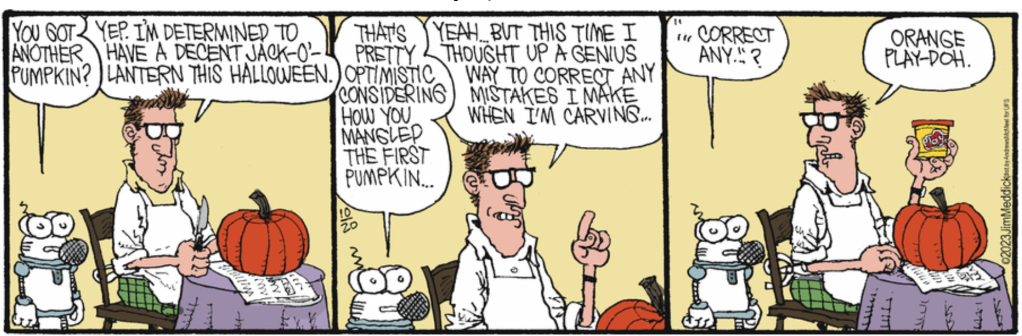

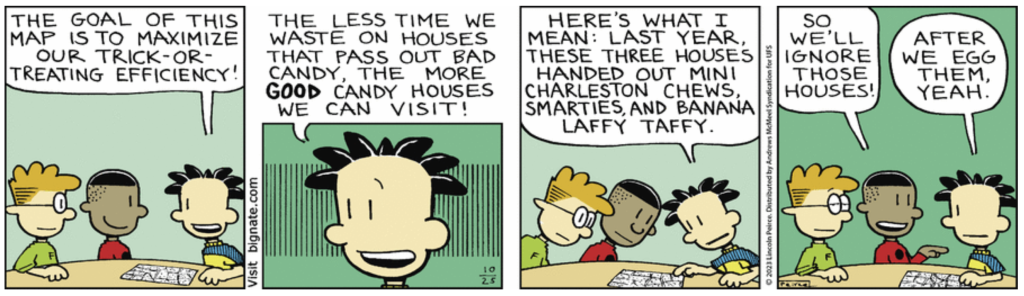
Each year, Caufield dresses up as some character from literature, as padraig reminded us. Guessing the book doesn’t seem too hard, if you are a reader of a certain genre, but which character do you think he’ll be? The correct answer will be in the comic section soon!

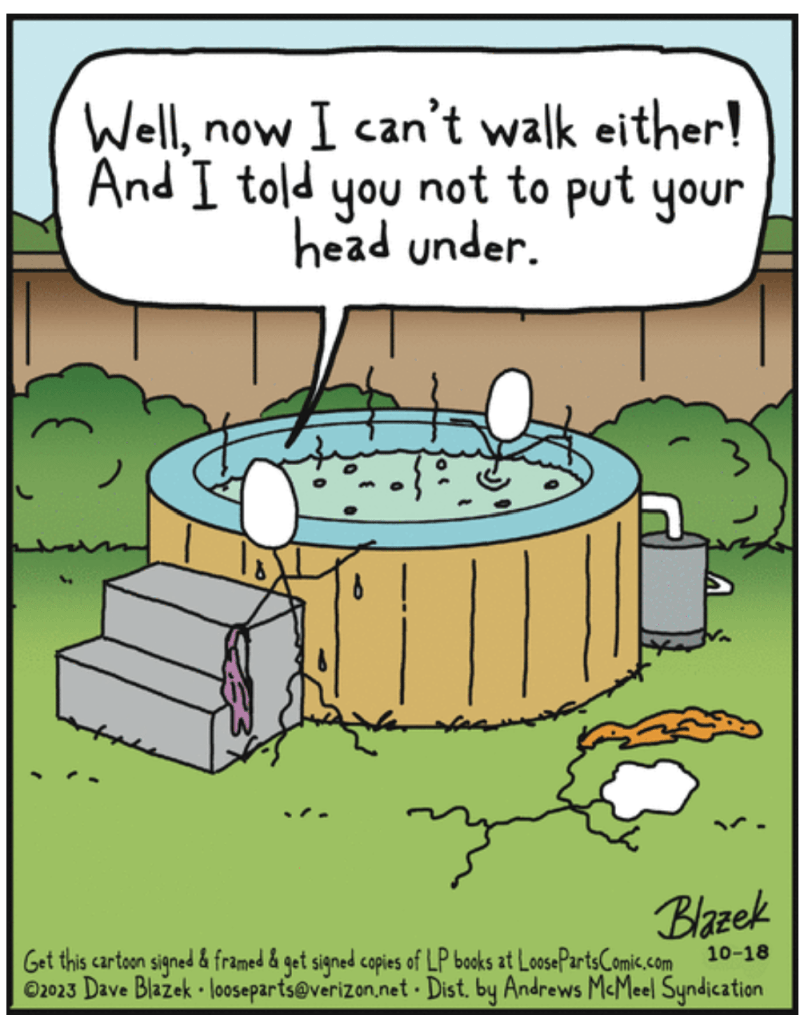
Is this some homage to XKCD? Or to some other cultural reference? Why would stick figures be affected by a hot tub? What’s the problem with putting their heads in? Are those towels?
Boise Ed notes: “Seriously CIDU. We have a man on the shore, watching a diving whale and what looks like a giant, flying Covid virus. Some commenters thought the latter was a mine, slapped by the whale who somehow avoided being blown up.”
Or a small Death Star? High-tech whale watching (or hunting)?

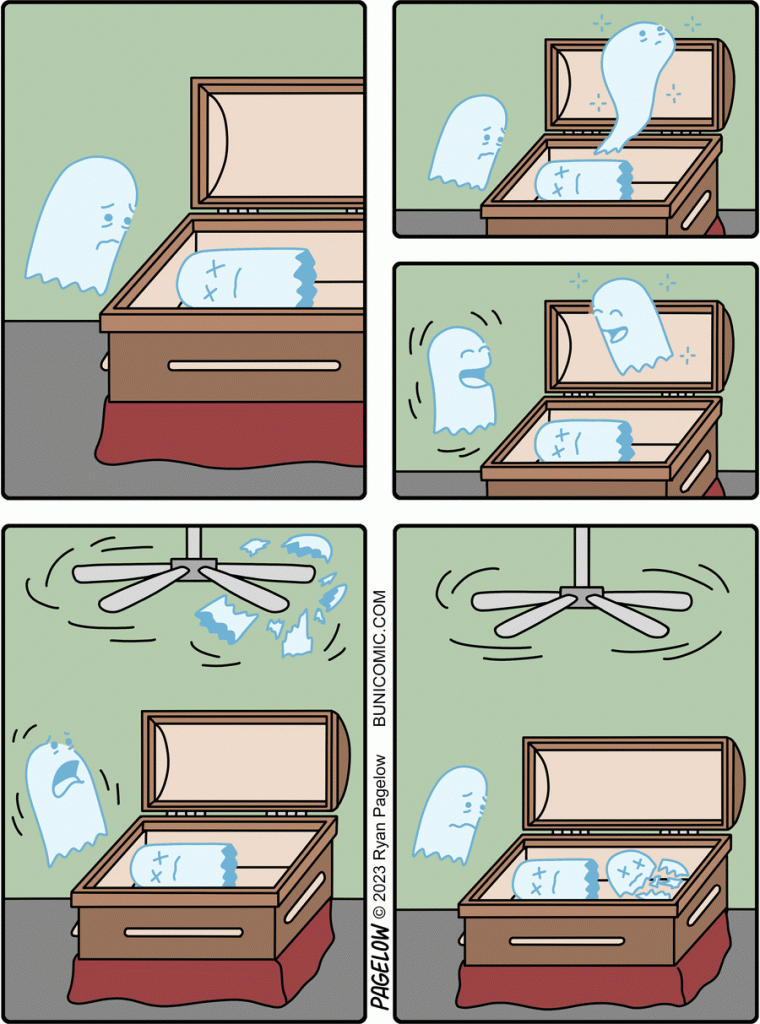
Ghosts can die? Their ghosts have ghosts? The ghosts’ ghosts can be further killed by ceiling fans, even though they are noncorporeal?
Guero sends this one in. “Brad Guigar publishes the (possibly NSFW) web comic Evil-Inc and occasionally pauses the story, posting one panel comics as filler. This is the current comic, and although I am pretty sure it has to do with some icon on some social media, I have no idea what any of it means. I’m sure one of the CIDUers can help. “
For someone, this will be an easy one to explain. Enlighten us!

Syndicate sites like GoComics and ComicsKingdom have a variety of reruns (or, if you prefer, vintage comics). But some of them don’t age well.
These are all old comics which are being repeated. There are certainly a number of old comics that we wouldn’t expect to see now (e.g. the drunken domestic violence played for laughs in old Andy Capp), but I’m limiting this to ones that I’ve currently found being repeated.
Here’s a few examples:

A fire at an asbestos factory (and there are still some) would likely be a major disaster, putting all those asbestos fibers into the air.

Mitch sent in this one, dated 1991. George Burns was indeed long-lived, and continued performing into his very senior years — which is sort of the joke here, saying he might go on into the distant future. But then he did die, in 1996 (at age 100).

Concussions aren’t funny any more.

Hair tonics have historically been marketed as a way to make hair grow faster, but without much evidence. In recent years, there has been a shift towards more evidence-based approaches to hair care, with a focus on products that are supported by scientific research, such as medications like minoxidil and finasteride, which are approved by the FDA for the treatment of hair loss.
 Comics I Don't Understand