It took me a tick with the Andertoons. I parsed the second store as “Only the sons that we will show you.” So what’s up with the others? Then it clicked.
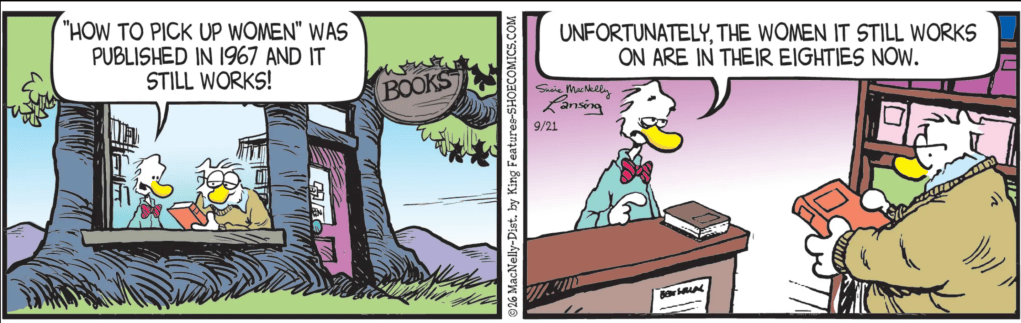
The book was “How to Pick Up Girls”, first publshed in 1970, and it was advertised in the back pages of National Lampoon and other male-oriented magazines. Still have my copy: the 21st printing from 1980, expanded with some new text and stock photos of models. While not as toxic as the later “Pickup Artists” cult (whose disciples I suspect became the original angry incels), it was full of suggestions that even my emotionally-adolescent self recognized as Stupid.
The book’s pitch was that the author claimed to have interviewed Twenty-Five Beautiful Women, who assured him hot chicks in general were open to and usually eager to be picked up by unknown men. The book goes on to suggest you should approach nurses in hospital cafeterias, women in yoga classes, strangers walking the same direction on the street … in fact, any attractive female in any context, because odds are she’s hoping you’ll pick her up.
While the Twenty-Five Beautiful Women and the author go on about how sincerity, confidence, manners, and all-around niceness are more valuable than good looks, the various lines and stratagems lean heavily on falsehoods, comments crafted to force continued conversation, field-tested compliments, etc. Telling a sales clerk you’re choosing a gift for Mom to compel her to talk to you, for example. Also the kind of lines Howard Wolowitz would use in “The Big Bang Theory” (early seasons). But you have to be COMMITTED to picking up girls. Get out there and chase those skirts!
Revisiting this brought back memories. Never had the nerve to apply any of its principles to girls I knew, much less strangers. The nail in the coffin was when a female coworker described a creep trying to chat her up, and I recognized it as a gimmick from the book. Cosmo’s friend notwithstanding, I doubt she’d find it any more enticing today.
It’s now back on the shelf by “How to Succeed in Business Without Really Trying” and “The Complete Upsmanship” (two frankly satirical works framed as advice), “How Not to Write a Play” (Walter Kerr dissecting current theater trends), and “How to Become Extinct” (Will Cuppy’s eccentric humor pieces on animals). “Parkinson’s Law” is not strictly advice, but an entertaining work on business and government bureaucracies, their foibles treated as immutable laws of nature.
Footnote: “The Complete Upsmanship”, a collection of shorter volumes that began with “Gamesmanship” (the art of winning without actually cheating), inspired the original British version of “School for Scoundrels”. Author Stephen Potter embroidered his comically devious ploys as coming from a dubious academic institution, which was nicely realized in the film. “How to Succeed” became a Broadway musical, in which a window washer rises to the executive suite in a few weeks’ time by enacting the book’s examples.
And look, it’s now too late to tackle the drudgery I intended to address right after a brief visit here. Too bad.
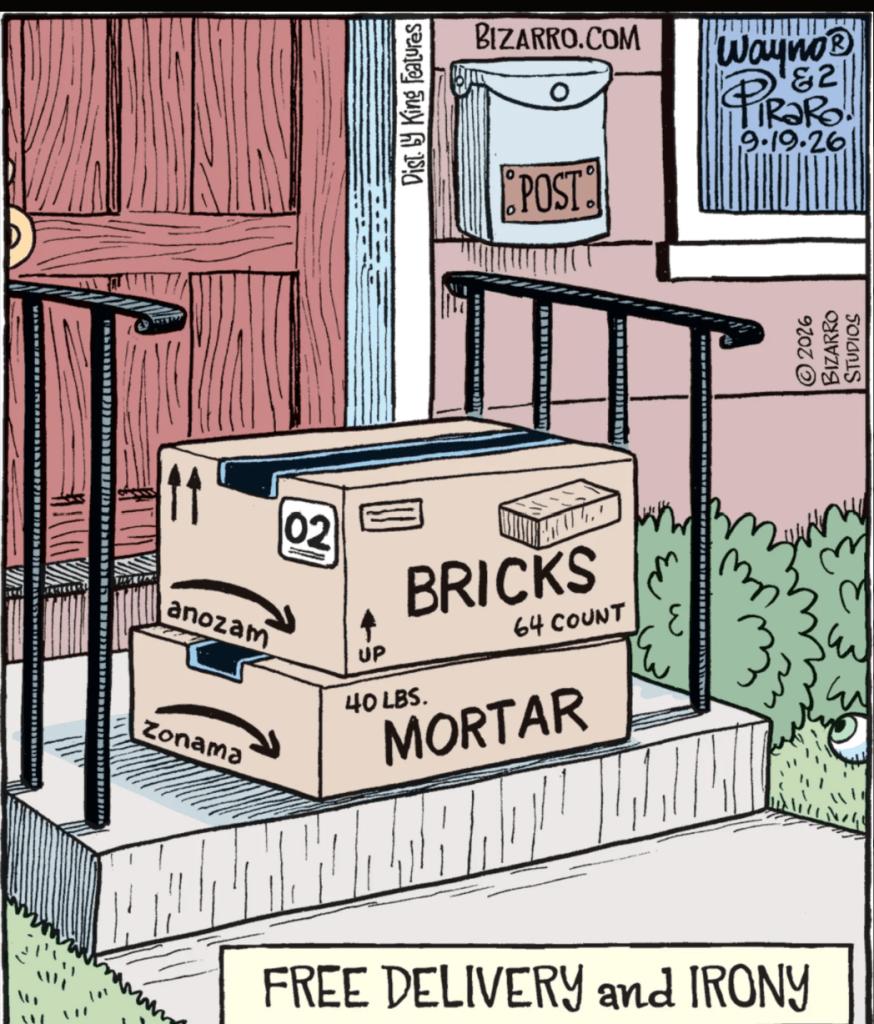
@Wendy, there was for a while (and still could be) a contrast made between “shopping online” and “shopping at a brick-and-mortar store”, where that was a way of saying a real, physical store. Now in this cartoon, it turns out that these pseudo-Amazon stores, though indeed still operating as online shopping outlets, could be counted as “brick and mortar stores”– by virtue of selling bricks and mortar!


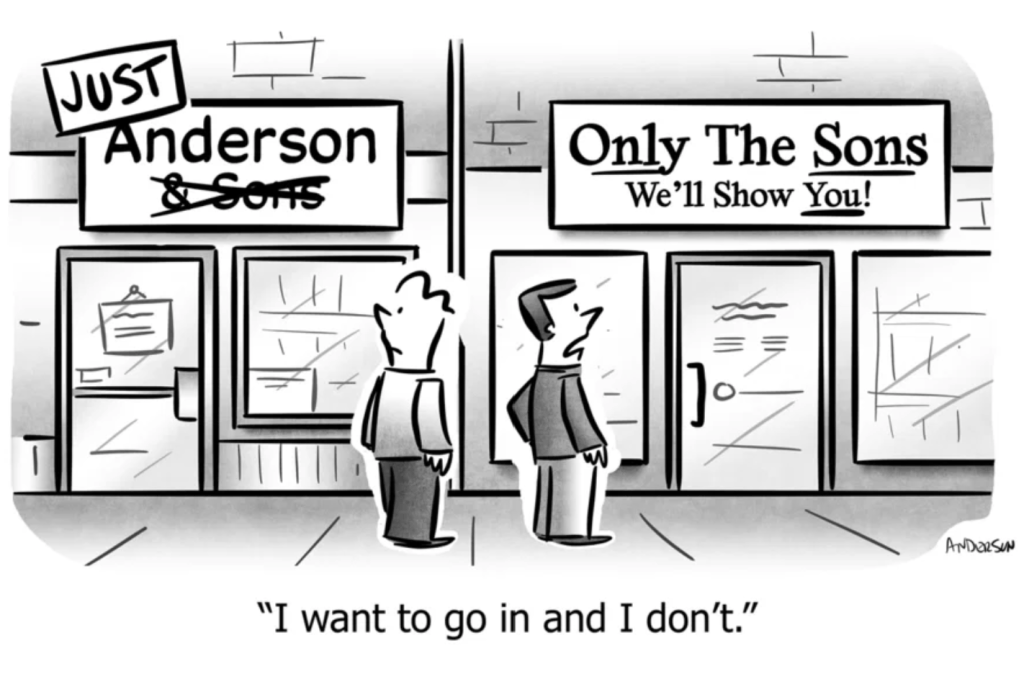


It took me a tick with the Andertoons. I parsed the second store as “Only the sons that we will show you.” So what’s up with the others? Then it clicked.
LikeLiked by 1 person
Re Shoe:
The book was “How to Pick Up Girls”, first publshed in 1970, and it was advertised in the back pages of National Lampoon and other male-oriented magazines. Still have my copy: the 21st printing from 1980, expanded with some new text and stock photos of models. While not as toxic as the later “Pickup Artists” cult (whose disciples I suspect became the original angry incels), it was full of suggestions that even my emotionally-adolescent self recognized as Stupid.
The book’s pitch was that the author claimed to have interviewed Twenty-Five Beautiful Women, who assured him hot chicks in general were open to and usually eager to be picked up by unknown men. The book goes on to suggest you should approach nurses in hospital cafeterias, women in yoga classes, strangers walking the same direction on the street … in fact, any attractive female in any context, because odds are she’s hoping you’ll pick her up.
While the Twenty-Five Beautiful Women and the author go on about how sincerity, confidence, manners, and all-around niceness are more valuable than good looks, the various lines and stratagems lean heavily on falsehoods, comments crafted to force continued conversation, field-tested compliments, etc. Telling a sales clerk you’re choosing a gift for Mom to compel her to talk to you, for example. Also the kind of lines Howard Wolowitz would use in “The Big Bang Theory” (early seasons). But you have to be COMMITTED to picking up girls. Get out there and chase those skirts!
Revisiting this brought back memories. Never had the nerve to apply any of its principles to girls I knew, much less strangers. The nail in the coffin was when a female coworker described a creep trying to chat her up, and I recognized it as a gimmick from the book. Cosmo’s friend notwithstanding, I doubt she’d find it any more enticing today.
It’s now back on the shelf by “How to Succeed in Business Without Really Trying” and “The Complete Upsmanship” (two frankly satirical works framed as advice), “How Not to Write a Play” (Walter Kerr dissecting current theater trends), and “How to Become Extinct” (Will Cuppy’s eccentric humor pieces on animals). “Parkinson’s Law” is not strictly advice, but an entertaining work on business and government bureaucracies, their foibles treated as immutable laws of nature.
Footnote: “The Complete Upsmanship”, a collection of shorter volumes that began with “Gamesmanship” (the art of winning without actually cheating), inspired the original British version of “School for Scoundrels”. Author Stephen Potter embroidered his comically devious ploys as coming from a dubious academic institution, which was nicely realized in the film. “How to Succeed” became a Broadway musical, in which a window washer rises to the executive suite in a few weeks’ time by enacting the book’s examples.
And look, it’s now too late to tackle the drudgery I intended to address right after a brief visit here. Too bad.
LikeLiked by 1 person
I also spent an extra moment of puzzlement, over why Anderson was using his own name in the comic.
LikeLike
I don’t get why the Bricks & Mortar comic is funny.
LikeLike
@Wendy, there was for a while (and still could be) a contrast made between “shopping online” and “shopping at a brick-and-mortar store”, where that was a way of saying a real, physical store. Now in this cartoon, it turns out that these pseudo-Amazon stores, though indeed still operating as online shopping outlets, could be counted as “brick and mortar stores”– by virtue of selling bricks and mortar!
LikeLike