Jack Applin wants to make us think, aided by these two comics that ran the same day: “I’m certainly inconsistent when I try to separate the artist from their art. I can no longer watch one actor for his stance in vaccination, and yet I enjoy the music of another performer despite his dubious actions concerning minors.”
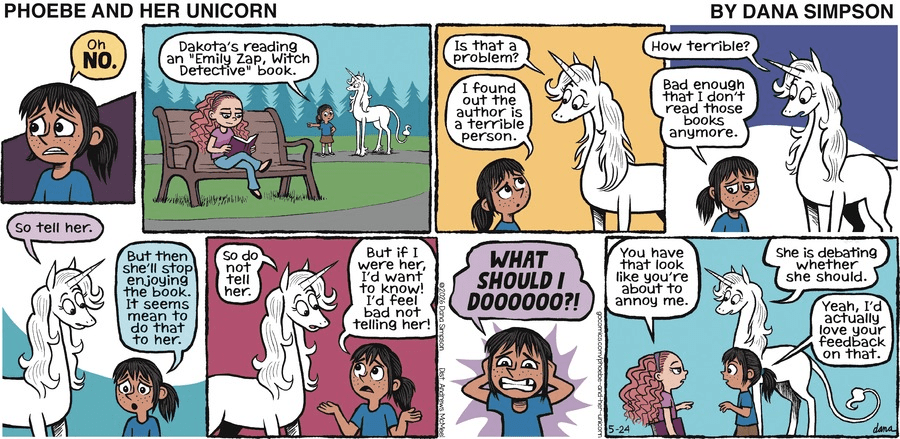
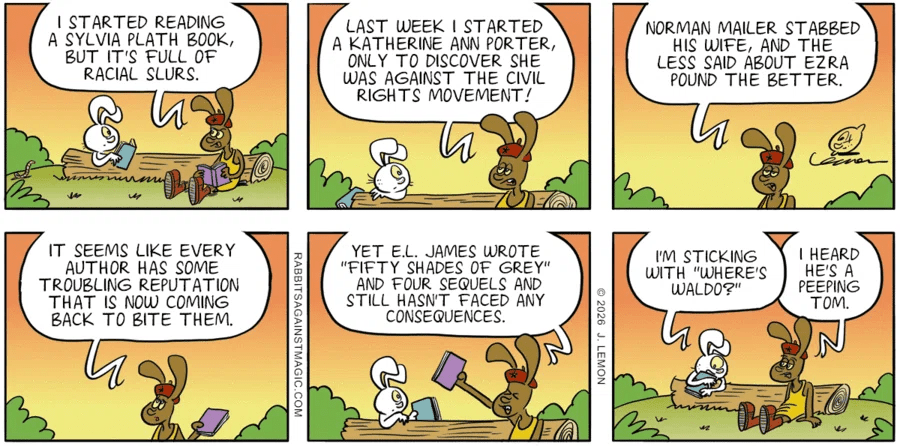


Almost every artist, author or musician throughout history has some aspect in their lives that we would find unacceptable today. It’s best to ignore the biography and enjoy the work on its own. IMHO.
LikeLike
I think there’s a bit of difference between historical, classic authors and current ones.
With the classic, DEAD, authors, their stories have already stood the test of time, and discussion of their lives and beliefs are part of the study of literature.
Current authors… why should I pay money to a person professing prejudices I don’t agree with? Not the prejudices some of their CHARACTERS believe, but the ones they PERSONALLY present.
LikeLike
A good reminder to get my Waldo/Wally books out of the storage closet, my kid might like them.
Also, I’ve never heard a cross word about Martin Handford or Waldo. Maybe the brown rabbit is thinking of Odlaw?
LikeLike
I think that last panel about Waldo is likely just a joke.
LikeLike
Another difference between dead authors and live authors is that live authors can keep using your money to promote their horrible causes. Someone still gets money when the author is dead, but not a lot of dead authors had wills that require their estates continue bigoted crusades.
LikeLike
Another thing about dead authors is that they can’t change their minds now. A writer who was racist or sexist might well have had different attitudes had they been born in 1960 instead of 1810. (And, conversely, many of us might have had different attitudes had we been born in an earlier age.)
LikeLiked by 1 person
My Actual Real Name makes a good point. Compare, for example, the evolution of Mark Twain’s writing during his lifetime, from the early days as a Confederate soldier in a slave state to the much different attitude in his later writing, influenced heavily by his wife’s family.
LikeLike
I think the last panel is more of an observation that some reputations are definitively true while others might be the product of gossip. I’m guessing the number of famous people that haven’t had a vicious rumor spread about them could be counted on one well mutilated hand.
LikeLiked by 1 person
I may be blind as she is my favorite author – but what can be said bad about Louisa May Alcott?
LikeLiked by 1 person
In one of those synchronicity events, someone in comments for Breaking Cat News today mentioned that Ms. Alcott wrote a slice-of-life short story about a fly that lived with her for a time. The name of the fly and the story was “Buzz”.
LikeLiked by 1 person
Google AI (usual caveats) sez:
Critics of Louisa May Alcott often point to her reliance on writing “moral pap” for profit, controversial depictions of Irish immigrants, and her own complicated, somewhat subversive relationships with traditional 19th-century domesticity and marriage.
While remembered today for her empowering female characters, she has drawn criticism across a few main areas:
Writing for Money Over Art: Alcott frequently expressed a disdain for the wholesome children’s books (like Little Women) that made her famous, stating she only wrote them because “it pays well” to support her destitute family. She preferred writing scandalous “blood-and-thunder” pulp fiction under the pseudonym A.M. Barnard.
Depictions of Immigrants: In her non-fiction and private journals, Alcott exhibited prejudices common to her era. She notably expressed anti-Irish sentiments, including endorsing discriminatory “No Irish Need Apply” attitudes when looking for domestic help.
Controversial Endings: Many modern feminists and readers are critical of her famous endings. Despite championing independent, tomboyish women, she bowed to societal and publisher pressures and forced her character Jo March to marry an older man (Professor Bhaer) and essentially quit writing.
Perceived Bigotry or Conformity in Literature: Some modern critics argue that her classic works project a rigid, elitist form of Christianity and pander to 19th-century societal expectations of marriage, rather than truly embracing the progressive views some fans attribute to her
LikeLiked by 1 person
She also did extensive work with immigrants and others of “lower the social classes”.
She was writing to sell the books she wrote more than anything. She is, of course Jo March – same as Jo the books she wrote which might not be to her thinking/likes paid for the family’s expenses. In addition to the March family books she wrote other books and not all were fiction.
She was woman in a time when women were suppose to marry, have children, and obey their husbands – but never did any of same. She never married to keep her income to herself. The original “Little Women” was what is now referred in the current publications as the first book or part and there is a second one which was written separately now second book or part – there are still some instances where the 2 books are published separately. Same as Jo she was the support of the family with her writing. In one instance Jo is talking to the (rich) boy next door and he does not like that she is writing what is called today pulp fiction and she get upset with him – such and such a book for paid for this repair to their home and that one paid for … and so on. This is basically why Louisa herself was writing the romantic girls’ books in addition to her more intellectual books which were what she was interested in writing.
And I always tell my poor husband that he knows more about LMA and her books than any male needs to know. He has taken me numerous times to her home in MA (when we used to travel before Covid). I had been to her home there with my parents when I was a girl, and several times he took me there when we were in the general area on trips, so he probably knows as much her and her family as I do. –
LikeLiked by 1 person
Bronson Alcott (Louisa’s father) is practically mythological in the Eastern Massachusetts area. He hung out with Hawthorn and Emerson and Thoreau and Margaret Fuller, and he and his family have their own movement in Charles Ives’ “Piano Sonata No. 2, Concord, Mass. 1840-1860.”
LikeLike
The family (at least on her father’s side – the Alcotts) has been here since mid 1600s. A family ancestor was a judge in the Salem Witch trials.
I have been to the family home, Orchard House – as a girl with my parents and then with my husband on numerous trips to Concord since the 1960s. I remember also going to another home or two of the family with husband, but that was around 50 years ago and I forget the name(s).
Right now I am at our kitchen table (as I normally when I come online) which is next to our craft studio. A bookcase just inside of same holds extra books which did not fit in our home office upstairs (3 partial walls of bookcases still can only hold so many books). I just got up and looked out of curiosity The oldest copy of one of her books I have was printed in the 1880s, with a copyright date in the 1870s. (This book picked out at random based on how old it looked compared to others printed in the general period.) There are 2 shelves of her books – stacked to fill the space and 2 deep on the shelves.
LikeLiked by 1 person