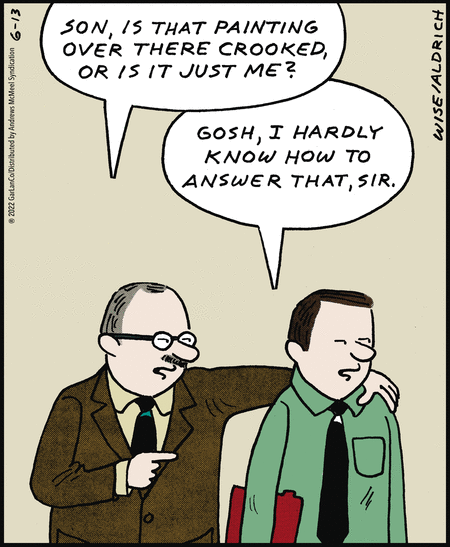
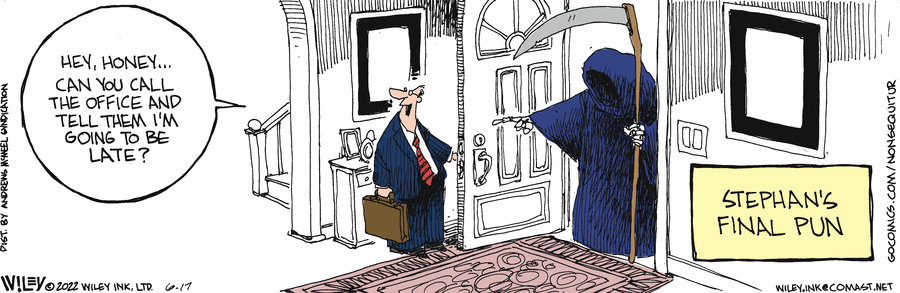
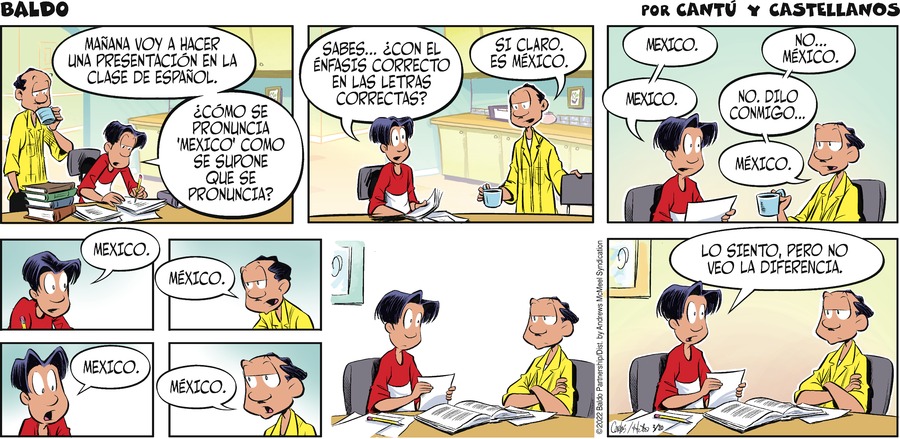
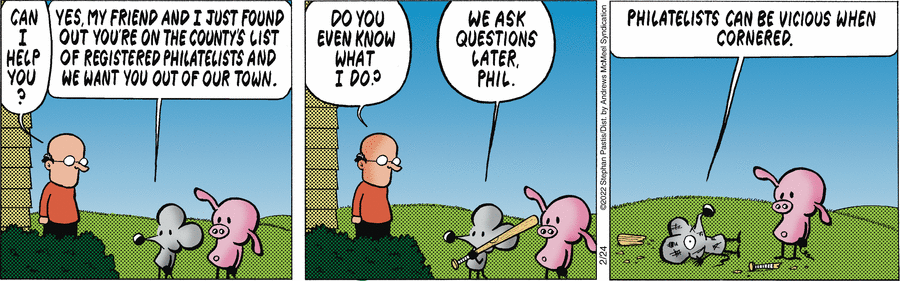
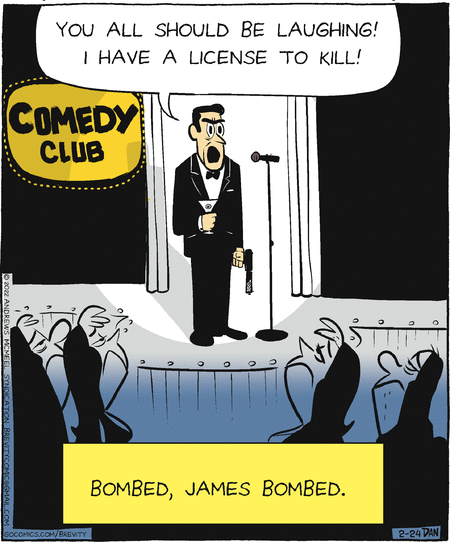
What is the joke in this one? ¿Cuál es el chiste en este?

And what is the joke in this version? ¿Y cuál es el chiste en esta versión?

Are they the same joke? Why not ? :-) ¿Son el mismo chiste? Por qué no ? :-)
What is the joke in this one? ¿Cuál es el chiste en este?

And what is the joke in this version? ¿Y cuál es el chiste en esta versión?

Are they the same joke? Why not ? :-) ¿Son el mismo chiste? Por qué no ? :-)
Thanks to Usual John for sending this in, and for useful email discussion! His focus is on the bottom strip, where we get amusing literalized visions of some common idiomatic expressions. Except — we apparently no longer have an idiom to match “He had a pony on his cuff”. So, what would that mean, apart from what’s in the literal illustration?

By the way, can anyone assist my memory and give me a clue why I remembered this Origins of the Sunday Comics feature as not always in the past being a genuine historical exploration, but rather including sometimes a parodic or fictive-history take? Maybe mental contamination from reading a sometime series of posts in Working Daze, pretending to trace a century-long history of that strip, thru different writers and artists, and even titles and publishers.
Back in last November, in this “OY collection” post, we discussed a Baldo strip and the matching Baldo en Español where an element of the joke doesn’t come thru in the Spanish version, and combined this observation with other instances, as well as “About” tab type info and external sources, to agree that the strip seems usually to have been first written in English, then translated for the Spanish version.
(In that November post, if you feel like scrolling back, there was also a fun digression stemming from a different comic, on a style of word-play puzzle called by some “Dingbats”, a sort of text-layout rebus.)
In March, Arnold Zwicky’s Blog discussed a related example, with the same conclusion, where the English Baldo was about English language spelling and pronunciation (just pointing out that tough, cough, and dough give different sounds to the -ough sequence of letters) and the Baldo en Español just used the Spanish translations of those words, which really don’t resemble each other in any special way, certainly not rhyming. Zwicky also brought up some possibilities on how the Spanish version could have been handled. (And yes, that’s me popping into the comments.)
.
Now lookit what just showed up on GoComics!


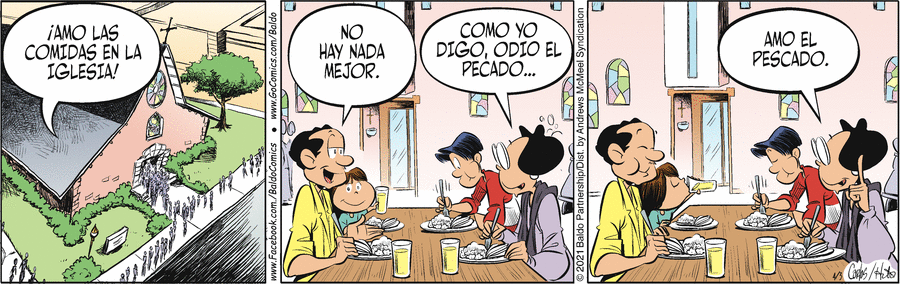
All the Spanish that you really need to know here is that pecado indeed means sin, and pescado means fish (as food).
In the English version, Tía Carmen’s jest is to turn the saying “Hate the sin but love the sinner” into “… love the dinner”. In Spanish she says “… love the fish [we are eating]” which is basically the same idea, but manages to preserve the word-play element because of the resemblance of pecado and pescado.
B.A.: This might be the worst place to ask this, but… would you say it’s acceptable to use “à chacun son goût” when writing for a reasonably well-educated English speaking audience?
It occurred to me (possibly because I’ve been home too long with no real end in sight) that people use “i.e.” in spoken discussion but rarely if ever “e.g.” Does this seem accurate?
Is it too much to expect that if a reporter for a major American newspaper doesn’t know the difference between “bearing responsibility” and “baring responsibility,” his editor will catch the error?
Or at the very least, that the online version would be corrected within the first 24 hours?
I think this story is sufficiently comic strip-related

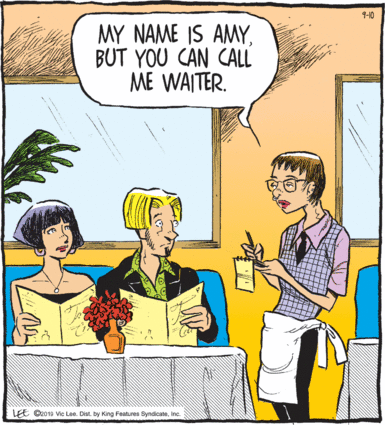
She wants to be called “waiter” because she doesn’t like “waitress?” Or “Amy”?
Or is the joke that this is the opposite of what a waitress might say, which still doesn’t explain “waiter”?
Related to the fact she’s wearing a tie?
Clearly I got nothing.
But while we’re on the topic…
A couple of weeks ago, while going through a photo album/scrapbook nobody had seen in decades, I came across a 1970 newspaper ad mentioning an appearance by an authoress.
How quaint.
I mentioned this to two of my cousins. One of them, a male, basically said “that’s what they’re called, isn’t it?” Well, not really since Jane Austen.
The other cousin, who is an authoress, said she’d never been called that in her life, but… she didn’t think she’d be offended or anything. Probably.
And that got me thinking about the trend lately to refer to actresses as actors. Which is all very well, but what happens when you have to give out awards? “This year’s Oscar for Best Actor With XX Chromosomes goes to…”
And that got me thinking… how many words with the -ess suffix are still in common use? Stewardesses are flight attendants now. Waitresses… I guess we’ll have to call them “Amy” until a good word for a member of the waitstaff gains acceptance.
“Seductress” remains on the board, because it’s an inherently gender-specific job (likewise “temptress,” but how often do we really hear either?)
I suppose 50 years from now “wife” and “widow” might fall by the wayside, but for right now… how many words with the -ess suffix are still in common use?
When did this trend of pluralizing words by adding a gratuitous apostrophe before the s begin? I don’t remember seeing this before a few years ago, and now it’s all over the place. Certainly nobody ever learned this in school.
English is a very tough language to learn. Just about THE ONLY THING THAT’S EASY is being able to pluralize most words by adding an s.