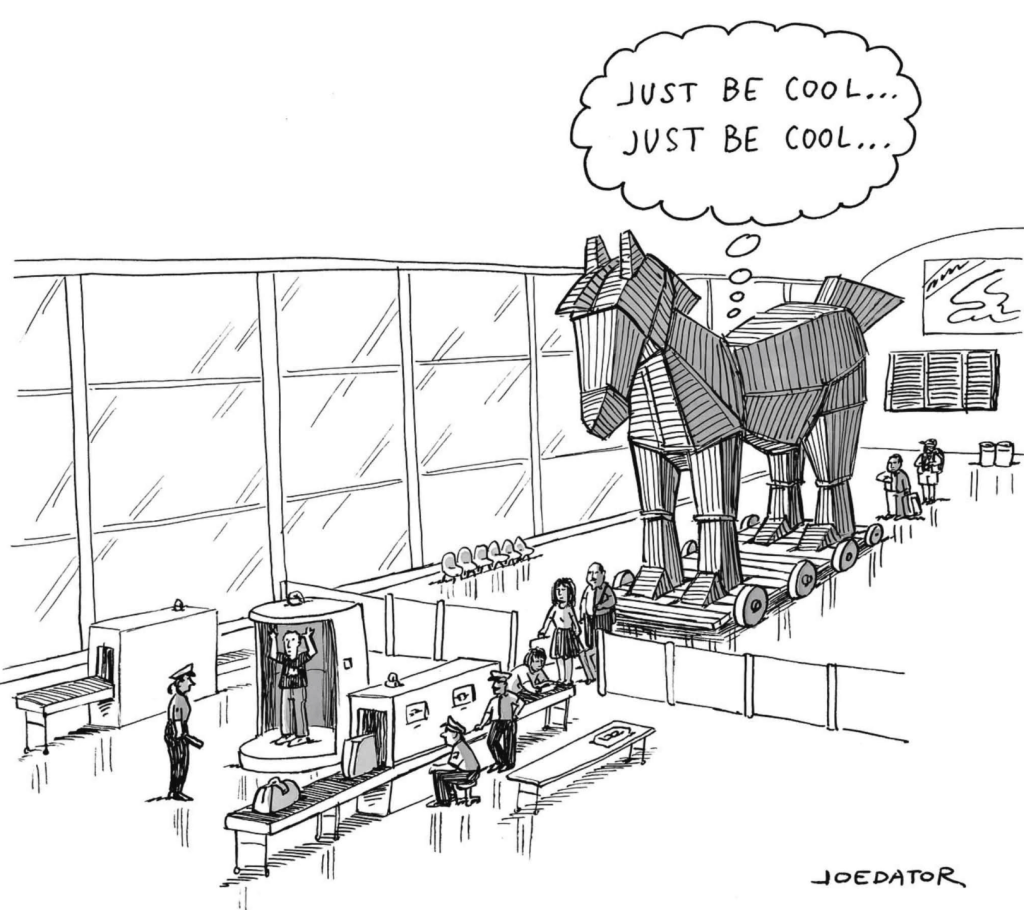
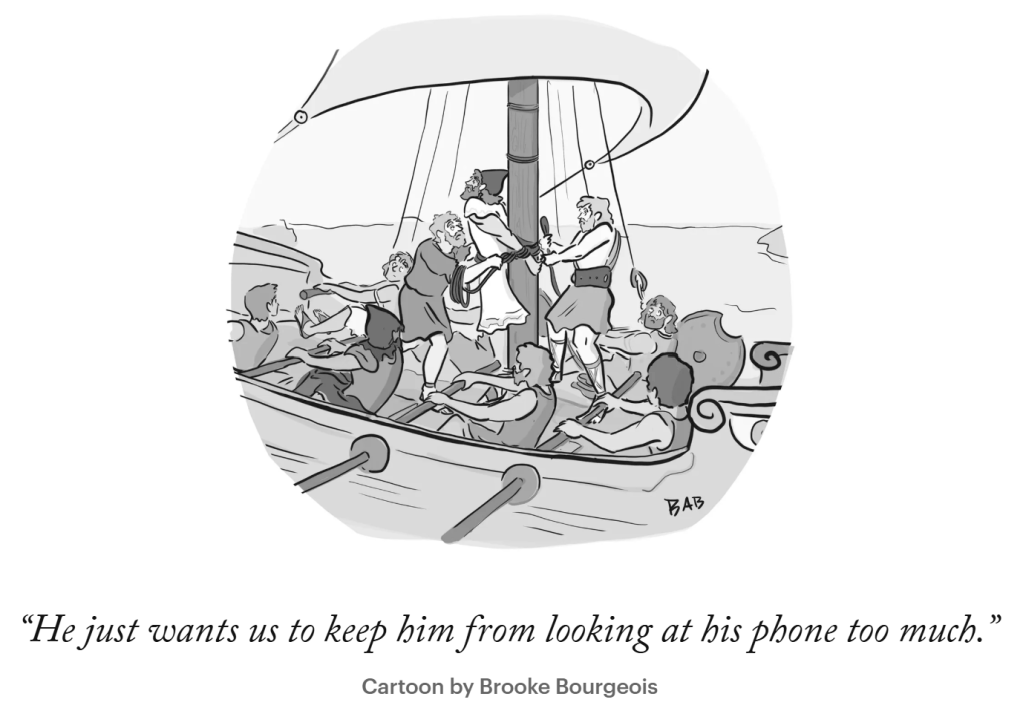
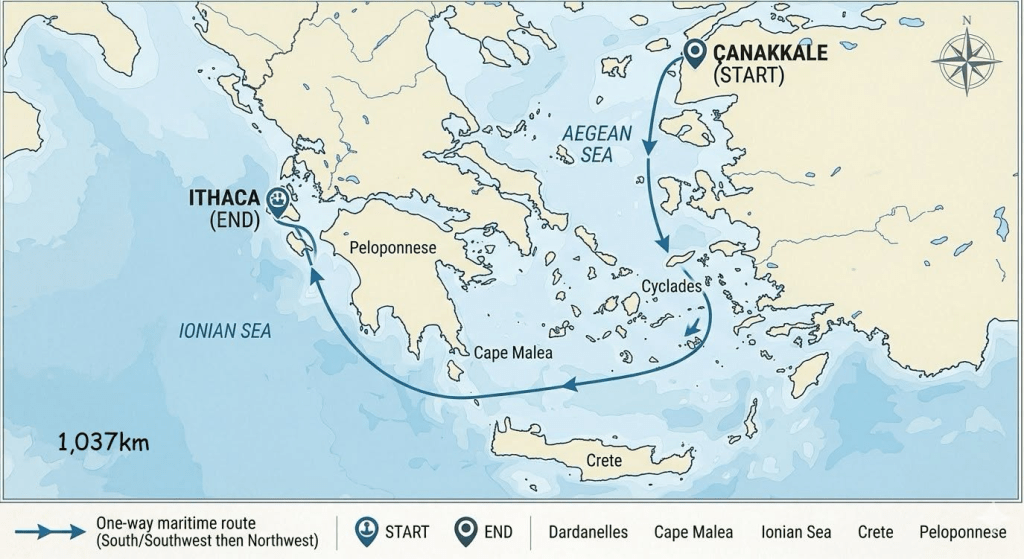
The distance from Troy (near modern Çanakkale, Turkey) to Ithaca is a bit over 600 miles. At a rowing speed of 4 to 5 knots, that’s not a terribly long journey, without the involvement of the gods.
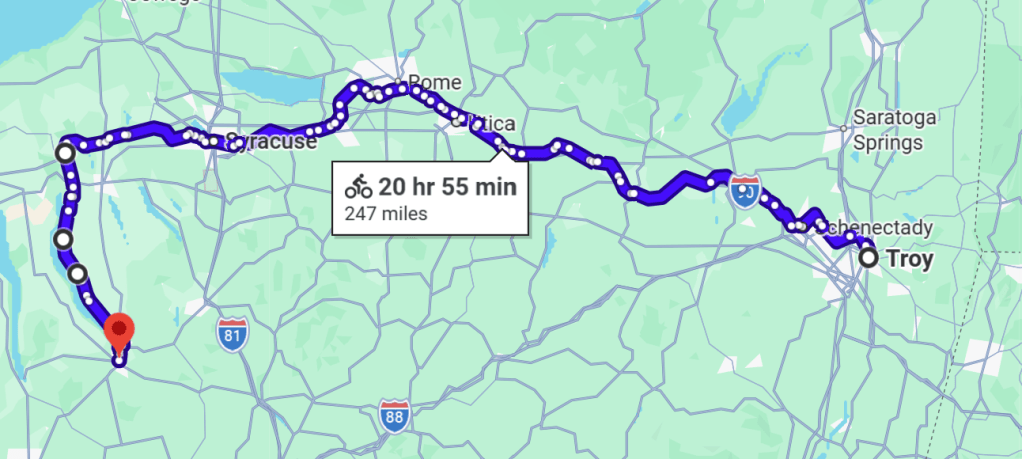
If we went from Troy, New York to Ithaca, New York by water (Erie Canal, then portage to Seneca Lake) it would be about 250 miles — shorter, but the same order of magnitude.
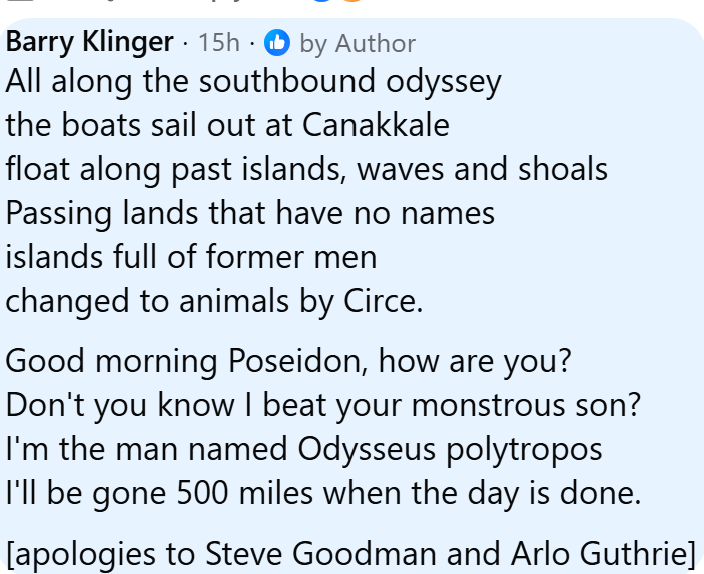
One person decided to use the modern Turkish city and make up alternative lyrics to City of New Orleans.
I just finished re-reading the Odyssey. I used the Samuel Butler translation, which is prose and emphasized the story more easily because it abandons any attempt at poetry. I’m also cheap: it’s available for free at Project Gutenberg.
Yesterday, I saw the movie, which didn’t disappoint. Highly recommended. Of course, there are many plot points which diverge from Homer, but overall I think that improves the flow — especially the ending.


You don’t need to portage between the Erie Canal and Cayuga Lake (not Seneca; Cornell’s alma mater is “Far Above Cayuga’s Waters”). You can make the entire trip from Troy to Ithaca in the water. The Cayuga-Seneca Canal connects Seneca and Cayuga Lakes to the Erie Canal.
LikeLike
Your bicycle odyssey seems about as #&@%ed up as Odysseus’, going through Rome and then Syracuse (to say nothing of Schenectady!) In fact, wasn’t that the Aeneid?
LikeLike
Powers, does that mean that Elon Musk’s promised “historically accurate” film version of The Odyssey will be shot on location in New York State?
LikeLike
See Margaret Atwood’s “The Penelopiad” if ever it is staged in your area.
LikeLike
The odd thing about the Samuel Butler translation is he uses the Roman names for the gods: Jupiter, Minerva, etc. I suppose if you’ve read Virgil and Ovid you’re used to the Roman names, but I found it confusing when I read the Butler translation as a kid.
LikeLike
The thing about Greek poetry is that it doesn’t look, feel or sound like poetry. It doesn’t always have regular meter, and it doesn’t have rhymes at the ends of lines, although there can be internal rhymes. It’s hard to tell if a given passage is poetry or prose. A teacher of mine gave this rule of thumb: If it makes sense, it’s prose. If it doesn’t make sense, it’s poetry.
LikeLike
@Mark: Several translators used Roman terms for the gods and the main character, rather than Greek. Alexander Pope’s translation (also on Project Gutenberg) uses Minerva rather than Athena, Ulysses instead of Odysseus. So does William Cullen Bryant’s, and William Cowper’s. I don’t really understand why. They seem to leave Telemachus as Telemachus, Agamemnon as Agamemnon, etc.
I did find this a bit jarring at first, but after a Herculean effort I got used to it.
LikeLike