

Grawlix has shared as a CIHS (Comic I Haven’t Seen) this instance, called “What’s New?”, from the strip Poorly Drawn Lines by Reza Farazmand. Grawlix sees them from time to time on Facebook, but the strip also has a website; and warns that “It does contain NSFW language from time to time, unfortunately.” Oh, and we have been unable to establish connections with musician Badly Drawn Boy.


But, another county heard from…

Not quite a CIHS, but truth to tell I’ve been looking at it rather inattentively for a while. This one made me stop, and wonder about the apparent mésalliance. Well, a little rewinding, and checking the “About” blurb, informs us that Little Pig #3’s Girlfriend is Wolfette, and is sister to the actual Big Bad Wolf — who in this retelling is still pretty bad.
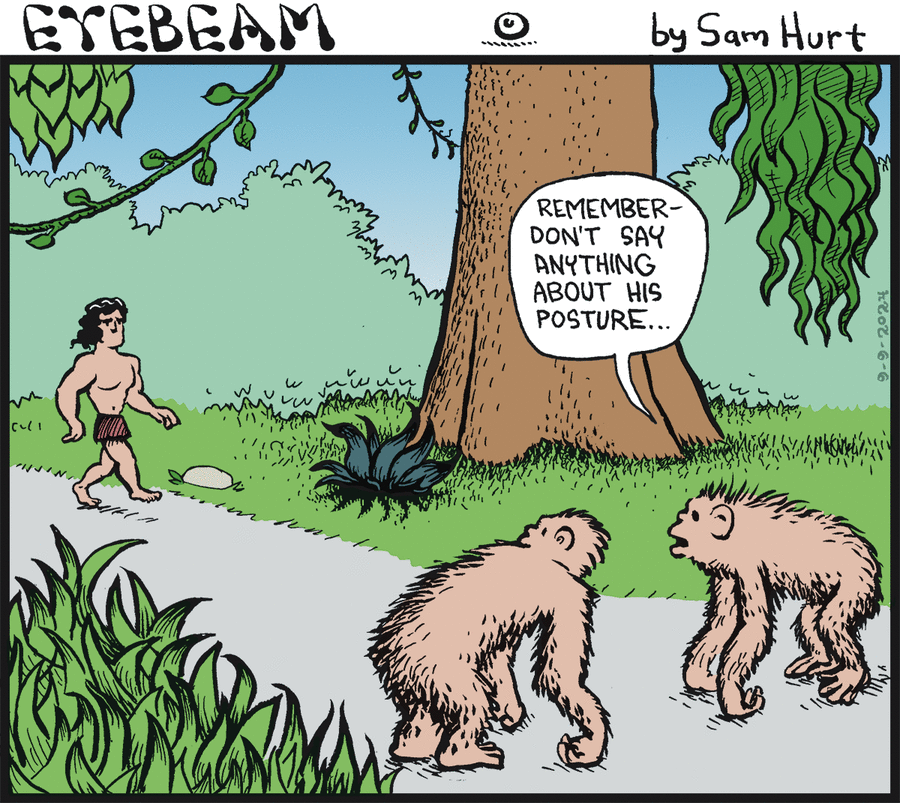
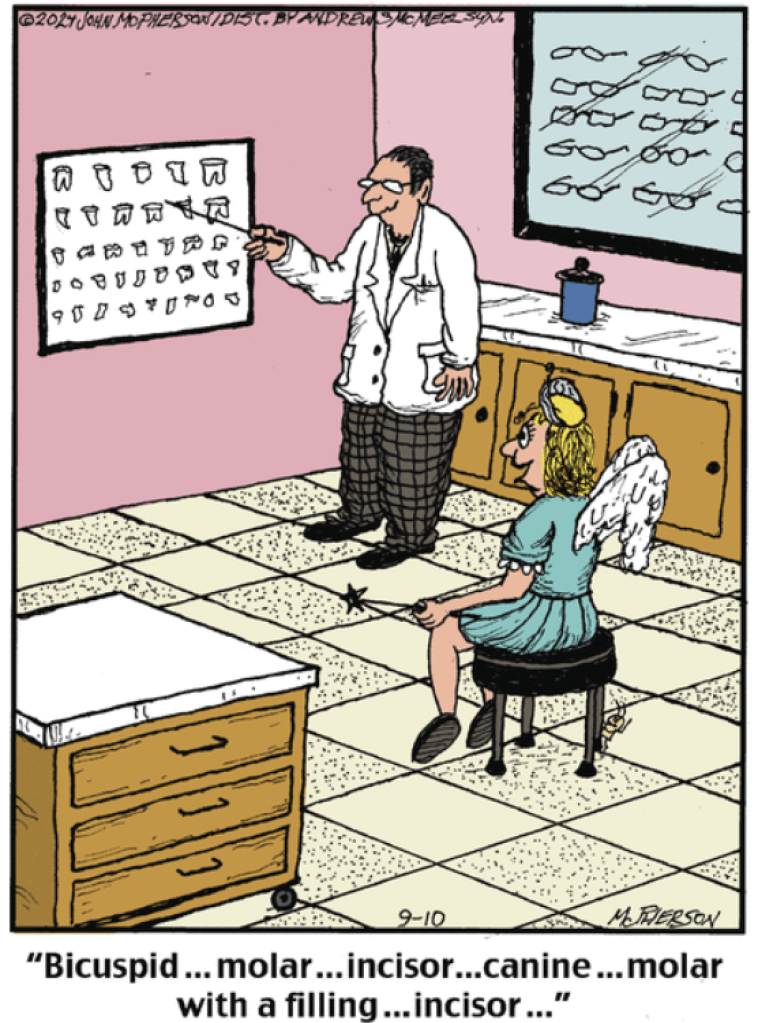
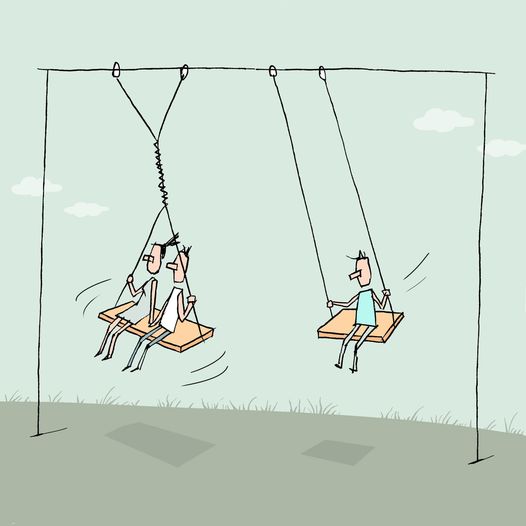
Useful among the online comments — “Relationship Status: It’s Complicated”
 Comics I Don't Understand
Pretty good job of drawing an Escher stairs, but of course not up to the master’s level
I was looking for the “What’s new” joke to be a physics or other science thing, where you give a response appropriate to “nu”.
Danny, but then you would have seen it yesterday :-)
Or the larger animal could have been a wildebeest instead of a bear, but that too would have material for Saturday‘s “OYs”.
P.S. @ Dana Kay (1) – The divisions of the steps along each side of the staircase make it more likely that the artist used the Penrose stairs as a template, rather than Escher’s version.
Aha, yes it is exactly that Penrose stairway! But an Escher reference is still in the picture – literally, as the name on the mailbox.
Poorly Drawn Lines got an animated show for one season. Usually cartoons based on comic strips are terrible, but PDL’s was mediocre. Great strip, though.
Escher got the idea of the stairs from Lionel and Roger Penrose – ‘Escher was captivated by the endless stairs and subsequently wrote a letter to the Penroses in April 1960: “A few months ago, a friend of mine sent me a photocopy of your article… Your figures 3 and 4, the ‘continuous flight of steps’, were entirely new to me, and I was so taken by the idea that they recently inspired me to produce a new picture”‘ https://en.wikipedia.org/wiki/Penrose_stairs
That same wiki article says the impossible staircase was originally created by Swedish artist Oscar Reutersvärd in 1937 and was later independently discovered and made popular by the Penroses (and Escher).
What’s new?
E/h
That’s what’s “ν“.
Is there a way the Editor could number each comic, as they aren’t identified?
The comic under the caption “But another country heard from” could go with this New Yorker one .
https://condenaststore.com/featured/todd-unloaded-the-dishwasher-jeremy-nguyen.html
https://poorlydrawnlines.com/comic/my-own-way/
Escher was indeed influenced by Penrose, and featured an endless staircase in his lithograph “Ascending and Descending”.
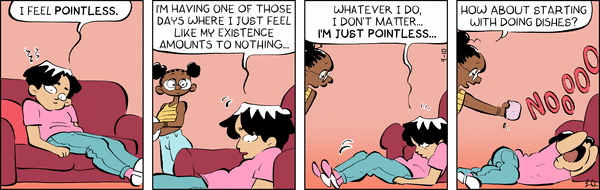
@ Grawlix (9) – Numbering the comics would be a pain (because the entire sequence would have to be adjusted whenever a comic is inserted or deleted). However, it might be worthwhile considering including a name for those strips that do not include a title or an identifiable signature. The one you referred to is “Wannabe” (I would have called it “the pastel dishwasher strip”, or “the strip after Bliss”). The “pointless” character is Andy, but I can’t resist at least mentioning Nilsson’s “Oblio”.
P.S. The dishwasher comic you linked to at Conde Nast appeared in the Sunday Funnies two weeks ago:
…
P.P.S. The first thing I did when I saw the latter comic was show it to both of my kids, who frequently grumble when I give them dishwasher duty.
@Nebu, yeah, that “E / h” is indeed the most commonly encountered science-flavored response to “What’s new?” (re-heard as “What’s nu?”).
Also, but not in the same science-nerdy category (instead, sociocultural-nerdy), there is the Yiddish interjection “Nu”, usually spelled that same way, and used as a sentence-introductory “Well,….” or a standalone questioning “Well??”. However, it’s hard to see how to make that definition stand in as joke answer to a sincere/perfunctory “What’s new?”
@ Mitch (12) – There’s are possible cognates to that Yiddish word in standard German: “Nu” could be translated as “now”, but is used only in the expression “im Nu”, which means “right away”, or “instantaneously”; In the Saxon and related German dialects there’s also a lowercase “nu”, which is a particle meaning “yes”, or to signal agreement.
@ Mitch – My husband recently started teaching himself Pennsylvania Dutch from a website which is set up to do so. He will come down and say the word he just learned and ask me what I think it means. Between my rudimentary Yiddish and my rudimentary German I can usual tell him what it means.