

Just BTW, does “aggro” in casual speech these days mean aggressive or aggravating?
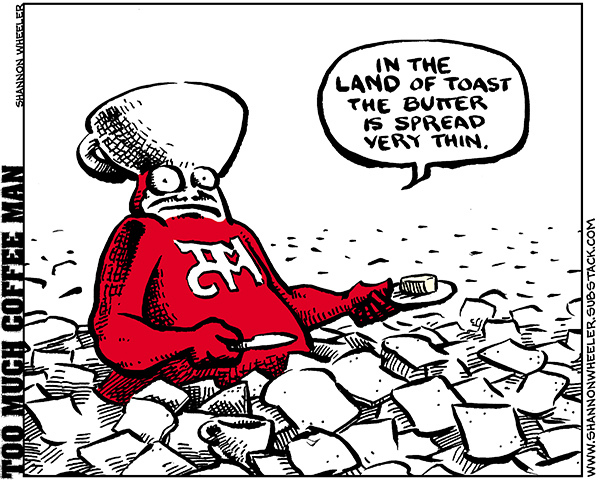
Dýou think this is well-positioned to become even more popular than the one about the land of the blind?
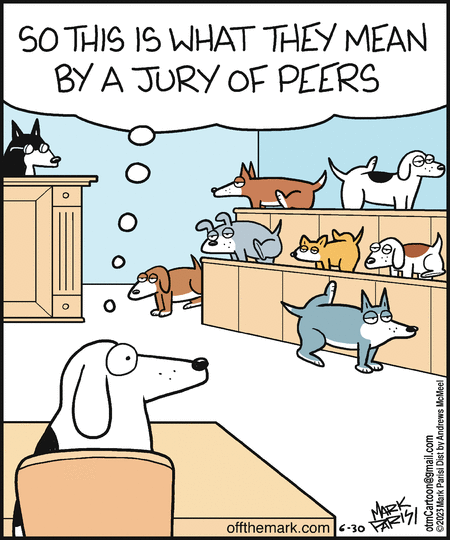


A fine line between pun and equivocation.

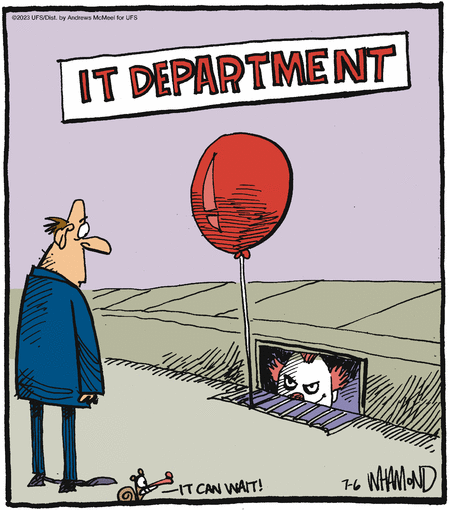
In the GoComics comments, Teresa Burritt (creator of Frog Applause) revealed that this was a CIDU for her! (Several commenters answered to provide the Stephen King reference.)

 Comics I Don't Understand
I do read some Stephen King (or watch adaptations), but have never read or seen the IT referenced here. Yet I knew from osmosis that it’s the one where the evil is a clown appearing from sewers.
But is IT considered his name?
And BTW, is it something of a cliche’ in itself to use the frame “The ___s next door”?
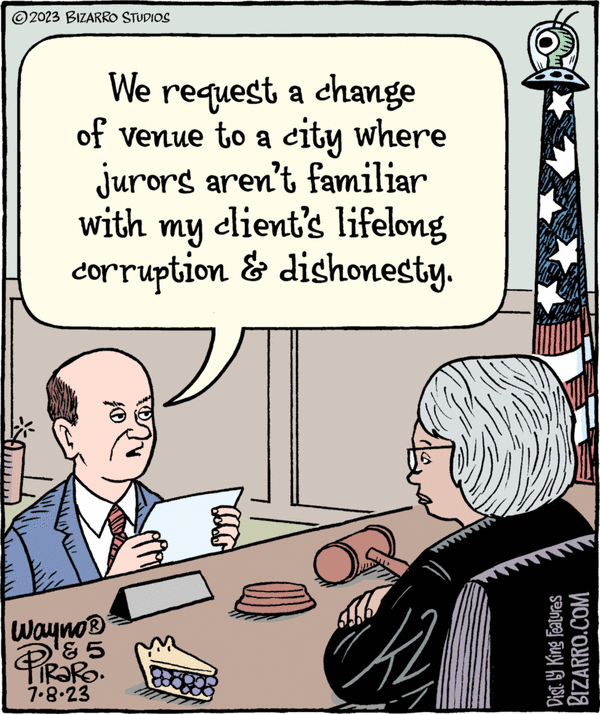
I wanted to clip that Bizarro because that common phrase “change of venue” caught my attention right at a time when I have begun driving a Venue!
Is the Speed Bump meant to be “Dr. Anabolic Steroids”?
For what it’s worth – isn’t the Bizarro actually a legitimate, non-ironic reason for a change of venue? The client is being tried on whether they did this specific shady illegal thing, not whether they do shady, illegal things in general, so, while their habit of doing shady, illegal things in general isn’t irrelevant, you want to limit the amount to which that affects the jury’s decision-making process.
Ian: My thoughts exactly. And in fact, their habit of doing shady, illegal things in general is irrelevant, and if brought up in trial will be objected to, and sustained.
larK and Ian, I believe there is an exception, allowing evidence or even testimony about a defendant’s “prior bad acts” if they “go to establishing a pattern”. Including for instance, an M.O.
But of course that is about admitting such as evidence, not just accepting that the jurors will have prejudicial beliefs about the defendant.
So the only thing wrong there, is that the lawyer didn’t call it “alleged” :-)
@ D.B.-L.D. (8) – That’s precisely what the whole joke is about: the lawyer admits that he is defending a crook. It sort of reminds me of Steve Dallas:
P.S. That Lay Lines is one of the better ones to appear at CIDU, but I think it’s only fair to mention that it had its very own solo OY post in January.
Hmm, and in that January post I asserted that a cartoon of that size wouldn’t do well in a Saturday Morning OYs list-post. But now it seems quite all right anchoring this mixed-mode non-CIDUs list-post.
I am indebted to the high school English teacher who quoted the complete saying: “Curiosity killed the cat; satisfaction brought him back.”
Good comics today.
In the land of the blind the one-eyed man is playing vicious nasty pranks on everyone else.
Re Bizarro: Long ago my mother was on the jury for a drunk driving case. The defendant, who insisted on defending himself, opened by demanding his previous legal problems — which the jury was so far totally unaware of — “be stricken from the record”. Once he finally grasped it didn’t work that way, he agreed to talk to a public defender who was present. In the end he simply lectured the jury, in at attempted folksy tone, that while the evidence and police testimony were compelling, it was theoretically possible they were simply wrong. The jury’s deliberations were pretty short.
The Daily Cartoonist pointed out that this Bizarro panel is not a “political” cartoon because of, well, “reasons“.
The canine jury reminds me of Bill, a feline member of my family with questionable litterbox habits. He was a member of the no-bill!-ity, a peer of the realm.
Mitch @ 7: yes, I didn’t bring up the exception in an effort to avoid complicating the matter, because it is a very limited exception, and doesn’t apply at all to the comic. The general idea, as ianosmond explained, is that you are being tried for a specific thing, not for your general character, not for something else in the past or for which charges haven’t been brought in this court — those things must be dealt with separately. Here you are to consider only the case at hand, and whether or not he did it, specifically. It is not a question of whether he is the type of person who would do such a thing, but a question of did he do this thing. It is also not a question of is it more likely than not that he did this thing, it is a question of can you prove he did this thing beyond a reasonable doubt. So anything brought in that talks not to the specific evidence in question, but to his general character, including past acts, is highly prejudicial and not admissible (with a few very narrowly defined exceptions). He might well be a serial ax murderer deserving of punishment, but if he didn’t do this specific ax murder, then justice is not being served by convicting him, and in fact, doing so ensures that the real murderer is still out there getting away with it!
(The narrow exceptions include if the prosecution brings up his character, then you may be allowed to address his character in rebuttal (he’s really a nice guy who would never do this sort of thing — you can now provide evidence that no, he is not, and in fact he has done this kind of thing — so only a really bad prosecutor would open this up without a really, really good reason); there is the habit and routine practice exception, where you can establish that on “a particular occasion the person or organization acted in accordance with the habit or routine practice”; and there is an exception for establishing a pattern, as you brought up, which is as you said really specifically a modus operani argument, that because this crime in question matches past crimes that the defendant has done in execution and style, that that is evidence that the defendant also did this one.
(In any case, again as you said, this is for the trial, and not for jury selection, so none of them apply, and it is perfectly reasonable — for the reason I stated above, that you want to find the actual person who did this crime — that the jury not be biased because they all know already that he is an ax murderer, and if moving the venue is a way to accomplish that, then that is perfectly legitimate, and a way to avoid lazily convicting the wrong ax murderer and leaving the actual guy who did this one out and free and unconvicted…)
Thank you for that considerable elucidation, larK!
@ Bob Ball (17) – Any comic fan who names a cat “Bill” should not be surprised by the consequences:
My daughter, then in high school, brought him home when her boyfriend’s mom, as I recall it, ejected him. The name came with him. Beth remembers him as “an awful cat,” can’t imagine why her parents permitted her to do it and says she’d never allow her two kids to bring an animal home.
Sentencing, on the other hand, definitely considers previous misdeeds. Today in the Judge Middleton Show (as one attorney quipped last week) sentencing was going on for a guy for his sixth OWI/DWI/DUI whatever they call it where you are. The best the lawyer had was that many of those happened over 20 years ago. It was also the case that Indiana Wants Him for the same thing.
The capper was when he got to the jail, they gave him a breath test, and he failed with a .16. Middleton said he couldn’t sentence someone that drunk, so gave him contempt and rescheduled the sentencing to after a dry-out period in jail.
Daniel J. Drazen – When I was young dad was the first person I heard say the second line. Dad tended to quip a lot and I thought he had made up the second line.