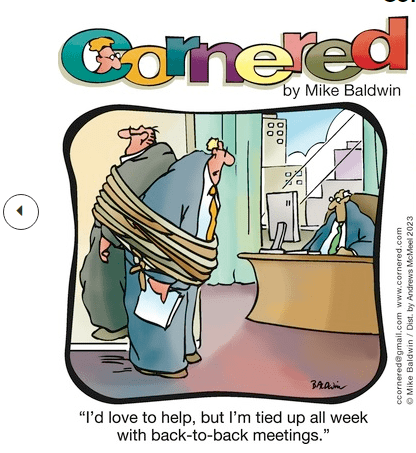

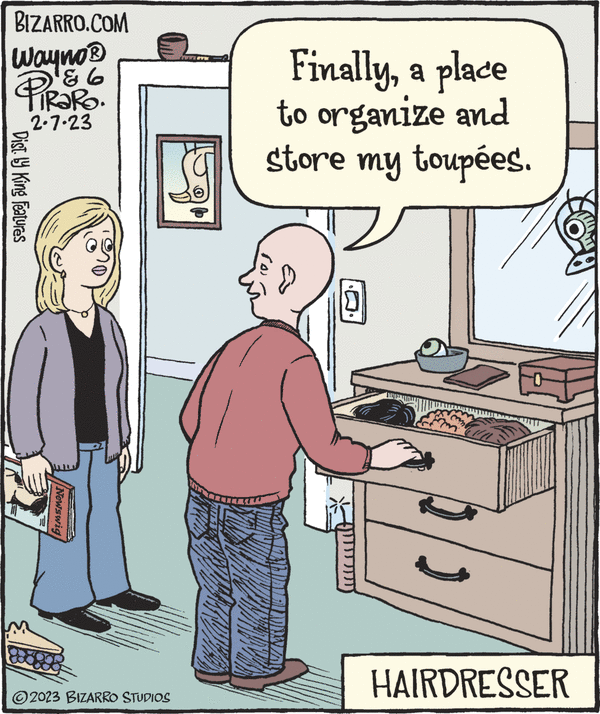
Thanks to Becky for this XKCD.
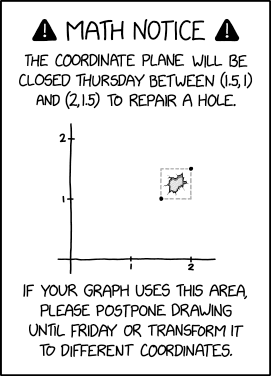
The rollover text (for those who insist it’s an integral part of each XKCD cartoon) was “3D graphs that don’t contact the plane in the closure area may proceed as scheduled, but be alert for possible collisions with 2D graph lines that reach the hole and unexpectedly enter the 3D space.”

Is the therapist playing off an ambiguity to humorously chide the client for being late … again?
 Comics I Don't Understand
In my days in publishing sales (college textbooks) I knew a customer of ours in Lebanon whose first name was (and still is) Jihad. Ironically, I suppose, he was from the Christian community.
Unless someone knows for certain that the woman in Reply All is a recurring (therapist) character, I would assume that she is a patient, hoping to reach the goal of being cured faster, rather than continuing to lay out gobs of cash for overpriced treatment.
Who’s yelling “Boooo” in the “Gehad” comic?
Also, is “Yes, I’m hot in this” a double-entendre?
@ Powers – The “Boo!“-man is a stand-in for the audience, acknowledging the awful pun; and yes, the “hotness” is indeed a double entendre.
Yes, the woman in the Reply All panel is definitely the therapist. Her usual client is the comic’s regular central character (name forgotten).
But indeed, one of the meanings of her remark is that they (the therapist and client working together) could accelerate the process.
I just finished having my mind blown by the “Three-Body Problem” series by Cixin Liu, and that features a lot of speculation on what happens when you take 2-dimensional things to 3 or 4 or back again (it’s not advised), so this XKCD re-blew my mind.
Besides the ongoing double meaning of the strip title (which, come to think of it is maybe a triple, or 2+1),, the pun in this particular episode is between “jihad” and “struggle” (which might be the translation). This is presumably what the “Boo” is directed at.
@padraig, what a coincidence, or Baader-Meinhof experience (I sort of hate that name but can’t remember the “official” term). Except that I haven’t read it! But I first heard of the “Three-Body Problem” series by Cixin Liu a few weeks ago in the “additional readings” part of the syllabus for the History of Science Fiction class I’ve been taking online this quarter. (Today’s session starts in an hour!) One of our instructors is into manga and has included readings in several weeks’ lists. (That’s Ada Palmer, whom you may know for Terra Ignota.) Then I saw something about it elsewhere (a video series??). And your mention was the crucial third time.
@ padraig – The XKCD reminded me of a series of problems in a college course dealing with resonance frequencies for various (idealized) objects. During a joint homework session, one guy postulated such a problem for a standard galvanized garbage can. The “simple” solution would then be to transform everything to “corrugated cylindrical coordinates”.
@ Danny – That is indeed the accepted translation; I assumed that it was relatively well-known. Besides the “boo” commentary in the fifth panel, the author has also cracked the fourth wall with the classic “rimshot” or “sting“. It seems possible that the final two panels may be “throwaways” that would be omitted in papers that have room for just four.
When you start Three-Body, I suggest you set some serious time aside. ;) It seems a bit slow sometimes but the scale is amazing. Apparently Netflix is producing a mini-series which is quite brave of them. I have no idea how they’re going to put some of this stuff on screen.
I found Three-Body Problem to be intensely annoying after the first few chapters, but that’s just me.
My question: why does the drum have the symbol of The Flash on it?
@ padraig – Indeed, the mere density of the plot summary in Wikipedia indicates that distilling an understandable TV script will be a mammoth undertaking. I have not (and probably will not) read the novel, but I think the title is a major spoiler, and the solution to the celestial mechanics riddle seems to parallel Asimov’s “Nightfall“.
P.S. @ Carl Fink – A simple lightning bolt is not necessarily a reference to a comic book character.
“Get there, faster!” might be encouragement during Ramadan…
Three-Body Problem is on my near term queue, but I am sort of dreading it after having read some harsh reviews regarding the central “difficult” problem, ie: too much is made of the the impossibility of a perfect solution for the titular problem, while ignoring that perfectly acceptable partial solutions for the time frame in question are perfectly and easily feasible, and in fact we already successfully do them all the time. However, the same font of criticism also made me approach The Martian with trepidation because the reviewer harped on the stupidity of growing crops under artificial lighting whose power derives from solar, but that was such a minor plot point in the end, and so easily handwaved to other, better solutions, that I have to remember to take reviews from this particular source with a huge grain of salt.
Carl Fink: No, it’s not just you. I read it a few years ago, for out book club, and was glad to put it behind me.
… for our book club …
Am I the only one who thinks “Not a CIDU” might not be the most appropriate heading today?
Steve, which one(s) would you like help with?
MITCH4: This week’s Jesus and Mo . . .
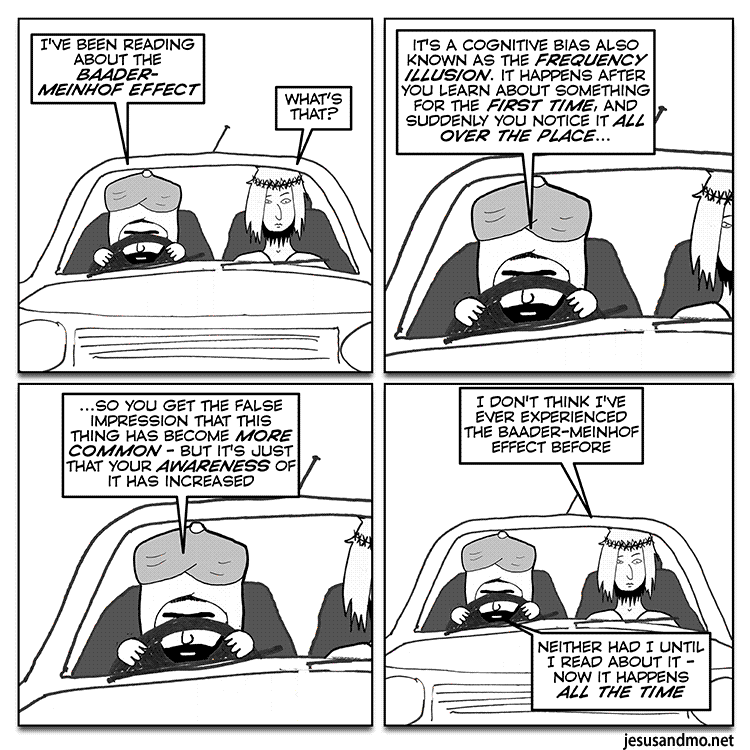
Thanks, I did see that one! And they do give (but I didn’t remember) the “official term” I was looking for — “the frequency illusion”.
Danny Boy –
Thanks for asking. I mostly meant that without some of the explanations people have given, I would not have understood some of these.
I still have questions about a couple of them. In the “Gehad”/”Jihad” comic, are the two different spellings relevant? Is “Gehad” just more likely to be used as a person’s name? Also, is the apparent ethnicity of the man saying “Boo” relevant? (I think not.)
In the Reply All entry, I accept Mitch4’s explanation “that they (the therapist and client working together) could accelerate the process.” I don’t get why that is a joke. That may well just be me though.
Again, thank you.
Hey Steve, my gloss on the Reply All was meant to explain the surface or forthright meanihg. But then the joke would be that a disguised meanng remains, where she is complaining that the client arrives late and is suggesting that she put some effort into getting there faster.
Mitch4:
Thanks. I know that the comment under the comic said that maybe it was a reference to the patient being late, but for some reason that didn’t seem right to me. However, combining that with what you said about them working together does make it clear (which it may already have been to most people).
@ SteveHL – “…are the two different spellings relevant?”
They are simply two different transliterations of the same Arabic name. Converting a foreign alphabet into Roman characters is often difficult, even when there is a uniform “official” pronunciation, as with Japanese or Russian. In Arabic, there is the additional complication of regional and sectarian differences, which can produce a number of variations for the “preferred” transliteration of specific words. Hebrew has similar problems, Bill once posted a “March madness” style grid for all the various ways to spell “(C)Han(n)uk(k)a(h)” (I couldn’t find that one, but the link contains several relevant comics).
I would not consider Reply All and Reply All Lite to be ‘comically funny’. I’ve been following them for quite some time; sometimes they’re amusing, sometimes they’re thought-provoking, sometimes they’re meh. I do think they should be followed for some time to ‘get’ what they’re about . . . if, in fact, they’re ever ‘about’ anything.
P.S. There is a fascinating (and very amusing) dialog with T.E. Lawrence that was included in a forward (or appendix) to his book “Seven Pillars of Wisdom“. I don’t remember whether it was an interview or just responses to questions about an earlier edition, but many of the exchanges dealt with orthographic variations in the published version of the book. A question such as “The word [or name] ‘ABCDEF’ on page XYZ is spelled ‘EBCDIF’ on page UVW. Is that an error?” would get a reply something like “No.” or “That’s the way I wrote it.” from Lawrence. He obviously had little tolerance for any pressure for uniformity, and transcribed the Arabic terms just as he felt like at the moment. It would never have been possible back then, but if it were, I almost feel that Lawrence would have preferred to record all those names in Arabic script, and force the reader to learn them.
There are now some three or four accepted ways of writing in Western alphabets the name of the poet I learned about as Li Po; and the one most favored today it seems is one of the others. It is frustrating when I’m not aware that’s what is going on. I was reading up on the texts used for Mahler’s Das Lied von Der Erde and some point was taken aback and said “Wait! I thought for sure one of these poems — or even two — were by Li Po! Has the scholarship on these sources changed?” Well yes it had, but not about the attributions themselves, just about the form of the name.
@ Mitch – I sometimes trip over Cyrillic transcriptions in German TV. There’s one standard used by all German networks, but Eurosport (and international event such as the Olympics) prefer the English equivalents. Most names are easy to figure out (Medvedev vs. Medwedew), but it can be very puzzling when the initial consonant is different.
Extract from Wikipedia
Li Bai’s name has been romanized as Li Bai, Li Po, Li Bo (romanizations of Standard Chinese pronunciations), and Ri Haku (a romanization of the Japanese pronunciation). The varying Chinese romanizations are due to the facts that his given name (白) has two pronunciations in Standard Chinese: the literary reading bó (Wade–Giles: po2) and the colloquial reading bái; and that earlier authors used Wade–Giles while modern authors prefer pinyin. The reconstructed version of how he and others during the Tang dynasty would have pronounced this is Bhæk. His courtesy name was Taibai (太白), literally “Great White”, as the planet Venus was called at the time. This has been romanized variously as Li Taibo, Li Taibai, Li Tai-po, among others. The Japanese pronunciation of his name and courtesy name may be romanized as “Ri Haku” and “Ri Taihaku” respectively.
He is also known by his art name (hao) Qīnglián Jūshì (青蓮居士), meaning Householder of Azure Lotus, or by the nicknames “Immortal Poet” (Poet Transcendent; Wine Immortal (Chinese: 酒仙; pinyin: Jiuxiān; Wade–Giles: Chiu3-hsien1), Banished Transcendent (Chinese: 謫仙人; pinyin: Zhéxiānrén; Wade–Giles: Che2-hsien1-jen2), Poet-Knight-errant (traditional Chinese: 詩俠; simplified Chinese: 诗侠; pinyin: Shīxiá; Wade–Giles: Shih1-hsia2, or “Poet-Hero”).
(end extract)
Luckily, there has been no move to retrofit older essays on him, say by Pound, where he is still Li Po.
@Kilby I now can’t recall where I saw Tchaikovsky written starting with Ch-. Actually that would fit general English / American spelling patterns, but we do use Tchai-.
The idea that English has spelling patterns is very implausible. Must I bring up “ghoti”?
Carl, I would count that instead as illustrating how the patterns are non-unique and can lead to amusing conflicts.
Thanks, Kilby.
@Kilby: I remember reading that same commentary by Lawrence, and in fact was recently trying to find it again (I have thus far been unsuccessful, but have not devoted my full attention to it). I recall he was even more strenuous in his disdain for narrowing down words to one spelling in English, responding to a note by someone that on page such and such, it appears as such, but on page so and so the same appears as other, and Lawrence responding, “Good! I would also add [spelling variation 3] and [variant 4]!”
As for English spelling patterns, they are not so much English spelling patterns (though of course, in the end, they are) as they are the spelling patterns from the languages English beat up and rifled through the pockets of in that dark alley way; as Mitch mentions, the “ghoti” thing is merely an amusing example of those differing spelling patterns from other languages meeting up in English. Knowing something about said spelling patterns helps you know more about the origins of the words the spelling patterns appear in. For example, words from German will have “ie” pronounced “ee” as in “feet”, and “ei” pronounced like “eye”, whereas in words from Scots Gaelic will have “ei” pronounced like the German “ie” — so “weird” and “Sheila”, but “Einstein” and “field”. So even though it looks like a direct contradiction, and certainly doesn’t follow the “rule” “‘i’ before ‘e’ except after ‘c'”, it is definitely following a pretty clear spelling pattern of “when from the germanic, ‘ie’ for ‘ee’, when from the celtic, ‘ei’ for ‘ee'”.
@ larK – One of my satirical rule for German (both for the alphabet and for pronouncing the spelling) is “EYE is EEE and EEE is EYE“.
P.S. for the Lawrence piece, try looking in one of the better editions in a local library.
re ” Also, is the apparent ethnicity of the man saying “Boo” relevant? (I think not.)” — actually, I think that’s a semi-regular character in this strip (YES, I’M HOT IN THIS), though not one who shows up often. He’s a government agent of some sort assigned to spy on/listen in on everything Huda and Gehad say and report whenever they say any trigger word like “bomb” (or anything that sounds like that). He seems to actually be a nice guy, just doing his job, and at least once he’s broken cover to help the couple out (reminding Gehad of their upcoming anniversay in time for him to get a present), though he did add “We must never speak of this.”
Sorry I’ve not posted in a few weeks. I’ve been sick. (Well, actually I still am sick, but what the heck.)
A notable name with a variety of spellings is former Libyan leader Gaddafi. I had known it as Kadafi for long time but there are many other variants.
https://www.businessinsider.com/qaddafi-gaddafi-kadafi-qadaffi-libya-spelling-2011-2
@Shrug, sorry to hear you’ve been sick!
And then there’s Johann Wolfgang von Goethe. It’s been said that half of all Americans pronounce his name to rhyme with “both” and the other half pronounce his name to rhyme with “dirty”.
@ MiB -There’s also the schoolkid command pronunciation “Go, Thee!“, but it’s also worth pointing out that the name was originally spelled “Göthe” (among other variants), but was changed by the famous one’s father to the “standard” spelling known today. Unlike Shakespeare, who wasn’t consistent with his own name, Goethe clearly preferred the new version.
@ Shrug – Ditto on Mitch’s comment, and get well soon.
@Mitch4 re: Tchaikovsky
In Italian one of the usual spellings is “Ciaikovski” as in italian words “ch” is always pronounced as “k”.
In German publications, Prokofiev is spelled “Prokofjew”.
Gosh, I thought he must be Prokof-Gentile
Mitch, that gasp you heard was just Li Po suction.
And to add to the transliteration discussion, there are the successors to Peking (Beijing), Bombay (Mumbai), and Calcutta (Kolkata). And I still don’t know how Moskva became Moscow.
@ Boise Ed – The German transliteration (“Moskau“) isn’t that much closer to “Москва́“.
Do you pronounce the one in Idaho the same as the one in Russia?
I remember hearing MOSS-koh (not MOSS-cow), but I think you’ll hear it both ways, possibly influenced by students coming from all over the place. Similarly, Boise is BOY-see to locals and BOY-zee to others.
I have seen Tchaikovsky written starting with Ch- in some old music scores.
Shrub – Hope you are feeling better!
There are plenty of disparities even without venturing into foreign territory, such as “Houston Street” in NYC, which has nothing to do with Texas, and is pronounced “House-ton”. There’s also “(Andrew) Carnegie”, whose last name is pronounced “CAR-na-GEE” almost everywhere, except in his adopted home town of Pittsburgh, where it is “car-NEG-ee”.
P.S. @ Meryl A – I’m sure that his wife is watering him regularly and keeping him turned toward the light.
I have never heard “Carnegie” as anything but “car NEE gee” (hard “g”).
Carl, you’re right that it is always a “hard” g sound — the differences Kilby is discussing are not about the g at all really, though his syllabification choices may have made it look that way. The difference, rather, is in the placement of stresses, and (going along with that) the vowel values, particularly in the middle syllable. (An unstressed syllable is easier to give a neutral vowel to.)
To clarify that, I may rewrite Kilby’s second version as kar-NAY-gee, so it has the same treatment of the g as starting the final syllable, not closing the middle one. BTW, I’m sure I have heard that urged upon the general public as the “correct” or better pronunciation overall, not just in Pittsburgh.
I have not recently read up on a summary history of how CMU evolved from previous separate institutions with their own independent histories of name changes. Suffice it to say both namesakes were named Andrew, so maybe that should be an informal designator for the merged institution.
There are a number of place names in the US that are pronounced differently than the originals.
Versailles – Frequently ver-sales
Lima OH – Lie-ma
Nevada MO – Ne-vay-da
Quoting Allen Sherman:
“H, O, R O W, I T Z spells Horowitz.
I went with my girlfriend Peggy
To one of his concerts at Car-neggy.
You know that V, L, A D I M I, R that’s Vladimir,
And he plays piano good like a good piano player should.
Horowitz, hear hear!”
Oh I almost remember that! Was it from H A double-R I, G A N spells Harrigan?
Comedian Jim Gaffigan had a version of the song with his name, performed by his brood of children.