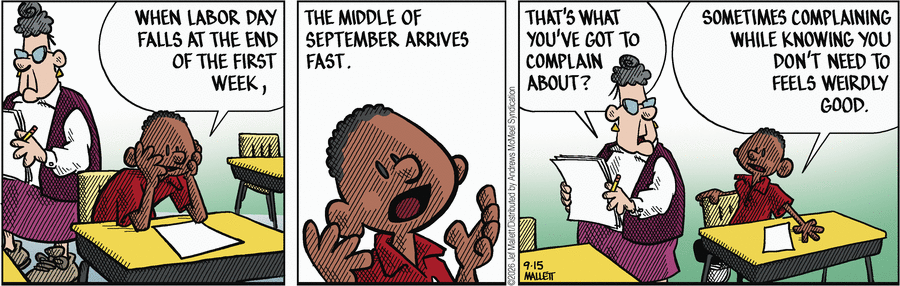
Jack Applin writes:
“When Labor Day falls at the end of the first week”? Where does Frazz take place? In the United States and Canada, Labor Day is the first Monday in September, which isn’t at the end of a week.
https://en.wikipedia.org/wiki/Labor_Day
https://en.wikipedia.org/wiki/Labour_Day_(Canada)
I’m guessing that what Mallett means is “When Labor Day is on the 6th or 7th of September”, i.e., near the end of the first week of September. But I still don’t get the joke even if that’s the intent.


Some school systems start after Labor Day, so school has barely started and it’s already mid-September, as opposed to years where Labor Day is earlier in the month.
LikeLike
When Labor Day falls at the end of the first week of school. As in this year, when Labor Day was on the 7th, many (northern) schools that normally start in early September started before Labor Day instead of after. So by the time Labor Day finally rolls around they’ve already been in school for (almost) a week and it feels like mid-September already.
LikeLike
Right, school always started the day after Labor Day when I was growing up, and also for many years here in Virginia, where a law known as the King’s Dominion Law (after the King’s Dominion amusement park) required school districts to wait until after Labor Day.
This law existed explicitly “… The rule was designed to extend summer vacation for students, ensuring that seasonal amusement parks like Kings Dominion and Busch Gardens had access to teenage student workers and family vacationers through the end of summer”.
But Monday isn’t the end of any week anywhere, and I still don’t see any joke here.
LikeLike
Complaining when you have something to complain about means there is something off in your life. It can still help emotionally to complain, but the problem is still there. If you complain without anything really being wrong, you can still feel good because, first, you don’t really have anything to complain about, which is a nice feeling. Second, once again, complaining (or venting) can be cathartic. I can’t complain but sometimes I still do…. life’s been good to me so far.
LikeLike
TedD: “Complaining when you have nothing to complaint about”??
LikeLike
phsii- Yes. People complain about anything and everything, often over 1st world problems. It is like complaining your mercedes is too big to find easy parking. Some are tone deaf to the fact they really don’t have much to be be complaining about, but some realize these are trivial inconveniences but it still feels good to vent.
LikeLike
The best thing to be said for complaining about comics is that it can distract everyone from complaining about infinitely more substantive issues going on in the world today, since these cannot be discussed here at CIDU. Please vote in November.
LikeLike
As is the case with many strips posted here, the ‘joke’ is negligible. (‘Caulfield is a whiny know-it-all’).
Labor Day fell on September 7, so it was at ‘the end of the first week’ of the month.
LikeLike
should’ve been written as: “…at the end of September’s first week …”
LikeLike
Brian ONEILL and Jonesy have it right. That puts mid-September only about a week away. I’m not sure why mid-September is significant, though.
When and where I was a kid, school ran from the day after Labor Day to the weekday before Memorial Day. Now, local schools start about the Ides of August.
And Frazz is set in or around Detroit.
LikeLike
Boise Ed: The weekday before Memorial Day?! Wow, that’s early, especially for a system that started after Labor Day! Can I assume this was in Idaho? Perhaps influenced by farming?
LikeLike
When I was going to school in the Bay Area, Memorial Day meant you had 8 class days left in the school year(the following week, you were finished on Thursday).
LikeLike
(I think the Frazz setting is closer to Grand Rapids or Muskegon than to Detroit.)
LikeLike
Even people who think the week is standardized can’t agree on which is the last day of the week. On the calendar it looks like Sunday is the first day and Saturday is the last day. But most Christians treat Sunday as “the seventh day”, the day for worship. (Except for Seventh Day Adventists, who count Saturday as the seventh.) But I can see the point of saying that “the first week of September” is the seven-day period that starts on September First. It doesn’t seem to make sense that “the first week of September” starts on September Sixth, as if the previous five days weren’t September.
LikeLike
Mark in Boston: That makes sense. The comic still doesn’t, because it doesn’t mention “AND school starts the day after Labor Day”.
LikeLike
Am I being whooshed? 15 comments complaining (okay, nitpicking) over a comic about complaining when there is nothing to complain about. This is subtly sophisticated satire, right?
LikeLike
phsiii (11): No, that was in Northwest Indiana. But yes, I’m sure it was influenced by farming.
Mark in Boston (14): I have seen calendars that run M-Su. I think that makes more sense, based on our normal work week here, but it’s too confusing to buck the predominant Su-Sa calendar.
guero (16): That seems to define the “meta” concept.
LikeLike
phsiii (11): No, that was in Northwest Indiana. But yes, I’m sure it was influenced by farming.
Mark in Boston (14): I have seen calendars that run M-Su. I think that makes more sense, based on our normal work week here, but it’s too confusing to buck the predominant Su-Sa calendar.
guero (16): That seems to define the “meta” concept.
LikeLike
Boise Ed: Some business calendars run Monday through Sunday.
One of the most interesting business calendars was kept by Eastman Kodak (a long time ago, but not now). It had 13 months in the year. Each month was exactly 28 days, four weeks, and then there was one extra day in the year (two in leap years).
The reason was so that sales and production figures would be more comparable month to month. There were always 20 business days in the month.
But quarterly reports (required by the SEC) must have been difficult!
LikeLike
Mark in Boston (19): I suspect the database was organized per day, and there were report generators gathering records by the week, quarter, calendar month, and 28-day month.
LikeLike
See https://en.wikipedia.org/wiki/International_Fixed_Calendar . “Though it was never officially adopted at the country level, the entrepreneur George Eastman instituted its use at the Eastman Kodak Company in 1928, where it was used until 1989.”
LikeLike