
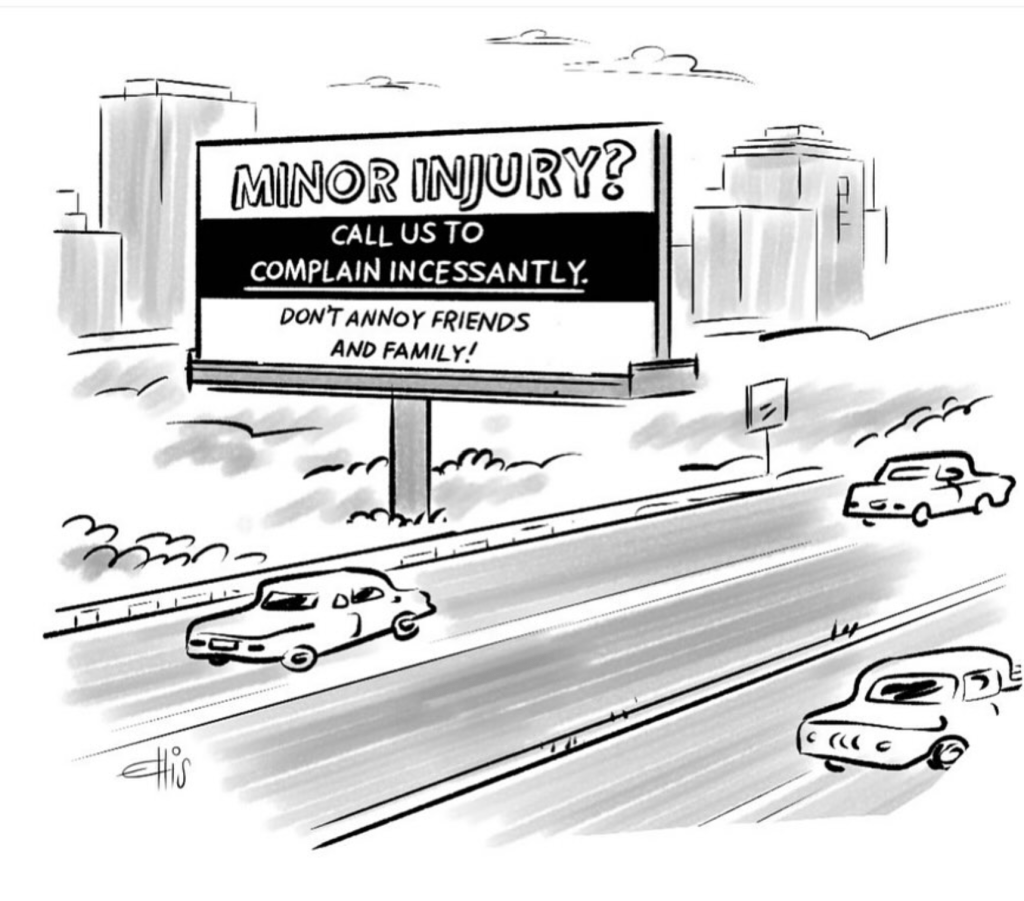
The number to call is 867-5309. Jenny went to law school.
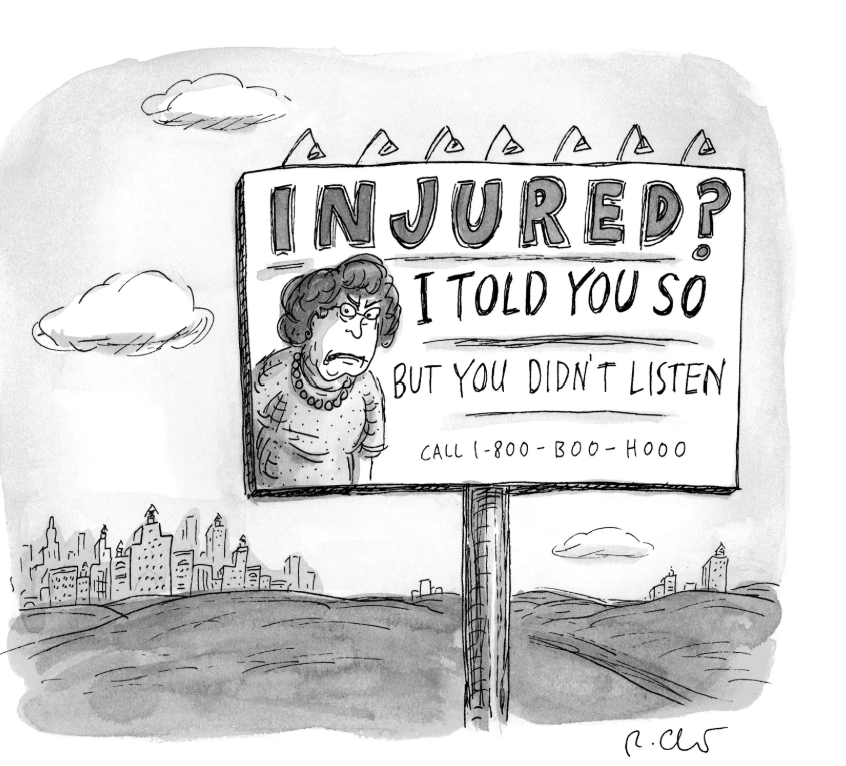



A recent New Yorker Caption Contest winner.

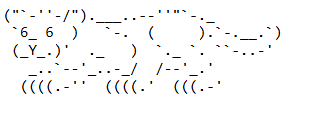
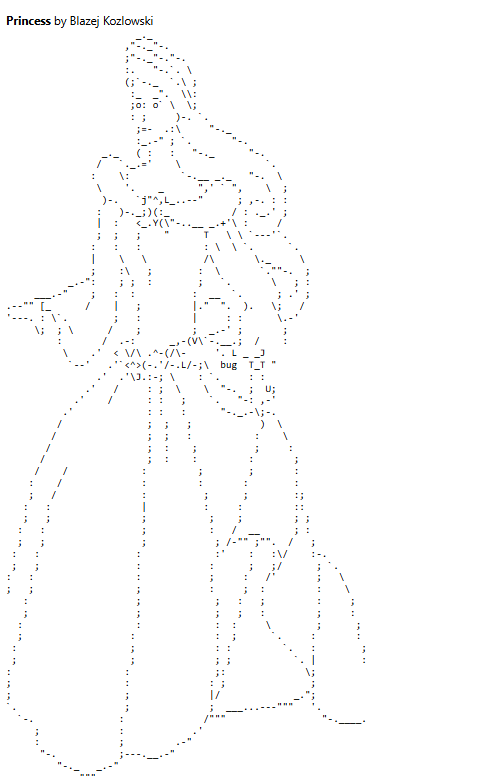
Definitely a Geezer Alert on this one. ASCII art was a big deal in the age of dot matrix printers and fanfold paper: printing out pinups was a rite of passage, along with “Happy Birthday” banners. These are from the ASCII art studio.

 Comics I Don't Understand
A’ight, show of hands . . . who else scratched their heads over the “candy corn” help group before realizing they were traffic cones?
Candy corn with the yellow heads chewed off — that might call for an abuse support group.
Ah, ASCII art–of course it wasn’t originally ASCII, it was EBCDIC (and BCDIC before that, etc.) on greenline printer paper.
In the early 1970s, my sister took a computing class in high school. This was still the punch card era. My dad, who had been programming for 15+ years by then, was of course interested in what they were learning, and was appalled to find out that they were creating pictures like ASCII art instead of actually learning to program.
He had gotten into programming by being a linguist with a PhD in Slavic linguistics, working on a machine translation program in the 50s for The Government (hint: TLA beginning with C and ending with A, focusing on translating Russian to English). He would describe what he wanted a subroutine to do; a programmer would write it out on Autocoder sheets; a keypunch operator would enter it; and the next day he’d find out what it did. He figured that if he learned to write the program, he could get more work done, so he did that.
The project was a failure, as was the follow-on at IBM Yorktown a few years later, but he’d be so amazed by Google Translate (while I’m sure finding things it gets wrong). He also parlayed the experience on those projects into an academic career teaching text-focused computing to Arts students. In the early 80s I’d help him with his labs, not just because he was my dad but because there were female Arts students in his classes! And now I’m 45 years into a computer career, so I guess it all ties together…
@phsiii:
I heard that back when they were first working on machine translation in the 1950’s, they gave the following sentence to the program to translate from English to Russian:
“The spirit is willing, but the flesh is weak.”
Then they took the Russian result, told the program to translate it back to English, and got this:
“The vodka is strong, but the meat is rotten.”
Another even older story, from the 1940’s. One of the first all-electronic computers was the ENIAC at the University of Pennsylvania. It was vastly faster than computers that used mechanical relays. One of the projects they tried was predicting the weather.
When programmed with observed readings — temperature, humidity, air pressure, cloud cover and all that stuff — over a large area, it predicted what the weather would be 24 hours later and was surprisingly accurate.
The only problem was that the program took 25 hours to run, so it predicted what the weather was like one hour ago.
In the late 70s, I took Fortran in college. Also with punch cards. Those were tough for someone like me, as I had learned touch typing and could go pretty fast, but made a lot of mistakes. So punching in one of those assignments would result in a large stack of ruined cards, and a small one of Schrödinger cards, whose correctness was unknown until turned in at window and (after some time) the printout returned.
After that, I pledged never to have anything to do with programming. That guy would have been surprised when the future brought me an MS Computer Science and a career shift to software engineering.
I got introduced to punch cards in college, but it was “and this is how we used to have to do it”. Did one program that way (and that was plenty!).
It made me think of the Computer Chanty, though…
When mainframes were the only game and stretched from wall to wall
The computer center took up half of Engineering Hall.
We punched our cards in Hollerith and sometimes had to laugh
That the error statement printout took an hour and a half.
https://madmusic.com/song_details.aspx?SongID=12795 (the lyrics aren’t quite right, but close – and I don’t see it anywhere elseweb).
Mark, I’ve heard the “spirit is willing” story, but I don’t believe it for two reasons:
1) My dad didn’t believe it, and he was there
2) Nobody was translating TO Russian; FROM Russian was hard enough. Remember how expensive computing (and programmer!) time was
It’s a fun story, though. Up there with “bite the wax tadpole” (which is at least sort of true-ish, apparently) and of course the Chevy Nova.
Actually, here’s a third reason: https://en.wikipedia.org/wiki/Literal_translation#Translator's_humor
Brian, in 1965, when I was four years old, my dad rented a keypunch, had it delivered to the house, because he was working on a concordance of Beowulf and my mom was going to enter the text. They let me play on it; I had a lot of fun. Pretty sure I wsa the only four-year-old in New York state–maybe the world–with a keypunch in the house!
I didn’t touch one for another decade, when I sat in on my dad’s class after 8th grade and learned PL/I. Long, long ago!
The Snopes article on the wax tadpole indicates that initially Chinese shopkeepers came up with various phonetic character strings. That seems to indicate to me that they, and their customers, were used to doing that sort of thing and were able to get around the literal problem.
https://www.snopes.com/fact-check/bite-the-wax-tadpole/
A flip side to this sort of story, besides “US companies so dumb” is a required “foreign customers so dumb.” Not usually. I don’t doubt that in this case, or with the Nova, that the customers probably saw the ambiguity, but it would be more of a humorous observation than them taking it literally and avoiding the product.
In an SF collection called Pohlstars, containing stories from writer Fred Pohl, there was an experimental work. A story called “The Wizards of Pung’s Corners”, set in his high-consumer background, was translated into Mandarin and back.
The resulting story was “The Wizard-Masters of Peng-Shi Angle”. One bit that stuck with me was the fanciful cereal name of “Prune Bran Whippets”, which ended up “Plum bran dogs”.
The translator that was involved with the return translation discussed some of the issues. He mentioned the “wax tadpole”, apparently accepting the story at face value. But the problem of using Chinese characters to represent word sounds is a real on in translation.
Back in the 1960’s when Pepsi was using the slogan “Come alive! You’re in the Pepsi Generation” I heard that a translation by the marketing department to some language (Chinese maybe?) turned out to mean “Pepsi brings your ancestors back from the dead.”
Of course we kids were having plenty of fun with the original English version, “Urine the Pepsi Generation.”
The idiomatic expression I’d always heard as a humorous take on machine translation was the phrase “Out of sight, out of mind” which when translated from English to and back resulted in “invisible imbecile”.
I don’t really get that, as “out of mind” isn’t idiomatic for having mental or psychological problems. Now, “out of [possessive pronoun] mind” can indicate the latter, but not really the former. At any rate, I’d say it was not very plausible. I think it gets back to most of these being made up by people not involved in the actual creation of translators.
Is BASIC still of use in this day and age?
In regards to the infamous Chevy Nova myth, the story never seems to identify the country the incident supposedly took place in. Argentina, Brazil, Uruguay and Chile were separate markets, and you would think each plant would know its market. I’m inclined to think the story was made up by a “North American” as a joke.
Grawlix: Visual Basic and VBA, Visual Basic for Applications are core languages for Microsoft stuff, so yeah. Both macros (in VBA) and compiled programs.
The Chevy Nova myth made no sense, as you note: not just the plants, but the local reps, sales folks, et al. would all have immediately said “No way”.
Sorta related, we had an employee in India for a while whose last name was S***ole. A friend mooted, “That’s pronounced ‘shy-toe-lee’, right?” If they were to immigrate with kids, they’d really want to change that–imagine being in elementary or middle school with that last name! Torture.
Another reason not to believe the Chevy Nova story is that in Spanish, “Nova” would be pronounced “NOva”, the same pronunciation as the astronomical term (which is the same in Spanish as in English). If you were going to say “no va” (it doesn’t go), you would normally pronounce it “no VA”.
Sorta related, we had an employee in India for a while whose last name was S***ole.
Brings to mind the SNL skit with Nicholas Cage. “It’s pronounced AHZ-Weep-Eh!”
Sheesh – I am in my 70s and based on the conversation I must be older than at least some of you.
I first learned to program a computer my senior year of high school. I was in the “special” group of students who were good in math and allowed to take “the” class in computers. We had a main frame computer and used punch cards to program in Fortran (I think FORTRAN II, but another part of my mind says Fortran IV). The big excitement was to get the computer to print something such as “bang” on the sprocket holes edged paper. Our teacher told us to enjoy the class as we would never have this much time and ability to play with a computer.
In college I took a class (along with what would be in the future, my husband – though I knew him from other than same) in BASIC. BY this point we did not need to be in the room with the computer. There were stations around the computer to access the computer by a campus-wide network. Spent a lot of time making more of those pictures using letters to form them and print them out. Husband would copy my homework as he math and science were not his strong points.
From there our life went on and eventually we married and when it came out he bought an Atari game, then Atari 800 computer, followed by a Commodore (forget if 64 or 128). That was followed by Windows desktop for him, then one for me and so on. Once we were into using the Atari game – he took over as the one in charge of the computers and the main user.
He keeps my old computers which I refuse to give up running as the software I like does not exist in the newer computers. (Can only prepare income tax returns with software on “this” laptop as other computers too old for the software. Desktop is Win 7 with a virtual Win XP machine. Calendar/planner software I like and won’t give up only works up through Win XP so all of my laptops since then and my desktop have virtual XP machines in them.) He gets upset when I do not let him or want him to buy me gifts – not even for occasions like Christmas – I explain to him each time that keeping my computers running so I can use them with old software I don’t want to give up is all the gifts I need.