A fondly remembered scene from my twenties was at a small semi-drunken dinner party where the hostess kept urging refills of her excellent Stroganoff on guests (particularly single gay male buddy Stan) with a suggestive garbled pronunciation. “Stan, wouldn’t you like some more stroking-off?” “Thanks, Sue, I’ve really been enjoying the stroking-off, but can’t handle more right now.” Sue’s husband, a medical intern at that time, had not been drinking as he had to go in for a shift shortly. But he seemed to be the one getting the greatest kick from this by-play!
Andrew, if you mean the way it is used in the Brevity panel, you are surely correct, and that’s how it earns its “Oy!”.
But if you mean the way it was said in Dana’s story, I think we’ll just have to take their word on it!
That’s definitely not how I pronounce “stroganoff.”
It’s close enough for jokes, like one about a bull pleasuring himself (I don’t recall if the anatomical difficulties of that are addressed) that ends with, “beef stroking off.”
Pete, I saw it first thing in the morning, and I didn’t know the term. After looking it up, I thought “Okay, I guess that’s right” but by then had forgotten to be looking for a joke ;-(.
So thanks for teaching me a new term…. And before I forget again, what’s the intended joke? Anybody?
Thanks, Guero. I’m familiar with the “henway” part, but have always heard that alone. I figured “picost” would be about pie, but was pleasantly surprised to see from your response that it meant pizza pie! Hmm, or does it? Apple pie and cherry pie do come by the slice, at restaurants…
Pie served in the Prairie Home Companion’s “Chatterbox Café” was sometimes described as being a “slab“. I always assumed that this was a midwestern oddity; I once heard someone at a bakery in Washington D.C. ask if he could get his bagels in a “sack” (rather than the usual “bag“). When I asked, he confirmed that he was from somewhere in the northern midwest.
Seriously? Huh…. I Googled (well, Duckducked) picost and came up empty. I just thought I was making a joke. Like Dana K, or were they being serious, too?
Guero, I’m positive Dana was playing along, and provided the usual last step in this pretty old joke. You work in “henway” in some context that doesn’t help give it a meaning but makes it a noun. Then the naive other party asks “what’s a henway?” and the jokester answers with a weight amount, thus reframing the question as “what’s a hen weigh”.
Mark’s version included, besides “henway” another opaque term, “picost”. It pretty clearly had to be a second part of the joke, modeled on the “henway”. But it was new to me! So I was unsure what the re-hearing was supposed to be. But your answer was exactly the sort that would fit, and I figured you knew the joke from way back. If you just made it up, great, it fit perfectly!
Ha! I’d never heard the henway joke before now, but I was pretty sure you were doing a set-up so I thought I’d play along. Apparently I’ve “whooshed” myself.
Of course in Boston we already have the Fenway, a road that goes through the Back Bay Fens. You common folk may have swamps, but here in the land of the bean and the cod where the Cabots speak only to Lowells etc., the Lowells call them Fens. Not far from the Fens is a place you may have heard of, Fenway Park.
So when you mention a Henway, someone familiar with Boston thinks “I know what the Fenway is, but what’s a henway?”
Wasn’t familiar with “picost” but putting it in with “henway” tipped me off that it was a joke word. One of the things you can do if you’re familiar with the joke is respond with something like, “I’m unfamiliar with that word, what does it mean?”
There was a recent announcement here that the last “Pi Pizzeria” in town is closing. It had a moment of fame when Obama visited and raved about their Chicago-style pie. You could probably buy the rights, but I don’t know what the Pi cost would be.
Another gag with the same basic structure involves “snoo”; when the victim asks, “What’s snoo?”, the reply is “Not much, what’s new with you?”
P.S. Walt Kelly used “snoo” in “Pogo” on at least two occasions; right after the punchline in one of the later strips, one of the characters commented: “Not that ten year old gag!”
I don’t know about Seattle pie but I heard that over in Pennsylvania, William Penn had two aunts who opened a bakery. The cakes and doughnuts sold well because not only were they high quality, but they were low-priced compared to the competition. They also made pies but as you may know, pies are labor-intensive and the cherries or peaches or whatever fruits you use tend to be costly. So they set the price of their pies at a rate that reflected the cost of the labor and ingredients, and that was just too much for most people to pay. Even after all these years, people still talk about the Pie Rates of Penn’s Aunts.
I mean, “stroke” and “strong” don’t even rhyme, so I’m not sure why they’d be comparable. Stroganoff does sound a bit like “stroking off” but not at all like “strong enough.” It’s a bad joke.
Of far less humor than the above – I do like the picture in the sewing comic. Just what ladies – and these do seem to be “ladies” or their personal servants – not just women, based on their clothing, – were suppose to do with their time.
I can tell that they are probably doing mending not making new clothing as sewing machines had been invented some decades before, as well as women dressed so well could afford to have their clothing made for them or for their employers to have same made for themselves and their personal servants.
But they are working on something necessary and not decorative needlework such as embroidery.





I take it that’s the Commis Chef.
LikeLike
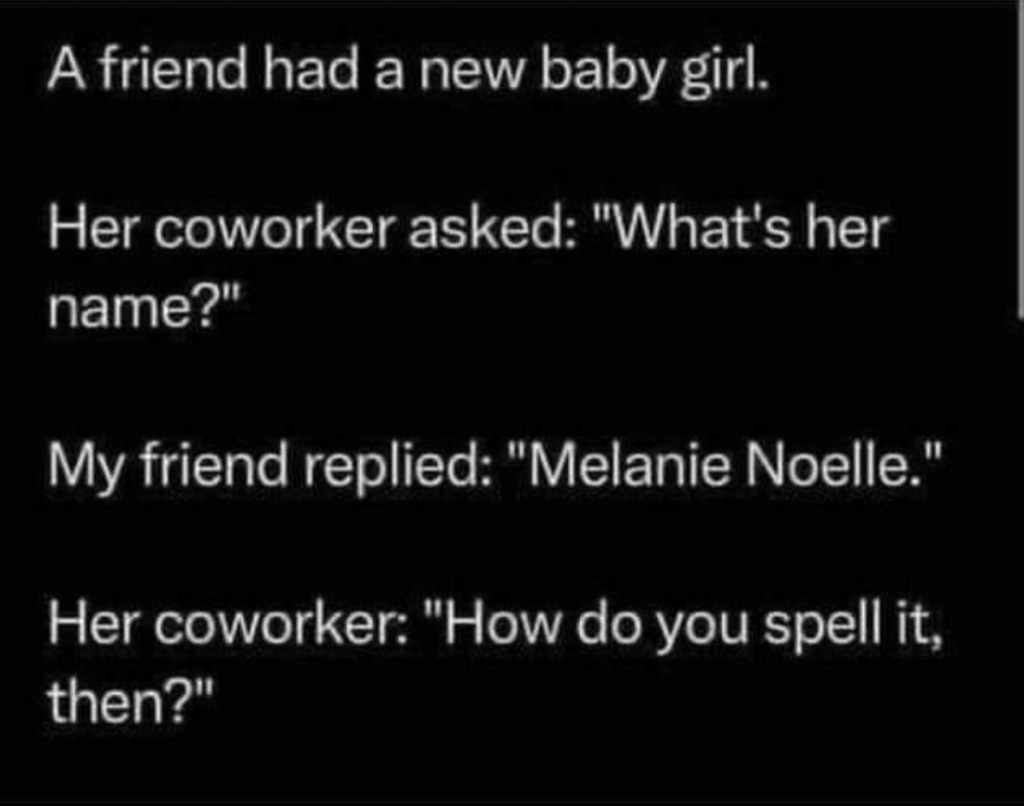
OK, I’ll admit it: I have no idea what “Melanie Noelle” is supposed to sound like, besides two feminine-gendered names.
LikeLike
Carl, Noelle sounds like “no L”.
LikeLike
A fondly remembered scene from my twenties was at a small semi-drunken dinner party where the hostess kept urging refills of her excellent Stroganoff on guests (particularly single gay male buddy Stan) with a suggestive garbled pronunciation. “Stan, wouldn’t you like some more stroking-off?” “Thanks, Sue, I’ve really been enjoying the stroking-off, but can’t handle more right now.” Sue’s husband, a medical intern at that time, had not been drinking as he had to go in for a shift shortly. But he seemed to be the one getting the greatest kick from this by-play!
LikeLiked by 1 person
Dana K(3): Along the same lines, for years I’ve made a “Christmas BLT”…
LikeLiked by 1 person
Carl,
And “Melanie” with no ‘L’ is “Meanie”
Not exactly a good name.
LikeLiked by 1 person
@phsiii: the fiber optics on your sandwich are terrible!
LikeLiked by 1 person
That’s definitely not how I pronounce “stroganoff.” And I don’t think anyone else does, either.
LikeLike
Andrew, if you mean the way it is used in the Brevity panel, you are surely correct, and that’s how it earns its “Oy!”.
But if you mean the way it was said in Dana’s story, I think we’ll just have to take their word on it!
LikeLiked by 1 person
That’s definitely not how I pronounce “stroganoff.”
It’s close enough for jokes, like one about a bull pleasuring himself (I don’t recall if the anatomical difficulties of that are addressed) that ends with, “beef stroking off.”
LikeLike
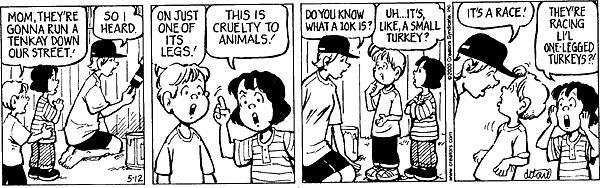
The tenkay reminds me: they are building a new picost over by the henway.
LikeLike
“What’s a picost?”
LikeLike
And what’s a henway?
LikeLike
Sorry, Mark, but some of us don’t speak Boston.
LikeLike
An adult hen can weigh upwards of 5 pounds, and even reaching 10 is not rare.
LikeLike
Mitch4(12) – $3.99 a slice.
LikeLike
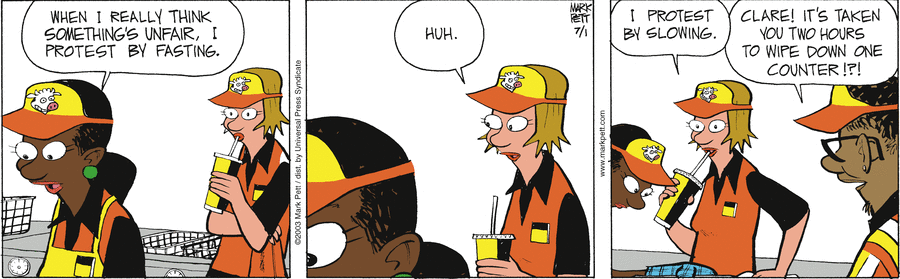
Nobody responded to “Commis Chef.” Sigh.
LikeLike
Pete, I saw it first thing in the morning, and I didn’t know the term. After looking it up, I thought “Okay, I guess that’s right” but by then had forgotten to be looking for a joke ;-(.
So thanks for teaching me a new term…. And before I forget again, what’s the intended joke? Anybody?
LikeLike
Thanks, Guero. I’m familiar with the “henway” part, but have always heard that alone. I figured “picost” would be about pie, but was pleasantly surprised to see from your response that it meant pizza pie! Hmm, or does it? Apple pie and cherry pie do come by the slice, at restaurants…
LikeLike
Pie served in the Prairie Home Companion’s “Chatterbox Café” was sometimes described as being a “slab“. I always assumed that this was a midwestern oddity; I once heard someone at a bakery in Washington D.C. ask if he could get his bagels in a “sack” (rather than the usual “bag“). When I asked, he confirmed that he was from somewhere in the northern midwest.
LikeLike
@Mitch4, Beef Stroganoff is a Russian dish. “Commis” is a French word. It sounds like “Commie”
LikeLiked by 1 person
OK, Pete, thanks for that backthrow!
LikeLike
Seriously? Huh…. I Googled (well, Duckducked) picost and came up empty. I just thought I was making a joke. Like Dana K, or were they being serious, too?
LikeLike
Guero, I’m positive Dana was playing along, and provided the usual last step in this pretty old joke. You work in “henway” in some context that doesn’t help give it a meaning but makes it a noun. Then the naive other party asks “what’s a henway?” and the jokester answers with a weight amount, thus reframing the question as “what’s a hen weigh”.
Mark’s version included, besides “henway” another opaque term, “picost”. It pretty clearly had to be a second part of the joke, modeled on the “henway”. But it was new to me! So I was unsure what the re-hearing was supposed to be. But your answer was exactly the sort that would fit, and I figured you knew the joke from way back. If you just made it up, great, it fit perfectly!
LikeLike
Ha! I’d never heard the henway joke before now, but I was pretty sure you were doing a set-up so I thought I’d play along. Apparently I’ve “whooshed” myself.
LikeLike
Henway and piecost both go back to my teens at least, so 50+ years.
LikeLike
Of course in Boston we already have the Fenway, a road that goes through the Back Bay Fens. You common folk may have swamps, but here in the land of the bean and the cod where the Cabots speak only to Lowells etc., the Lowells call them Fens. Not far from the Fens is a place you may have heard of, Fenway Park.
So when you mention a Henway, someone familiar with Boston thinks “I know what the Fenway is, but what’s a henway?”
LikeLike
Wasn’t familiar with “picost” but putting it in with “henway” tipped me off that it was a joke word. One of the things you can do if you’re familiar with the joke is respond with something like, “I’m unfamiliar with that word, what does it mean?”
LikeLike
There was a recent announcement here that the last “Pi Pizzeria” in town is closing. It had a moment of fame when Obama visited and raved about their Chicago-style pie. You could probably buy the rights, but I don’t know what the Pi cost would be.
LikeLike
Another gag with the same basic structure involves “snoo”; when the victim asks, “What’s snoo?”, the reply is “Not much, what’s new with you?”
P.S. Walt Kelly used “snoo” in “Pogo” on at least two occasions; right after the punchline in one of the later strips, one of the characters commented: “Not that ten year old gag!”
LikeLike
I don’t know about Seattle pie but I heard that over in Pennsylvania, William Penn had two aunts who opened a bakery. The cakes and doughnuts sold well because not only were they high quality, but they were low-priced compared to the competition. They also made pies but as you may know, pies are labor-intensive and the cherries or peaches or whatever fruits you use tend to be costly. So they set the price of their pies at a rate that reflected the cost of the labor and ingredients, and that was just too much for most people to pay. Even after all these years, people still talk about the Pie Rates of Penn’s Aunts.
LikeLiked by 3 people
I’m pretty sure the Muppet Show featured the “What’s snoo?” joke among other old ones. :-)
LikeLike
I mean, “stroke” and “strong” don’t even rhyme, so I’m not sure why they’d be comparable. Stroganoff does sound a bit like “stroking off” but not at all like “strong enough.” It’s a bad joke.
LikeLike
Of far less humor than the above – I do like the picture in the sewing comic. Just what ladies – and these do seem to be “ladies” or their personal servants – not just women, based on their clothing, – were suppose to do with their time.
I can tell that they are probably doing mending not making new clothing as sewing machines had been invented some decades before, as well as women dressed so well could afford to have their clothing made for them or for their employers to have same made for themselves and their personal servants.
But they are working on something necessary and not decorative needlework such as embroidery.
LikeLike