I don’t mind an occasional re-run, but it gets a little more interesting when an artist decides to re-draw a strip.
Here’s the Non-Sequitur from Valentine’s Day, 2023:
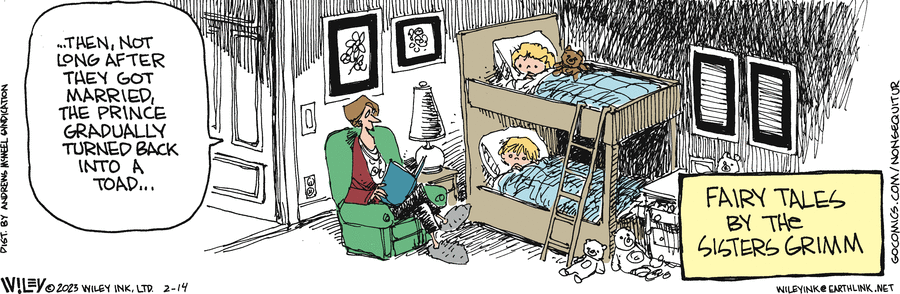
It seemed awfully familiar, and I soon discovered that Wiley had already done a strip with exactly the same joke (1-Nov-2019):
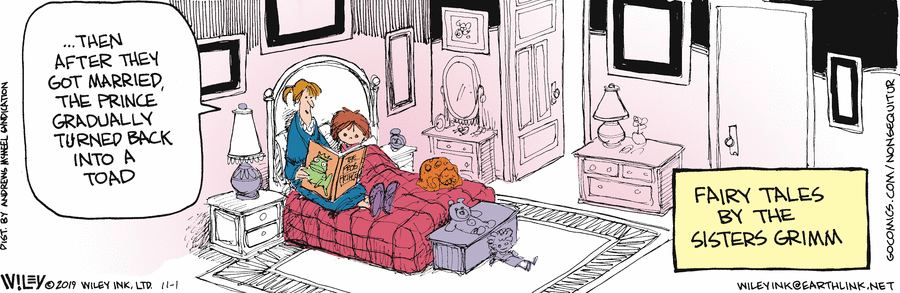
(This time on All Saints’ Day, which doesn’t seem quite as appropriate.)
The really weird thing is that Wiley had already done exactly the same strip (but in monochrome) a full twenty years before (26-Jan-1999):
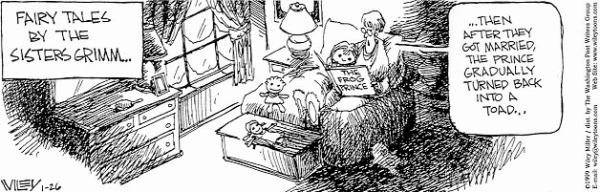
Either Wiley is completely forgetting his own archive, or he is being unusually careful about getting this joke “perfect”.
 Comics I Don't Understand
Watterson did a similar thing with this strip (8-July-1989)†:
The second version (15-May-1992) is notably different, but strengthening the final interjection doesn’t seem to increase the magnitude of Calvin’s realization of his error:
P.S. As far as I know, this is the only example of such a repetition in Calvin and Hobbes.
P.P.S. † – It’s not relevant to the strip, but that date just happens to have been Bill Bickel’s 34th birthday.
Little kid goes out in the backyard with his bat and ball. Throws the ball in the air and swings at it and misses. Picks up the ball, throws it in the air, swings and misses again. Again picks up the ball, throws it in the air, swings and misses. Picks up the ball again and says “Boy, I am a good pitcher”
I wonder why if the story is “The Frog Prince” he eventually turned ‘back’ into a toad.
The funny thing about Wiley’s repeats is how he completely re-drew the illustration for the joke. I for one would consider that to be the hard part.
@Kevin, you reminded me of the most shameful headline from The Onion that I ever laughed at.
“Special Olympics Batting Tee Pitches Perfect Game.”
Good catch, @Anon!
@ padraig – The second iteration is understandable (redrawing it for color), and I can see that the position of the title box and the dialog might be another consideration, although I cannot say which orientation is better. It’s the second color version (just short of 40 months after the first) that I cannot comprehend. The text/dialog orientation is identical, and putting in a bunkbed doesn’t seem to be sufficient reason for redrawing the comic. (Adding “…not long…” to the to the dialog could have been accomplished without altering the rest of the drawing.)
Sometime check Wayno’s blog, where he gives notes about his weekday+Saturday Bizarro cartoons. He prepares two versions of each one, in different aspect frames, for different outlets. Most weeks he will include both versions of one of the cartoons, and explain what he needed to rearrange or maybe add or skip, to make both work.
@ Mitch – It’s unclear who came up with the idea first. According to Wikipedia, Wiley “…developed a format in 1995 that allows one cartoon to be used in two different ways for both panel dimensions and strip dimensions.“
I doubt that he’s intentionally repeating a joke but going through all the work of redrawing the cartoon. I think it’s more likely he just forgot about the earlier one(s).
Which seems pretty understandable. Over the years he probably has a backlog of jokes that he’s considered and rejected or postponed using, and it’s hard to remember which ones he ended up using.
@ Anonymous – The original German tale is called “(Der) Froschkönig” (frog “king“, rather than “prince”), and the standard (published) text uses “(der) Frosch” throughout the entire story, except for one reference to “Fretsche” at the end, which is dialect, and possibly an archaic pun. The creature is described as wet, cold, and slimy, so it is clearly a frog, rather than a toad (which would have been “(die) Kröte“). The type of amphibian was probably selected because of the water in the well, rather than their nominal gender (in German, frogs are masculine, but toads are feminine).
@ Winter Wallaby – If his joke archive is in his head, then I could understand the repetition, but the virtually identical form of all three instances seems to indicate a paper antecedent, in which case a check mark or a scribbled note such as “used this on [date]” might be a good idea.
P.S. Perhaps I should make it clear that I am not in the slightest offended by any of these repetitions, I actually find them interesting, revealing, and rather amusing. The fact that Wiley can produce excellent cartoons on a daily basis at age 71 is very encouraging.
P.S. Re: formatting – An example of Wiley’s alternative formatting appeared in a CIDU post just last December. At the time I (wrongly) assumed that the panel might have been a repetition of the strip, but now I’m sure that both were published (on the same day) in 2004, and that the panel was simply an alternative version for papers that preferred that format. Here’s the strip:
And here’s the panel (from Bill’s 2019 post, because I cannot find the original source):
P.P.S. Despite the reduced image quality, the cross-hatching is fairly definitive proof that the panel shows a section of exactly the same artwork as in the strip.
Kilby, does grammatical gender affect a German’s perception of an animal’s biological gender? (You say that the grammatical gender probably wasn’t the reason for the selection, but the fact that you mention it at all seems to imply it would be a consideration.)
@WW: considering that the word for “girl” in German is neuter (das Mädchen), probably not…
Schulz did some repeats of a joke over his 50 year career; I can’t be bothered to look them up just now; I think there was a wikipedia kind of page listing them, and I’d often in my reading recognize a joke or two as being repeats. My recollection is that there was usually at least a decade between their apperances, making me think that it was just forgetting that he’d already used a particular gag once (or twice…)
There are a number of repeated Peanuts jokes listed in the Peanuts FAQ at http://fivecentsplease.org/dpb/peantfaq.txt (section 3.10).
I took German for a year in college, and our teacher told us that a cat is almost always “die Katze” whether male or female. “A male cat can be ‘der Kater’ but he has to prove himself first.”
The “king” of that is Jeff Keane, who routinely reuses “Family Circus” panels. Sometimes with new or revised dialog, other times just tweaks to the artwork to update Thel’s hair or the like.
@ WW – I have to disagree with larK: the effect of the nominal gender on German thinking is subtle, but it definitely exists. As MiB said, in German one generally thinks of any cat as being a “she”, unless one knows it (by name or appearance) to be a male. Similarily, a dog (or bird) is a “he”, a horse is an “it”… the list is too long to recite here. There is a very interesting effect in Rowohlt’s German translation of “Winnie the Pooh“: in the original text, Owl (“Wol“) behaves as and is named as a “he”, but since “(die) Eule” is feminine, the translation calls “Oile” a “she” (his/her behavior is of course identical). Piglet and baby Roo become “it”s, but I believe Kanga is still called “she” (because of her obvious motherly instincts).
Recycling artwork (such as by Keane or in “Pardon my Planet”) doesn’t bother me so much, as long as the writing is new. Similarily, an intentionally repeated joke is a different thing from the “unintentional” cases shown above. There are limits, however. An occasional repeated strip in Peanuts is one thing, but when Schulz started rehashing the same old gags over and over again, I started to lose interest in the strip. Yes, Garfield likes lasagne, and Snoopy likes chocolate chip cookies, but there has to be something new in the presentation, otherwise it’s simply tiresome.
@ lark – “…the word for “girl” in German is neuter…”
Twain commented about this fact in his essay on “The Awful German Language“:
In German, a young lady has no sex, while a turnip has…. [Here is] how it looks in print:
Gretchen – “Wilhelm, where is the turnip?”
Wilhelm – “She has gone to the kitchen.”
Gretchen – “Where is the accomplished and beautiful English maiden?”
Wilhelm – “It has gone to the opera.”
… Think what overwrought reverence that shows for the turnip, and what callous disrespect for the girl.
The thing about Mädchen is that it’s a diminutive, and in German all diminutives are neuter. The original word for girl was die Magd, i.e. maid (in the Maid Marian sense, not the housekeeper), and it just got shunted out of use at some point.
Fräulein is also a diminutive and is thus neuter, but is now generally dead except for ironic or snarky use. Any female person old enough to be addressed formally is addressed as Frau. Something similar will probably happen to Mädchen someday, but not before the ongoing brutal back-alley knife fight over how to handle gender neutral plurals is resolved.
We have (mostly) lost the connection that people used to have to working animals, but I always find the remnants left in English fascinating: it’s often as if the male is a completely different species from the female: bulls and cows, eg. For me growing up, they were even more distinct than say cattle vs. oxen. Hens and roosters. Geese and ganders? Come on, you’re kidding me! As a non-animal specialist, I’d rather just lump them all in one species category, cows, chickens, geese, especially when the differences aren’t particularly obvious or relevant to me anymore. Imagine if before referring to any old cat I see, I had to go sex the damn thing first.
I wonder if its as axiomatic as we would assume that article gender follows animal sex; are there languages that violate that?
In German, as far as I know, the only violations occur into the neuter article, and that because of grammar rules as DemetriosX points out.
Nevertheless, I always find it startling in German when you are say referring to an unknown person in a book, but it is clear the sex of this person, you just don’t know who it is, but nevertheless, depending on the noun you are using, that’s the sex of the pronoun you have to use to refer to this person. So if you describe “a shadowed figure” skulking in the alleyway, because “die Figur” is feminine, you have to then say, “she suddenly darted away”, even if you know it’s a man, because it’s the figure doing the darting, and die Figur is feminine.
Now, this sounds extremely strange to English ears, and even mine, having mostly grown up in the US after the age of 4, but we have to remember, English is by far the outlier here, we are the weird ones, so we can’t really use the fact that just because it’s odd to English speakers it is universally odd. Twain used the contrast to humorous effect to his English speaking audience, but that piece does not translate. At all. And what it highlights to me is that Twain was a poor language learner, unable to even begin to come out from under the trap of translating everything — you have to learn to think in a new language, hard as that may be.
(For the example above about the figure, I don’t think in English we would blink if we referred to specifically the figure as “it” (“the figure spun on its heel, and it was seen no more”), even if we know it’s Jack the Ripper, we don’t let the “it” get in our way and make us think it’s some kind of gelded or asexual being skulking in said alleyway (“The shadowy figure put away its engorged member and fled when it perceived the police approaching”).)
Kilby, thanks for the insights into the effects of grammatical gender on Germans.
Even in English, the “default” gender for dogs is male, and for cats is female. One of the comments on this page claims that among languages with a default grammatical gender form for “dog”, 47/49 are male.
@ Lark – “…Twain was a poor language learner, unable to [escape] the trap of translating … you have to learn to think in a new language…”
In fairness to Twain, this is a skill that requires practice, knowledge, and a lot of time. It is unclear how long he had been learning German when he wrote that essay, although it was probably longer than the “several weeks” that Twain mentions in the opening paragraphs (here edited for brevity):
“I went often to … Heidelberg Castle, and one day I surprised the keeper of it with my German … after I had talked a while he said my German was very rare, possibly a “unique”, and wanted to add it to his museum. If he had known what it had cost me to acquire my art, he would also have known that it would break any collector to buy it. Harris and I had been hard at work on our German [for] several weeks … although we had made good progress, it had been accomplished under great difficulty … A person who has not studied German can form no idea of what a perplexing language it is.“
French “la chatte” / “une chatte” (“the/a cat” feminine) has a special application just like “pussy” in English. And you can’t use “le chat” / “un chat” (masc.) for that!
The same thing can be multiple genders. In French, un homme can be une personne. How would you say “I saw the man you told me about but he was not the person I was looking for.”? Would you say “I saw the man you told me about but SHE was not the person I was looking for”?
Also in French, the possessive pronoun takes on the gender of the thing possessed. In English: “John brought his flute and his violin, and Mary brought her flute and her violin.” In French: “John brought her flute and his violin, and Mary brought her flute and his violin.”
Spoken Mandarin doesn’t have gendered 3rd person pronouns. When I hear someone describing their interactions with someone, and at the end of the story I still don’t know that person’s gender, I find it very distracting, even when their gender is irrelevant to the story. As a progressive feminist, I shouldn’t care, but as a native English speaker, the inside of my brain is screaming “Augh, is this story about a man or a woman?”
Even in English, the “default” gender for dogs is male
Except for poodles. Pooch Cafe has a fun flip of expectations. The main female dog is Droolia, a large mastiff.
@ MiB – In German, the gender of a relative (or personal) pronoun normally matches the nominal (grammatical) gender of the term that was most recently used to refer to the person (or object). A story about “Mary” could use the “natural” feminine pronoun (“sie“), but if the girl is later referred to as “(das) Mädchen“, the next instance of a pronoun would be the neuter form “es” (“it”).
As form the possessive pronouns, I think the problem in French is that the stem of the word has been reduced to “s…” for both genders, so that the declination seems more significant than the root. In German, the pronouns are also declined to fit the object possessed, but the root words show a definite difference, depending on the gender of thr possessor, as in English:
“John brought his violin and his chair, and Mary brought her violin and her chair.”
In German: “Johannes brachte seine Geige und seinen Stuhl, und Marie brachte ihre Geige und ihren Stuhl.“
P.S. The shift in gender of a relative pronoun can easily occur in a single paragraph, but in extreme cases even in a single German sentence, which are known for their excessive long-windedness, much like this one.
P.P.S. Twain quoted a friend who said, “I would rather decline two beers than one German adjective.“
In Portuguese, the possessive pronoun is the same for your, his, and her: seu/sua/seus/suas (declined to match gender and number of the noun). I found this very hard to swallow when I was learning Portuguese: Me dá seu livro can mean “give me your book”, but also “give me his book” or “give me her book”. But in actuality, to avoid exactly this confusion, you would say Me dá o livro dele or dela for his or her. (This problem arises especially where the “tu” form of “you” is not used much in favor of the “você” form (tu has teu/tua as possessive); this is kind of like English, where “thou” got deprecated in favor of always using “you”.)
larK, do you happen to know if Portuguese speakers use the gender-specific form as a matter of course, even when it’s not necessary to avoid confusion?
WW: I’m not sure what you mean. In Portuguese, every noun is either masculine or feminine, and you must use the proper gender (matching the noun) not only for articles, but adjectives, including possessives and the like — you can’t not use gender. But the gender follows the noun, whatever it may be.
I guess in Portuguese there is the fact you have to gender your adjectives even when the noun you are referring to is yourself: the word for “thank you” in Portuguese is “obrigado” for men, and “obrigada” for women; this is because the structure is like “I am obliged”, and so depending on the sex of the “I”, the adjective “obliged” has to follow that gender. It works that way for “you” too, depending on whether the “you” is a man or a woman, all adjectives must follow the gender of the sex of “you” (or “I”). “Você é linda” or “Você é lindo” depending on whether “you” (você) are a beautiful male or beautiful female. “Eu sou lindo”, since I (eu) am a male. (I am always getting this one wrong, it’s a common mistake for gringos like me (were I a woman, that would have to be “gringas”).)
Also, you can’t hide the sex of a friend, since the word changes depending on the sex of the friend: you either have un amigo or uma amiga.
larK: I was referring to the specific example you gave of the 2nd/3rd person possessive pronoun, which I understood you to be saying was gender-neutral with respect to the owner (not gender-neural with respect to the owned object). You said a speaker would likely use the structure with dele/dela, which varies with respect to the gender of the owner, to avoid confusion. I was asking if this was only done to avoid confusion, or would just be done as a matter of course, even when not necessary to avoid confusion.
e.g. if there are two books, one owned by a 3rd person man, and one owned by a 3rd person woman, using “seu” is ambiguous, and instead using “dele/dela” is clearer. But if there is only one book, using “seu” doesn’t create any ambiguity.
WW: hard for me to judge, because I always prefer the form without ambiguity, so I am biased, but I think that the dele/dela form is used much more than the seu; I think seu is used almost exclusively for “your”. I have almost never encountered it to mean his/her. Once when I did, I mentioned it to my wife, trying to elicit if it was a strange form for her, but she didn’t really understand what I was talking about, ie: she’d never really thought about it. When I pointed it out to her, she agreed that it was potentially ambiguous, but she’d never found it to be ambiguous. So in the end, I still don’t know.
(I just asked her, and she agrees with my assessment: seu is pretty much universally understood as only “your”, and you’d use “dele” for his; only in archaic usage would she be prepared to understand “seu” as his, so if she’s reading an old book or something; if I were to say it, I would be a dumb gringo getting my pronouns wrong.)
A friend of mine who spent time studying in Hungary told me that the Hungarian language does not have the verb “to have”, so much use must be made of the possessive case.
He said you can’t say “I have a ticket to the concert.” You say it as “There is a my-ticket to the concert.”
@ MiB – I have been told that Russian does not have a verb “to be” (am, are is), so that associations are established merely by proximity.
Getting back to comics: as I was looking up “Maria’s Day” for the “Romance” post, I discovered that the same author/illustrator pair also does Working Daze, including a comic that was posted to CIDU in 2021 :
Kilby: I think you are confusing Russian for Klingon. Klingon was designed by a linguist, and to keep things interesting for themselves, they decided not to have the most universal of verbs, ie: to be.
I believe that all known natural languages have the verb “to be”…
@ larK – You are correct that it does exist, but it is normally no longer used:
“… the verb “to be” быть … which is now omitted except for rare archaic effect, usually in set phrases …. The present tense of the verb быть is today normally used only in the third-person singular form, есть … As late as the nineteenth century, the full conjugation, which today is extremely archaic, was somewhat more natural…“
P.S. @ larK – “… confusing Russian for Klingon …”
I don’t want to start an argument, but in the current geopolitical situation this would be a very understandable mistake.
Thanks for the explanation, and further information from your wife, larK.
Hebrew also lacks a verb for “to have.” For “I have a book” you say “There is, to me, a book.”
I believe that all known natural languages have the verb “to be”…
I don’t know if you would count this at least as a partial counterexample, but Mandarin has no verb “to be” that links nouns and adjectives. It does have such a verb for linking two nouns. e.g. “he [is] a lawyer” has a verb for “is”, but “he is very tall” has no verb for is. “He is very tall” is just a three character sentence: “[he] [very] [tall].” (Which is why Mandarin speakers will often leave off “is” in those sort of sentences when speaking English.)
Just got curious about the “to be” question. According to wikipedia there are languages without “to be.” Apparently American Sign Language lacks a “to be,” and Nahuatl expresses “to be” by “conjugating” nouns or adjectives like verbs. (Kilby, the page also says the Russian “to be” verb is typically omitted in present tense, but used regularly in past and future tense.)
Ancient Greek has “to be” but you don’t have to use it much. If a sentence has no verb, the verb “to be” is implied. “Two men walking in the road” = “Two men were walking in the road.” “That man my father” = “That man is my father.” I don’t know about modern Greek.
It must be hard to perform Hamlet in languages which do not have “to be”!
[…] a year ago I posted a set of Non-Sequitur comics in which Wiley had repeated the exact same joke (including some lengthy dialog) in three different […]