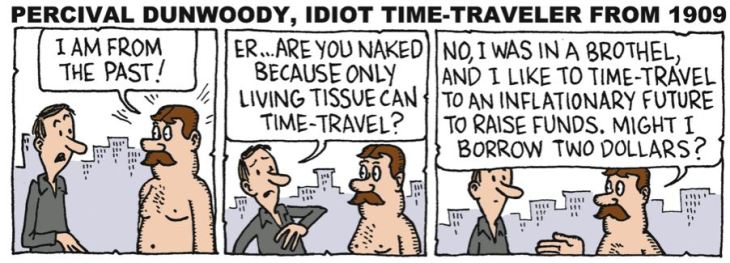
He really is an idiot, he would need to find a collector with antique money, which would be more expensive … oh fergit it!
Too bad those dollar bills will look phony to anyone in his own time.
I vaguely remember a short story involving a time traveler having trouble bringing modern-day money into the past, and had to resort to buying antique currency from an antique store. Does this ring a bell with anyone?
Grawlix – yes, definitely.
I don’t know if it was the same story as one where a backwards-jumping character has sports record books and yearly World Almanac statistics books, and makes a fortune betting.
Why bother? Gold and silver are the same anytime: just scratch out the date; as long as the weight is right, you should be ok.
In Heinlein’s “The Door into Summer“, the time travelling main character prepares for a 30 year jump into the past by stocking up on gold wire (which is cheap in the future), but he is careful (and pays extra) to obtain a “natural” balance of isotopes, so that its artificial origins cannot be detected.
What you’d want is antique bills in rough condition. Those aren’t worth much on the collector market so you can get them for relatively low price. Of course, that starts to become quite the project.
There was an SF story where home inventor creates a time machine, which is a failure because the only thing it can do is send you back for a short time to the 1930s in front of the butcher’s shop. His wife hears this, sorts through her cash, then pops back there to buy meat at Depression prices.
I was thinking The Door into Summer might be one source of the similar bits I was recalling in an earlier comment.
Another was a tv miniseries a couple years back written by Stephen King (or based on a Stephen King book?), titled by the date “11-23-63” in some format. The story eventually had the time traveller trying to save JFK from assassination, but had some pretty good nerdy bits about stuff he would get sent back to himself to use in the past and how he adjusted to life back then.
@ Brian in StL – I remember reading that story, but I cannot remember the title or the author’s name(*). I do recall that after the first order, the wife forgot either to pay or to collect her change, but the butcher wasn’t worried: her was sure that she would return.
P.S. From my reading habits back then, the most likely candidates would be Heinlein, Asimov, Niven, or Bradbury.
One of the charms of “The Door into Summer” is that the 30-year gap Kilby mentions is between 1970 and 2000 (or 2001?) , the two future era settings for this 1956 book. His ideas of how the robotics industry (as we would now call it) would develop are mostly weird bunk but here and there spot on. And in many little things he was way off, mostly by overestimating the speed of progress.
I was just reading the section where he has jumped back from 2001 to 1970 (for those unfamiliar with the book, this isn’t something that happens multiple times and is known to the public – unlike the commercial “cold sleep” services that take you the other way as needed), and complains of the old-fashioned practices and products he has returned to. I can buy that he had to use paper and a physical drafting board for his mechanical engineering in 1970 and missed the computer based systems of 2000. But sadly we never did get Sticktite instead of zippers, plates that don’t let your food get cold, etc.
Kilby and Brian in StL : I remember that story appeared in THE MAGAZINE OF FANTASY AND SCIENCE FICTION and was reprinted in at least one anthology, probably one of the BEST FROM series for that magazine. And I think the author was female, and a little-known or unknown name. Any of the above could be wrong, but I’ll see if I can find out and report back.
I remember reading that story, but I cannot remember the title or the author’s name(*). I do recall that after the first order, the wife forgot either to pay or to collect her change, but the butcher wasn’t worried: her was sure that she would return.
As I recall, she was coming back for a Sunday roast. The butcher has delighted that someone came in with cash and didn’t haggle. Probably needed to find some more appropriate money. Really you’d have better luck with coins. It’s not hard for me to find decades-old quarters in change.
I found it. It’s called “The Good Provider”, by Marion Gross. Years ago, someone asked about it on (synchronicity alert) rec.arts.comics.strips. I crossed it over to rec.arts.sf.written and William Hyde did the YASID duties.
I also seem to remember in Heinlein’s “Time Enough for Love” the character intends to time-travel back to 1919 but instead ends up in 1916 and has to quickly destroy all of the “Series 1919” antique money he brought with him, lest he be caught and prosecuted for “funny money”.
In “Time after Time” (movie) HG Wells has to do the opposite – change his old British coins into modern American money. He does so at at bank despite the employee telling him he would do better to go to a coin dealer.
Shows how little some parts of life change over time – exchange money from one’s home country to that of where one is located – go to a bank then and in 1979.
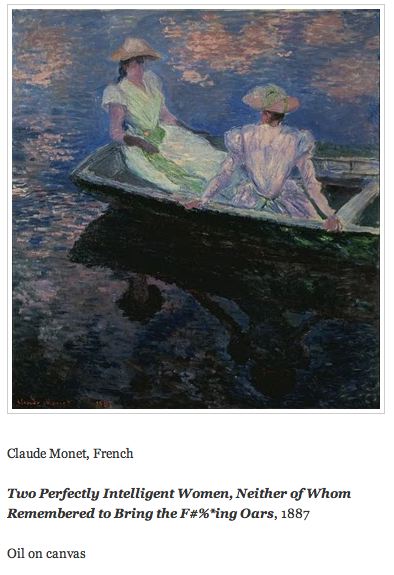
The ladies did not bring oars on purpose. As damsels in distress – of course some wonderful gentlemen will come along and save them – and perhaps become their future husbands.
Manet hid the oars because he didn’t want them rowing away when he was trying to paint them. Artists hate when models do that.
Thinking about Door Into Summer
Are we to take it he went in in 1973 and just got out today? If so, it’s an interesting take, and not quite the slam-dunk simple cynicism the author seems to be aiming for… The Cold War did end, and it’s interesting this guy is asking how it ended, because I would make an argument that anyone from that era would either assume it didn’t end (see Clarke’s 2001 and 2010 eg), or that it did end — very, very badly, so he wouldn’t be all excited, would he?
(Yes, we seem to be lining up for either Cold War 2.0 or WWIII thirty years later, but that doesn’t mean nothing’s changed!)
I would also question his preoccupation with climate crises and income inequality — climate crises would be smog (look at some photos of LA from the early 1970s!) and maybe the disappearing ozone layer, and both of those have been successfully mitigated (well, in the developed world, anyway). I would think he’d be worried about the over-crowding from over-population, and if we’ve finally invented a pills so you wouldn’t have to eat or sleep…
(To say nothing of wondering where the flying cars are…)
I suppose another way to take it (and this was indeed raised in the Gocomics comments) is that this is a future scene, and he entered cold storage right now. But that doesn’t work so well. Why would he be asking about “the Cold War”? Sure, we have issues with Russia and China, but don’t use that terminology. And is “famine in Africa” more of a prominent concern in 1973 or in 2023?
Not the ozone hole, 1973’s too early for that. But the term “climate crisis” is anachronistic even if you go just a few years back. I think the author just grabbed a bunch of headline issues without working out the details.


 Comics I Don't Understand
He really is an idiot, he would need to find a collector with antique money, which would be more expensive … oh fergit it!
Too bad those dollar bills will look phony to anyone in his own time.
I vaguely remember a short story involving a time traveler having trouble bringing modern-day money into the past, and had to resort to buying antique currency from an antique store. Does this ring a bell with anyone?
Grawlix – yes, definitely.
I don’t know if it was the same story as one where a backwards-jumping character has sports record books and yearly World Almanac statistics books, and makes a fortune betting.
Why bother? Gold and silver are the same anytime: just scratch out the date; as long as the weight is right, you should be ok.
In Heinlein’s “The Door into Summer“, the time travelling main character prepares for a 30 year jump into the past by stocking up on gold wire (which is cheap in the future), but he is careful (and pays extra) to obtain a “natural” balance of isotopes, so that its artificial origins cannot be detected.
What you’d want is antique bills in rough condition. Those aren’t worth much on the collector market so you can get them for relatively low price. Of course, that starts to become quite the project.
There was an SF story where home inventor creates a time machine, which is a failure because the only thing it can do is send you back for a short time to the 1930s in front of the butcher’s shop. His wife hears this, sorts through her cash, then pops back there to buy meat at Depression prices.
I was thinking The Door into Summer might be one source of the similar bits I was recalling in an earlier comment.
Another was a tv miniseries a couple years back written by Stephen King (or based on a Stephen King book?), titled by the date “11-23-63” in some format. The story eventually had the time traveller trying to save JFK from assassination, but had some pretty good nerdy bits about stuff he would get sent back to himself to use in the past and how he adjusted to life back then.
@ Brian in StL – I remember reading that story, but I cannot remember the title or the author’s name(*). I do recall that after the first order, the wife forgot either to pay or to collect her change, but the butcher wasn’t worried: her was sure that she would return.
P.S. From my reading habits back then, the most likely candidates would be Heinlein, Asimov, Niven, or Bradbury.
One of the charms of “The Door into Summer” is that the 30-year gap Kilby mentions is between 1970 and 2000 (or 2001?) , the two future era settings for this 1956 book. His ideas of how the robotics industry (as we would now call it) would develop are mostly weird bunk but here and there spot on. And in many little things he was way off, mostly by overestimating the speed of progress.
I was just reading the section where he has jumped back from 2001 to 1970 (for those unfamiliar with the book, this isn’t something that happens multiple times and is known to the public – unlike the commercial “cold sleep” services that take you the other way as needed), and complains of the old-fashioned practices and products he has returned to. I can buy that he had to use paper and a physical drafting board for his mechanical engineering in 1970 and missed the computer based systems of 2000. But sadly we never did get Sticktite instead of zippers, plates that don’t let your food get cold, etc.
Kilby and Brian in StL : I remember that story appeared in THE MAGAZINE OF FANTASY AND SCIENCE FICTION and was reprinted in at least one anthology, probably one of the BEST FROM series for that magazine. And I think the author was female, and a little-known or unknown name. Any of the above could be wrong, but I’ll see if I can find out and report back.
I remember reading that story, but I cannot remember the title or the author’s name(*). I do recall that after the first order, the wife forgot either to pay or to collect her change, but the butcher wasn’t worried: her was sure that she would return.
As I recall, she was coming back for a Sunday roast. The butcher has delighted that someone came in with cash and didn’t haggle. Probably needed to find some more appropriate money. Really you’d have better luck with coins. It’s not hard for me to find decades-old quarters in change.
I found it. It’s called “The Good Provider”, by Marion Gross. Years ago, someone asked about it on (synchronicity alert) rec.arts.comics.strips. I crossed it over to rec.arts.sf.written and William Hyde did the YASID duties.
https://groups.google.com/forum/#!msg/rec.arts.comics.strips/IWofuOuRcEQ/wY7dILX9atAJ
I think Brian in STL has it in one. Good show, sir!
It’s apparently her only professional publication, so “unknown name” also matches up:
http://www.isfdb.org/cgi-bin/title.cgi?56059
I also seem to remember in Heinlein’s “Time Enough for Love” the character intends to time-travel back to 1919 but instead ends up in 1916 and has to quickly destroy all of the “Series 1919” antique money he brought with him, lest he be caught and prosecuted for “funny money”.
In “Time after Time” (movie) HG Wells has to do the opposite – change his old British coins into modern American money. He does so at at bank despite the employee telling him he would do better to go to a coin dealer.
Shows how little some parts of life change over time – exchange money from one’s home country to that of where one is located – go to a bank then and in 1979.
The ladies did not bring oars on purpose. As damsels in distress – of course some wonderful gentlemen will come along and save them – and perhaps become their future husbands.
Manet hid the oars because he didn’t want them rowing away when he was trying to paint them. Artists hate when models do that.
Thinking about Door Into Summer
Are we to take it he went in in 1973 and just got out today? If so, it’s an interesting take, and not quite the slam-dunk simple cynicism the author seems to be aiming for… The Cold War did end, and it’s interesting this guy is asking how it ended, because I would make an argument that anyone from that era would either assume it didn’t end (see Clarke’s 2001 and 2010 eg), or that it did end — very, very badly, so he wouldn’t be all excited, would he?
(Yes, we seem to be lining up for either Cold War 2.0 or WWIII thirty years later, but that doesn’t mean nothing’s changed!)
I would also question his preoccupation with climate crises and income inequality — climate crises would be smog (look at some photos of LA from the early 1970s!) and maybe the disappearing ozone layer, and both of those have been successfully mitigated (well, in the developed world, anyway). I would think he’d be worried about the over-crowding from over-population, and if we’ve finally invented a pills so you wouldn’t have to eat or sleep…
(To say nothing of wondering where the flying cars are…)
I suppose another way to take it (and this was indeed raised in the Gocomics comments) is that this is a future scene, and he entered cold storage right now. But that doesn’t work so well. Why would he be asking about “the Cold War”? Sure, we have issues with Russia and China, but don’t use that terminology. And is “famine in Africa” more of a prominent concern in 1973 or in 2023?
Not the ozone hole, 1973’s too early for that. But the term “climate crisis” is anachronistic even if you go just a few years back. I think the author just grabbed a bunch of headline issues without working out the details.