Bonus: Onomastic question

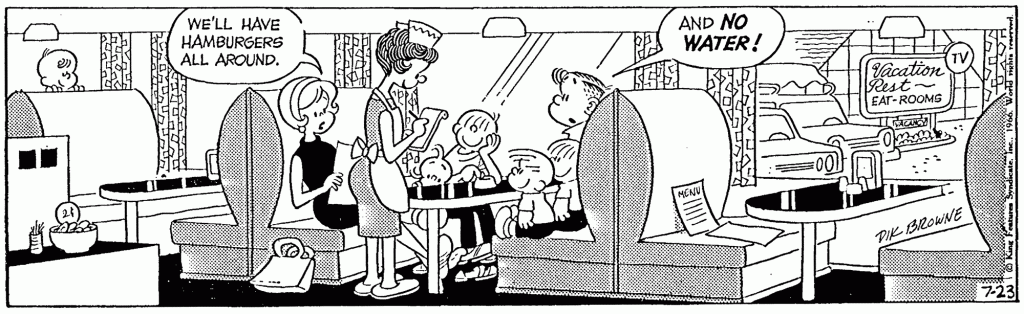
Okay, so how are those names translational equivalents?
Here is some help for Madariaga, from Ancestry.com:

Madariaga Name Meaning

Basque: habitational name from any of various places in Gipuzkoa province named Madariaga from Basque madari ‘pear tree’ + the locative suffix -aga ‘place or group of’. Compare Madriaga and Maradiaga .

Source: Dictionary of American Family Names 2nd edition, 2022

https://www.ancestry.com/name-origin?surname=madariaga

And then note that, as a noun in German, Mandelbaum would mean almond tree. 

Can we call it? As close-enough? 

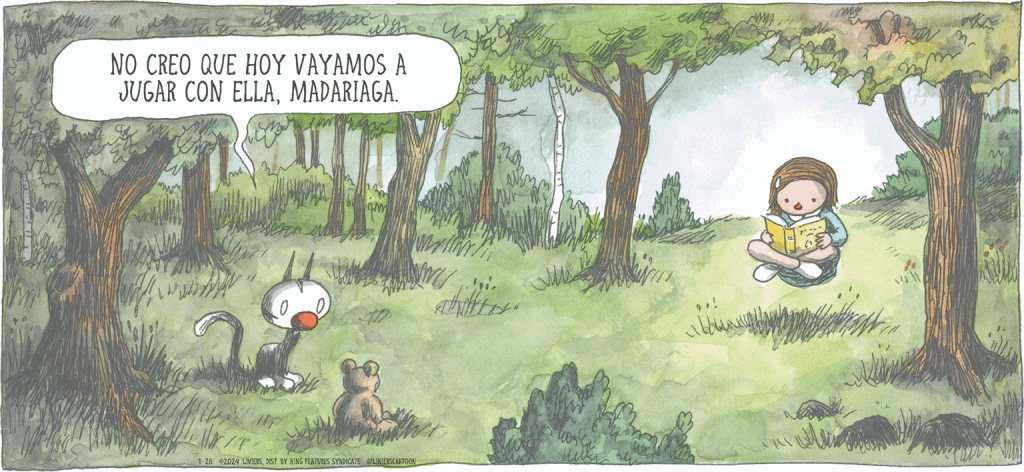
BTW, question for fans, is the little bear a recurring character? Is he often addressed by name?

Oh, wait! Why is it they can’t they play with her today? Because she is too busy reading and levitating? 

“Please help with understanding the Spanish”? — No, please help with understanding the humor!

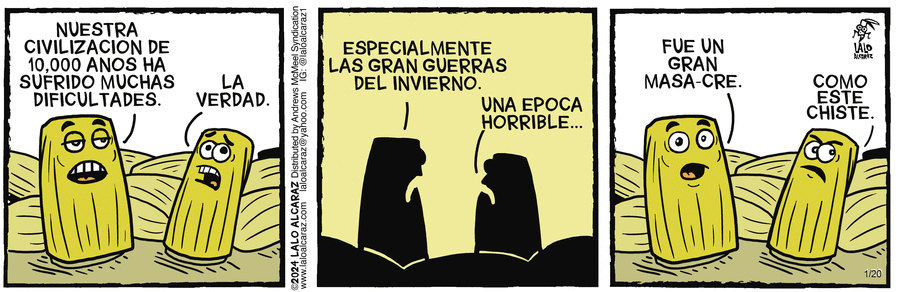
Very considerate of the English captioning to inform us these are tamales, which is not mentioned in the Spanish, and may not have been that obvious. In panel 2, invierno means winter, but I’m glad to learn that it might be a way Spanish speakers refer to what Anglophone North America calls “the holidays” or “the holiday period”. 

But the crux of the puzzlement is in the final panel. We have the material for a pun, in partial split meanings: masa by itself can mean dough, and masacre written solid would be the obvious massacre, or as Google Translate for some reason prefers, slaughter. But we have to ask, if there are fluent or native Spanish speakers here, does this work for you as a joke?

Identifies as a Colt

Thanks to Boise Ed for sending this in, and affirming that the surface joke is puny but obvious. (That this exec is trying to hold the mascot responsible for the team’s poor performance.)

But then, what kind of a mascot is that, anyway? The writing says Colts, twice, but the costume is a bird. Red because Cardinal? Sharp beak because Raven? Is that confusion a reason the poor thing has failed to energize the fans, and they in turn have failed to energize the players? 

1.5 words per hand??

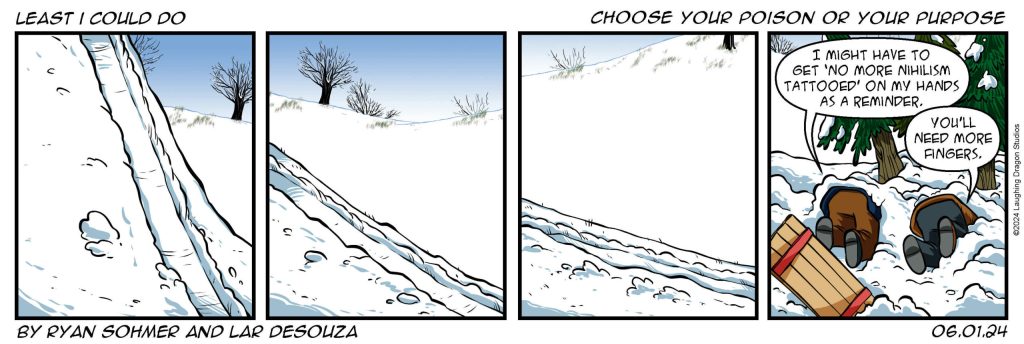
Thanks to Jack Applin for sending this in, and starting the debate on tattoo strategy!

As Jack suggests, and the CIDU team agrees, there has to be a mistake and the word “tattooed” should be outside the quotation marks. Still, that leaves a lot of text to fit. ”Also, ‘hands’, plural? Does he want the phrase duplicated on each hand, or two words on one hand, and the rest on the other?” The companion’s remark about fingers suggests the “Night of the Hunter” strategy…

P.S. For more examples of cinematic knuckle-tattooing, see this Guardian bit.

Bonus etymological dispute

I thought I *knew*, as an evidence-based origins account and “official” answer, that the term flack for a public relations officer was closely tied to flak “anti-aircraft fire” — via the intermediate occupational descriptive term flak-catcher for their role in deflecting or absorbing abuse and accusation. And that this was popularized in Tom Wolfe’s essay title “Maumauing the Flack Catchers”. (His flak-catchers were local bureaucrats rather than p.r. agents but the idea was closely related.)

But I wanted to check with something besides my own memory, in scholarly sources or some easily-accessible online approximation thereto.

And so, how disappointing that Dictionary.com gives us a story about some guy named Flack, and no mention of flak except a link in a “words sometimes confused with flack” section.

 ORIGIN OF FLACK

  1935–40; said to be after Gene Flack, a movie publicity agent

Well! At least some support from Etymonline, though they also give precedence to Gene Flack, but give some skeptical considerations against him. 

  flack (n.)

“publicity or press agent,” in Variety headlines by September 1933; sometimes said to be from name of Gene Flack, a movie agent, but influenced later by flak. There was a Gene Flack who was an advertising executive in the U.S. during the 1940s, but he seems to have sold principally biscuits, not movies, and seems not to have been in Variety in the ’30s.

Uppsa! (Awww)

I guess it’s mostly an Awwww. But then, some questions are raised but not answered. Mainly, what’s the joke? Between panels 2 and 3 it changes from two pairs of tracks to one pair — is it meant to be a puzzle, solved by the reveal in panel 4 that one skater is now carrying the other. 

Also: In the first panel, are all the skates drawn correctly facing the way they are going (or are the red ones wrong)? Where we see two pairs of tracks, are they equally skillful or is one more wobbly? In the final panel, are the tracks especially wobbly, and is that sort of the joke? 

Far from home

The artist’s title for this one is “Far From Home”, and the mailing message was “In the future all magazines will have one issue.” 

I can pretty much follow the time-travel ruminations. But there is much more backstory than anything I remember them doing. But then, I haven’t been a fan forever — perhaps someone who has can tell us how this was all anticipated long ago…?