My knee-jerk take is that they’re negotiating a treaty banning battering rams, presumably because they both dislike the idea of a weapon that could endanger them personally.
@Mitch4 Mediaeval battering rams had an iron cap on the pointy end to stop it splintering before its target did. these were often in the form of a ram’s head.
This is the description of the battering ram that the armies of Mordor used to break into the gates of Minas Tirith:
“…in the midst was a huge ram, great as a forest-tree a hundred feet in length, swinging on mighty chains. Long had it been forging in the dark smithies of Mordor, and its hideous head, founded of black steel, was shaped in the likeness of a ravening wolf; on it spells of ruin lay. Grond they named it…”
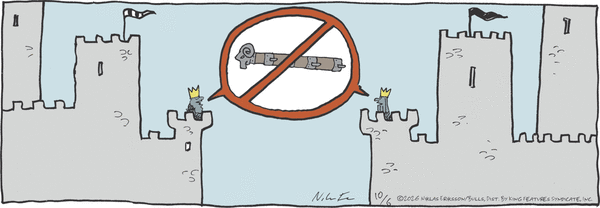


My knee-jerk take is that they’re negotiating a treaty banning battering rams, presumably because they both dislike the idea of a weapon that could endanger them personally.
LikeLiked by 2 people
That’s also what I thought!
And this is the first time I’ve seen a connection made between “battering ram” and “ram” the animal.
LikeLike
Ah, I can see that now. Maybe I need to zoom in more on these. Or get new glasses.
LikeLike
“Computer memory prices are through the roof! Neither of us can afford RAM.”
LikeLike
@Mitch4 Mediaeval battering rams had an iron cap on the pointy end to stop it splintering before its target did. these were often in the form of a ram’s head.
LikeLiked by 1 person
This is the description of the battering ram that the armies of Mordor used to break into the gates of Minas Tirith:
“…in the midst was a huge ram, great as a forest-tree a hundred feet in length, swinging on mighty chains. Long had it been forging in the dark smithies of Mordor, and its hideous head, founded of black steel, was shaped in the likeness of a ravening wolf; on it spells of ruin lay. Grond they named it…”
LikeLike