
CIDU frequently presents holiday-based material, but virtually all of the holidays we have ever celebrated so far have been American, even if a few of them (such as New Year’s Eve and Halloween) are also celebrated outside of North America. The following collection is presented in recognition of German Unification Day, which just happened to land on October 3rd (in 1990), and has been celebrated on that day ever since.

…
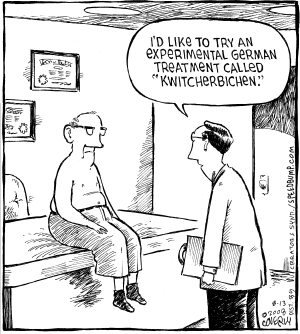
Coverly put a “T” in front of the first “CH”, but neglected to do the same for the second, which would have made the pronunciation clearer, but it might have annoyed the syndicate’s censors.


…
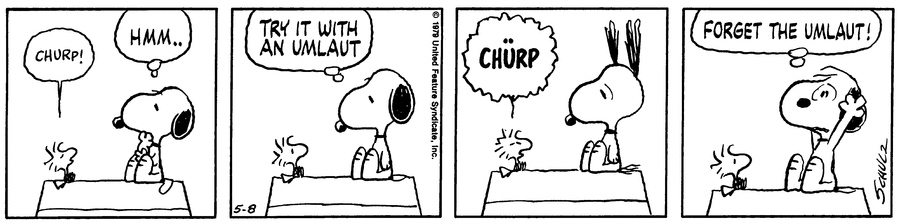
During my first stay in Germany (over 35 years ago), once I had begun to understand and speak a little of the language, I was frequently astonished (and/or embarrassed) by the linguistic abilities of German toddlers, which were often better than my own.
…
Here’s a classic riddle for students beginning to learn the language:
Q – “What does a German parakeet say?“
A – (in a deep voice): “Billig! Billig!” (meaning “cheap”, of course)

…
As unlikely as it may seem, Hogan’s Heroes wasn’t just translated into German, they actually did it twice, because the first version didn’t get good enough ratings. The scriptwriters for the newer version invented details and even (unseen) characters not found in the original shows, and the dialog (of the “Germans”) was changed from standard (“Hochdeutsch“) pronunciation to more comical (Bavarian and Saxon) dialects.
The American characters speak normal German in the translation, except for “Newkirk” (Richard Dawson’s character), who was changed from British to being a stutterer, which was both unnecessary and is absolutely unwatchable (at least for anyone who is familiar with the original show). I don’t remember whether LeBeau was synchronized into German with a French accent.
P.S. Keith Knight has drawn at least a dozen strips based on interactions with his (German) wife; there are simply too many of them to include them all here. Perhaps later, in a separate “linguistic” post.
 Comics I Don't Understand
Here’s one more from The Duplex to add to the collection:
Of course animals like dogs, cats, and chickens do say different things when they are speaking German, which I can read. And I assume every other language. And the sound things make are different too.
@ emjayay (2) – In many cases it’s just a different spelling for what is basically the same sound. German cats say “miau“, and German dogs bark “wau-wau” or “wuff” (the German “w” sounds like an English “v”, of course).
There are other examples for which the sound (or at least the spelling) is completely different. German frogs make exactly the same noise as German (or English) ducks: “quak!“; and German roosters say “Kikeriki!” (the first and last “i”s are a long “ee” sound, the final one is extended).
Germans tend to be highly amused (or sometimes incredulous) when I tell them that frogs say “ribbit!” in English, or that roosters say “cock-a-doodle-doo!” (I frequently get asked to repeat the sound a few times.)
Frogs say “Brekekekex Koax Koax” in [classical] Greek.
What comes after fear and before sex?
Fünf
I heard it this way, sort of setting it up for the German answer:
What (did Einstein say) comes after fear and before sex?
Fünf
Reminds me of this bit from an episode of Family Guy
The weekly mini-documentary series “Karambolage” on the “Arte” channel periodically shows comparisons between onomatopoetic sounds in French and German. For example, throwing a stone into a pond produces a “splash!” in English, but the German sound is “plumps!“, and in French they say something like “ploofa!” (I have no idea how it is spelled). Unfortunately, I don’t remember how a French rooster crows.
As to learning German –
Robert found online a man who teaches Pennsylvania Dutch words. He is a teacher in PA who is PA Dutch (modern). He started watching this fellow online. He would come to me and say whatever the word was that he had learned – eager to show he knew this word and I did not.
Despite my lack of ability to learn languages fluently about 9 out of 10 times between starting to learn German in junior high and knowing a good assortment of Yiddish words (family was not fluent in same, but used it when they did not want the children to know what they saying) I would know what he saying in PA Dutch.
We now watch this fellow after our “Saturday night movie on TV” date and generally I can figure out the word he is showing he is teaching that week from same.
“Plumps” actually sounds pretty good for a heavy rock and deep pond. I’m not entirely certain though that “splash” is the default English for that circumstance, there are others like “plop” and “ploink”.
@ Brian (10) – Excellent point; how about “spelunk”?