


Okay, so exposing and satirizing clickbait and spam is not entirely an original idea. But what excellent execution there is in the deflating domain names!

Possibly inspired by the number of people who refer to a pickleball racquet, rather than paddle. Oar maybe not.
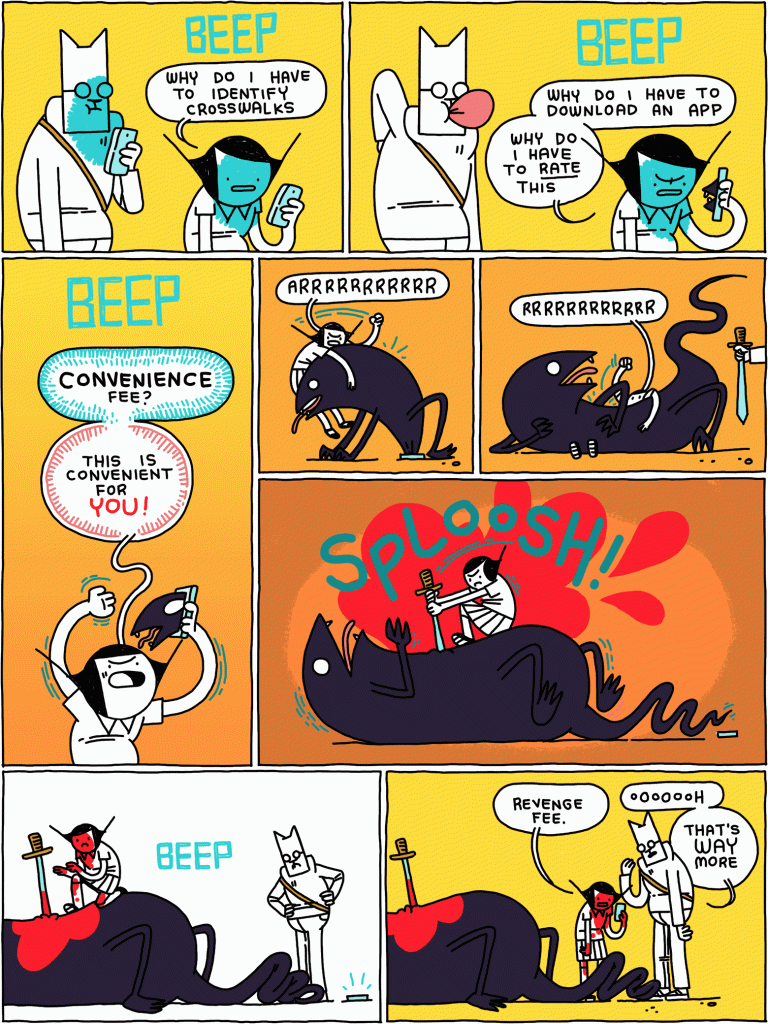
Typically when we’ve dealt with a long-form Cat and Girl, the cartoon has seemed to need some explaining, and we shoehorn it into a CIDU option of some kind. So what a pleasure it is to see them straightforwardly taking on some “complaint observational humor” (well, with exaggeration, but that’s to be expected).

 Comics I Don't Understand
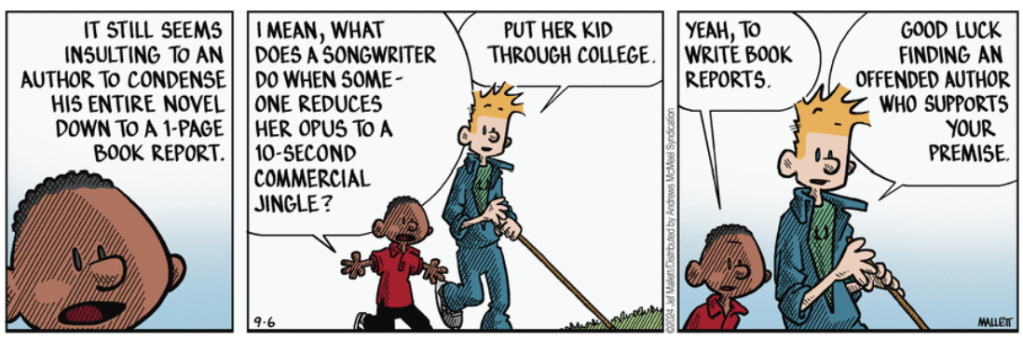
I’ve been wondering: Is a book report supposed to be a summary or a review?
(I’m talking mostly of elementary grades here, like Caufield’s. At the high school level it should be a literary analysis of the themes in the book, which necessarily includes elements of both.)
LikeLike
In my experience, the disadvantage of the back seat of the canoe (behind an inexperienced partner) was not actual contact with the wood, but simply getting soaked. That said, if there were a next panel to that comic, it would show the pedantic twit getting his skull split with a blunt wooden instrument, no matter what it’s called.
P.S. @ Powers (1) – The book report presentations that my kids did in elementary school were mostly summary, but were also supposed to include a short review (or recommendation) at the end. However, the actual purpose of every report was to “prove that you read the whole book”.
LikeLike
I’m slowly catching on to what you guys see in Yuval. Here the bow flying away as butterfly is like a “cousin” of an effect he does other ways, like if a section of wallpaper seemed to be missing and then you notice the pattern has been “stolen off” by somebody’s swimsuit, and the area on the wall where it’s missing is a matching shape.
LikeLiked by 1 person
Thumbs up for the “Oar maybe not.”
LikeLike
Thumbs up for the “Oar maybe not.”
LikeLike
Kilby- Book reports – that brings back a memory. I read some non-fiction book – something about history, maybe about Russia during some war as I seem to remember writing about people eating dogs or such as they did not have food during the war(?).
Teacher apparently had told us to read a novel and gave me a D on the report. I argued with her that non-fiction was much important to read than fiction and I should get a grade based on the report I wrote of the book I read. Yeah, I really was that annoying as a child.
When I was young I would read a book a day – fiction and non-fiction. Now I tend to read non-fiction only – limited time left to read.
I grew up in a book reading home. At first when we moved into our house (I was maybe 6) all the books went up to the attic where they were laid out by the type of book so each could be found easily. When we needed another bedroom (baby sister born) the books moved to what became my dad’s home office which had ceiling to floor custom bookshelves. Plus of course bookshelves in each bedroom and more in the den.
Robert and I shared this love of books and they are everywhere in our house by the type of book.
LikeLike
Meryl: The siege of Leningrad, https://en.wikipedia.org/wiki/Siege_of_Leningrad
People were eating the glue from the bindings of books–dogs were long gone. Horrific, and something that I bet doesn’t get taught in most history classes for whatever reason.
LikeLike
@ Phil (7) – Not nearly as horrific, but almost as deadly was the post-war “Hunger Winter 1946/47“, which affected most of northern Europe, including Germany and the Soviet Union. Although large sections of Berlin are fairly “green”, it is notable that much of the forested area is unusually “uniform”: virtually all of the trees are less than 75 years old, because large sections were cut down for fuel in that extremely cold winter.
LikeLike
Kilby: Yeah. somehow less horrific because it was more of a natural phenomenon, obviously exacerbated by the destruction left from the war.
LikeLike