I grew up in New York and moved to the Boston area after college for work. I remember the feeling of the day, years later, that I realized I couldn’t fully remember which accent was which.
In the Lard cartoon I think the phrase in panel 4 can be heard as onomatopoeia — which would fit the definition in panel 2.
(As Kevin A may be suggesting, the sound match works better if you think of “on-a-mat-up-here” being spoken in one of the “r-less” accents found in parts of New York and Boston, both)
I went to Boston University (having previously lived in western Massachusetts) and in all the four years I was there I didn’t hear a Boston accent. By far the dominant accent at BU was the Long Island (Lun Guyland) accent. Not so much in the music department, but all of the business students seemed to be from Lun Guyland, sent by Daddy to (if male) learn maybe barely enough to take over the family business or (if female) get their Mrs. degree and maybe help consolidate two family businesses.
I thought it seemed more “recently” familiar, but it turns out that the previous appearance of Lard’s “onomatopoeia” strip (most recently rerun on March 2nd) was just over two years ago, both here at CIDU (12-Feb-2022), and at GoComics (2-Feb-2022). Lard’s reruns are cyclic, but irregular: it also appeared on 17-Aug-2019, and probably multiple times before that (including 17-May-2017). I was not able to find an “original” instance within Lard’s boilerplate copyright range (2012-2016).
Kilby, thanks for linking the previous CIDU appearance of the Lard “onomatopoeia” strip. Reviewing the comments from that time, we covered (but in different order and emphasis) many of the same points adumbrated here, about the phrase “on-a-mat-up-here” sounding like “onomatopoeia”, but working better under certain accents so that the “here” part comes out more like “hee-yah”.
Deety (2): I thought of “onomatopoeia” but decided it was just too poorly done. I hadn’t considered the “r”-less accents. Thanks for pointing that out.
MiB (4): Consider your comment liked, from Lun Guyland to the student descriptions!
Boise Ed: One of my roommates in my freshman year was a Jewish kid from Long Island, son of the CEO of a small import-export business, the name of which appears on boxes in toy stores. The kid supposedly majored in business but actually majored in getting women into bed with him, sometimes two or three in one day, to the dismay of his steady girlfriend, who I think was his steady girlfriend even before they both came to college. Not long ago I was in a toy store and saw the company name on a box. I looked up the company. It is still around, as successful as ever, and the kid is now the CEO, and as far as I can tell he is married to that same long-suffering girlfriend. Most likely they have done much better financially than I have.
MiB (8): Either she has zero self-respect, or perhaps it is a marriage of convenience, with each running their own separate lives. The latter are fairly common, I understand.
Mark in Boston – Having been born on LI (in the NYC part) moved to the suburban part and lived on same all of my life, I must point out it is pronounced – Lawn Guyland.
In my case I stayed home for college- where I was going to get a degree in business (accounting) to follow dad and mom both into the business and eventually take over dad’s practice which had also absorbed that of my boss who I worked for about 20 years and who retired before dad. (Now down to 5 clients from the two of them.) Understand none of the clients were those big, fancy businesses one see accountants dealing with in movies and TV shows. Think instead “The Producers”. I was in and out of small factories – often the owner was the only employee, and retail stores. (Boss’s dad worked for the NYC assayer, so most of his clients were jewelers – small individual piece manufacturers, small wholesalers, and small jewelry stores. Dad’s clients were the same types.) One of my boss’s client was in a quick shot of the jewelers in a jewelry exchange in “Marathon Man”. Another one in another exchange had her booth blurred out in “Uncut Gems” as it was across the aisle from the one they used in the movie. (She just faxed me her info yesterday and today to do her business’s taxes.)
I have two younger sisters (no brothers) – the middle one also went into accounting – then teaching. The “baby” said there was no way she was going into accounting so her degree is in management instead.
I did not go to college to find a husband (and especially not in the sense of the old joke “I went to college to find a single man to turn into one”) nor did my mom before me. We just happened to find men while there who were the right ones for us to marry. Husband was not a business major – his degrees are in psychology and special education. So I deal with the bills and everything financial for the two of us.
Back when I was in college in California, there were two guys a year ahead of me who both came from Boston and had fairly strong accents; I was told that during their freshman year, one of them frequently had to “translate” for the other.
Both Robert and I work hard at not having a NYC/LI accent (especially when traveling away from here) – though I am sure we do even when trying hard not to have it – unless there is a reason to have it.
My accent is Flatbush Jewish. His is Bay Ridge Italian. Yes, there are differences. He did not grow up with Yiddish expressions thrown in and I grew up without Italian expressions thrown in.
Out here in the melting pot of post World War II suburban Long Island – almost everyone picks up on the assorted expressions - OY!
Meryl, thanks for the remarks on long Island ethnic/nationality accents!
Your question Mark – How else does one pronounce singer? does have an answer, but it’s hard to explain succinctly.
A short answer, which however may not be clear and convincing, is that “finger” (and “Singer” when it sounds like “finger” — so, when spoken by some speakers with this as part of a regional accent, or by anyone when used as a proper name, such as the sewing machine company) really does have a /g/ sound, following and as the release of the third-nasal (or back-nasal) consonant. But “singer” as spoken by most Americans (as a common noun) does not really have that release and a genuine /g/ sound — it only has that continuant third-nasal consonant.
What may make that a little hard to follow is that our spelling uses the sequence -ng- for two related but distinct things. And neither is the sequence of an /n/ sound followed by a /g/ sound!
One thing a -ng- written sequence represents is the single segment of the third-nasal or back-nasal continuant consonant, where the air goes out your nose and the closure in your mouth (shaping the sound) is at the soft palate, where you make a g or k. (This is the use in the majority American pronunciation of “singer” as common noun). This is a single “segment” in speech, not a sequence, despite being written with two letters. We just lack a letter for this sound, to go along with the other two nasal consonants, m and n.
The other thing a -ng- written sequence can represent is a genuine spoken sequence of sounds. These are that same back-nasal, but now followed by a genuine /g/ voiced release consonant. That’s what we get in the middle of “finger” for instance (or “Singer” as a name).
Singer always has the G sound when I have heard it pronounced.
My dad used to joke that in NewYorkese - one gets up “oily” in the morning and then goes and checks the “earl” in the car. (Reversing early and oil in speaking.)
When we are traveling I work very hard to lose my NY (technically I guess an NYC area as people from upstate don’t have the accent) accent. Cahfee not cawfee for example – as well as the oily/early.
Meryl, when you hear someone say a verb form ending in -ING, say “walking”, would you say you can “hear the g sound at the end” of the word? If yes, then we may still be talking about different things.
For many speakers, the ‘g’ isn’t totally lost in “singer” but it is not very pronounced. For others, it’s a very definite “singGer”. Yes, the two ‘g’s was deliberate, because “sing” and “sin” are usually different vowel sounds.
This is like the good old days on alt.usage.english. Last I checked there, they were getting spammed and trolled, but I wonder if the Google Groups shutdown helped with that. I should poke my head in and see.
Yes I hear the g at the end of the word, other than if they are talking in New Yorkese in which the g is dropped such as in “runnin’ “, “Hot fuckin tuna” (as the name of the band), etc. (can I use that word here - I guess I will soon know).
(Mom might not make it to 96 next year if she knew I used that word.)


 Comics I Don't Understand
I grew up in New York and moved to the Boston area after college for work. I remember the feeling of the day, years later, that I realized I couldn’t fully remember which accent was which.
LikeLiked by 1 person
In the Lard cartoon I think the phrase in panel 4 can be heard as onomatopoeia — which would fit the definition in panel 2.
(As Kevin A may be suggesting, the sound match works better if you think of “on-a-mat-up-here” being spoken in one of the “r-less” accents found in parts of New York and Boston, both)
LikeLike
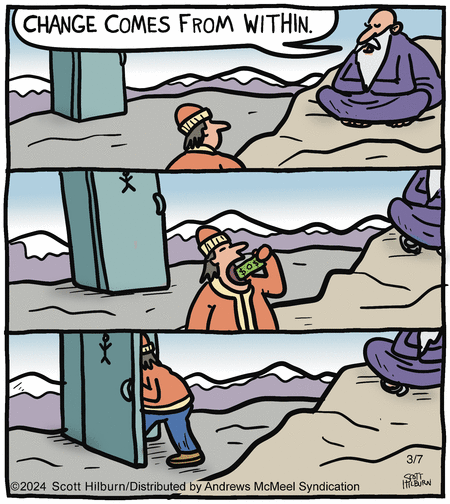
I find I can’t blame the door guard (St. Peter?) for being surly. After all, who wants to work even before you die? (At least, not in a clerical job.)
LikeLike
I went to Boston University (having previously lived in western Massachusetts) and in all the four years I was there I didn’t hear a Boston accent. By far the dominant accent at BU was the Long Island (Lun Guyland) accent. Not so much in the music department, but all of the business students seemed to be from Lun Guyland, sent by Daddy to (if male) learn maybe barely enough to take over the family business or (if female) get their Mrs. degree and maybe help consolidate two family businesses.
LikeLike
I thought it seemed more “recently” familiar, but it turns out that the previous appearance of Lard’s “onomatopoeia” strip (most recently rerun on March 2nd) was just over two years ago, both here at CIDU (12-Feb-2022), and at GoComics (2-Feb-2022). Lard’s reruns are cyclic, but irregular: it also appeared on 17-Aug-2019, and probably multiple times before that (including 17-May-2017). I was not able to find an “original” instance within Lard’s boilerplate copyright range (2012-2016).
LikeLike
Kilby, thanks for linking the previous CIDU appearance of the Lard “onomatopoeia” strip. Reviewing the comments from that time, we covered (but in different order and emphasis) many of the same points adumbrated here, about the phrase “on-a-mat-up-here” sounding like “onomatopoeia”, but working better under certain accents so that the “here” part comes out more like “hee-yah”.
LikeLike
Deety (2): I thought of “onomatopoeia” but decided it was just too poorly done. I hadn’t considered the “r”-less accents. Thanks for pointing that out.
MiB (4): Consider your comment liked, from Lun Guyland to the student descriptions!
LikeLiked by 1 person
Boise Ed: One of my roommates in my freshman year was a Jewish kid from Long Island, son of the CEO of a small import-export business, the name of which appears on boxes in toy stores. The kid supposedly majored in business but actually majored in getting women into bed with him, sometimes two or three in one day, to the dismay of his steady girlfriend, who I think was his steady girlfriend even before they both came to college. Not long ago I was in a toy store and saw the company name on a box. I looked up the company. It is still around, as successful as ever, and the kid is now the CEO, and as far as I can tell he is married to that same long-suffering girlfriend. Most likely they have done much better financially than I have.
LikeLike
MiB (8): Either she has zero self-respect, or perhaps it is a marriage of convenience, with each running their own separate lives. The latter are fairly common, I understand.
LikeLike
I think the “…mat up here” pun might be based on the catch phrase “Hey, I’m walkin’ here!”, spoken by Dustin Hoffman in “Midnight Cowboy”.
LikeLiked by 1 person
Mark in Boston – Having been born on LI (in the NYC part) moved to the suburban part and lived on same all of my life, I must point out it is pronounced – Lawn Guyland.
In my case I stayed home for college- where I was going to get a degree in business (accounting) to follow dad and mom both into the business and eventually take over dad’s practice which had also absorbed that of my boss who I worked for about 20 years and who retired before dad. (Now down to 5 clients from the two of them.) Understand none of the clients were those big, fancy businesses one see accountants dealing with in movies and TV shows. Think instead “The Producers”. I was in and out of small factories – often the owner was the only employee, and retail stores. (Boss’s dad worked for the NYC assayer, so most of his clients were jewelers – small individual piece manufacturers, small wholesalers, and small jewelry stores. Dad’s clients were the same types.) One of my boss’s client was in a quick shot of the jewelers in a jewelry exchange in “Marathon Man”. Another one in another exchange had her booth blurred out in “Uncut Gems” as it was across the aisle from the one they used in the movie. (She just faxed me her info yesterday and today to do her business’s taxes.)
I have two younger sisters (no brothers) – the middle one also went into accounting – then teaching. The “baby” said there was no way she was going into accounting so her degree is in management instead.
I did not go to college to find a husband (and especially not in the sense of the old joke “I went to college to find a single man to turn into one”) nor did my mom before me. We just happened to find men while there who were the right ones for us to marry. Husband was not a business major – his degrees are in psychology and special education. So I deal with the bills and everything financial for the two of us.
LikeLike
People from Lawn Guyland pronounce “singer” to rhyme with “finger”.
LikeLike
Back when I was in college in California, there were two guys a year ahead of me who both came from Boston and had fairly strong accents; I was told that during their freshman year, one of them frequently had to “translate” for the other.
LikeLike
Mark – How else does one pronounce singer?
Both Robert and I work hard at not having a NYC/LI accent (especially when traveling away from here) – though I am sure we do even when trying hard not to have it – unless there is a reason to have it.
My accent is Flatbush Jewish. His is Bay Ridge Italian. Yes, there are differences. He did not grow up with Yiddish expressions thrown in and I grew up without Italian expressions thrown in.
Out here in the melting pot of post World War II suburban Long Island – almost everyone picks up on the assorted expressions - OY!
LikeLike
Meryl, thanks for the remarks on long Island ethnic/nationality accents!
Your question Mark – How else does one pronounce singer? does have an answer, but it’s hard to explain succinctly.
A short answer, which however may not be clear and convincing, is that “finger” (and “Singer” when it sounds like “finger” — so, when spoken by some speakers with this as part of a regional accent, or by anyone when used as a proper name, such as the sewing machine company) really does have a /g/ sound, following and as the release of the third-nasal (or back-nasal) consonant. But “singer” as spoken by most Americans (as a common noun) does not really have that release and a genuine /g/ sound — it only has that continuant third-nasal consonant.
LikeLike
What may make that a little hard to follow is that our spelling uses the sequence -ng- for two related but distinct things. And neither is the sequence of an /n/ sound followed by a /g/ sound!
One thing a -ng- written sequence represents is the single segment of the third-nasal or back-nasal continuant consonant, where the air goes out your nose and the closure in your mouth (shaping the sound) is at the soft palate, where you make a g or k. (This is the use in the majority American pronunciation of “singer” as common noun). This is a single “segment” in speech, not a sequence, despite being written with two letters. We just lack a letter for this sound, to go along with the other two nasal consonants, m and n.
The other thing a -ng- written sequence can represent is a genuine spoken sequence of sounds. These are that same back-nasal, but now followed by a genuine /g/ voiced release consonant. That’s what we get in the middle of “finger” for instance (or “Singer” as a name).
LikeLike
Singer always has the G sound when I have heard it pronounced.
My dad used to joke that in NewYorkese - one gets up “oily” in the morning and then goes and checks the “earl” in the car. (Reversing early and oil in speaking.)
When we are traveling I work very hard to lose my NY (technically I guess an NYC area as people from upstate don’t have the accent) accent. Cahfee not cawfee for example – as well as the oily/early.
LikeLike
Meryl, when you hear someone say a verb form ending in -ING, say “walking”, would you say you can “hear the g sound at the end” of the word? If yes, then we may still be talking about different things.
LikeLike
For many speakers, the ‘g’ isn’t totally lost in “singer” but it is not very pronounced. For others, it’s a very definite “singGer”. Yes, the two ‘g’s was deliberate, because “sing” and “sin” are usually different vowel sounds.
This is like the good old days on alt.usage.english. Last I checked there, they were getting spammed and trolled, but I wonder if the Google Groups shutdown helped with that. I should poke my head in and see.
LikeLike
Yes I hear the g at the end of the word, other than if they are talking in New Yorkese in which the g is dropped such as in “runnin’ “, “Hot fuckin tuna” (as the name of the band), etc. (can I use that word here - I guess I will soon know).
(Mom might not make it to 96 next year if she knew I used that word.)
LikeLike