@ Dana – The caption in “Cornered” is easier to understand with a little strategic expansion: “The support staff supports the staff“. The editorial subtitles are similar examples, but I have to admit that I only understand two out of three, perhaps one has to have lived in New York State (or on the prairie) to get the first one.
P.S. There’s a German tongue twister with a similar gimmick: “Wenn Fliegen hinter Fliegen fliegen, fliegen Fliegen hinter Fliegen her“. In written form, the standard German capitalization of the nouns gives the meaning away (roughly: “When flies fly after flies, (then) fly flies after flies“). But when spoken (and heard for the first time), it is a very difficult puzzle to parse.
@ Phil (3) – Thanks for the link to the explanation. I see that I correctly understood the names of the city and the prairie animal, but what failed was “the verb ‘buffalo‘, meaning to outwit, confuse, deceive, intimidate, or baffle“. I have never heard that word used in that manner.
I think I have almost always (as a teen or adult) known the verb buffalo. My difficulty with that sentence (in its longer version) and some of the others is the use of a restrictive relative clause without linkage via a relative pronoun. I almost always write or say the “that” even when considered optional, and cringe at writing advice that suggests omitting them as one among many ways to avoid being wordy.
@ mitch (7) – “relative pronoun” – I agree: notice, for instance, the “then” that I interpolated into the English translation of that German tongue-twister @2.


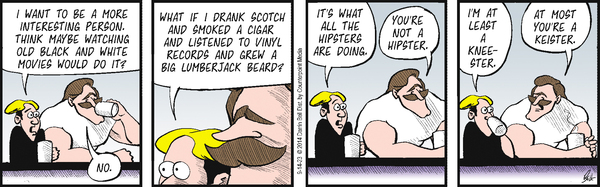


The Frank And Ernest is a really good joke! And definitely a pun, based on settle (for).
IDU the Cornered entirely. Are the editorial remarks meant to illuminate it? Didn’t work, for me.
LikeLiked by 1 person
@ Dana – The caption in “Cornered” is easier to understand with a little strategic expansion: “The support staff supports the staff“. The editorial subtitles are similar examples, but I have to admit that I only understand two out of three, perhaps one has to have lived in New York State (or on the prairie) to get the first one.
P.S. There’s a German tongue twister with a similar gimmick: “Wenn Fliegen hinter Fliegen fliegen, fliegen Fliegen hinter Fliegen her“. In written form, the standard German capitalization of the nouns gives the meaning away (roughly: “When flies fly after flies, (then) fly flies after flies“). But when spoken (and heard for the first time), it is a very difficult puzzle to parse.
LikeLike
Kilby: see https://en.wikipedia.org/wiki/Buffalo_buffalo_Buffalo_buffalo_buffalo_buffalo_Buffalo_buffalo
LikeLiked by 1 person
Yes, it could be said that malcontents are precisely the ones who will not settle!
LikeLiked by 1 person
@ Phil (3) – Thanks for the link to the explanation. I see that I correctly understood the names of the city and the prairie animal, but what failed was “the verb ‘buffalo‘, meaning to outwit, confuse, deceive, intimidate, or baffle“. I have never heard that word used in that manner.
LikeLike
@Kilby (5): Really? I’m…buffaloed by that! (sorry, couldn’t resist)
LikeLiked by 1 person
I think I have almost always (as a teen or adult) known the verb buffalo. My difficulty with that sentence (in its longer version) and some of the others is the use of a restrictive relative clause without linkage via a relative pronoun. I almost always write or say the “that” even when considered optional, and cringe at writing advice that suggests omitting them as one among many ways to avoid being wordy.
LikeLiked by 1 person
@ mitch (7) – “relative pronoun” – I agree: notice, for instance, the “then” that I interpolated into the English translation of that German tongue-twister @2.
LikeLike
He’s using the fork in his left hand, she’s using the fork in her right hand. Clearly a failed relationship.
LikeLike
Reminds me of the old puzzle: punctuate the following:
That that is is that that is not is not is not that it it is
or this one:
John where Bill had had had had had had had had had had had the teacher’s approval
LikeLike
I’ve only ever heard the verb “buffalo” to mean “confuse” or the like.
LikeLike
I have always heard the verb used same as Brian in STL
LikeLike