You do understand the problem with commenting that your comment is in moderation, right?
And for the record, I’ll probably notice the moderated comment sooner on my own. Second best is e-mailing me. Hoping I’ll spot it on the site is far and away the least effective option.
The only reason I understood the Dorian Gray joke at all is that a comic his driver’s license showed up here a while ago, and I had to look it up then.
Related to this one, do you remember (perhaps from books and movies, and not your own usage) “sawbuck” for $20? (Or maybe for $10, so that “double sawbuck” could mean $20. But it takes two X supports to hold up the crossbar.)
Sawbuck is $10, fin is $5, bit is 12.5 cents and a grand is real money.
Weird to have “slang” I’ve known my entire life & never heard a real person use 2 of them.
Some older versions of the ten-dollar bill had a large Roman number X somewhere on them. Reportedly that’s how the “sawbuck” slang got started. Merriam-Webster online seemed to dispute that, claiming that the first use in print of the term was for the bill and not the wood-cutting device.
One of the weirdest slang terms for a (German) coin is “Sechser” (meaning “6”), which was used (in Berlin dialect) for the “5 Pfennig” coin, because it was once the successor to an ancient “half shilling”. I’m pretty sure that the change from D-Mark to Euro has eradicated finally the term, Germans don’t even use the word “Pfennig” any longer, the Euro is divided into “cents”.
P.P.S. I just discovered (by clicking on “Dorian Gray” in the tags) that the same artist is responsible for both panels (the first appeared in “Waynovision”).
Bits – In earlier times coins were worth their weight in the metal they were made of. Meaning that if one had a pound sterling coin, it was worth what the amount of sterling silver, by weight, in it was worth the same as that weight of sterling silver. If one went to France with it, it was worth what that weight of silver was worth in France or Germany or Italy or the colonies,etc.
So when one went to buy something if the price was less than the value of the coin, the coin would be cut and the difference handed back to you. The coins could be cut in half, quarters or eighths. The eighths were called bits (and two bits, obviously was a quarter of a coin). While this was done with all coins, it was common to do so with the Spanish dollar so same became known as pieces of eight.
The British government therefore did not put coinage into circulation in the colonies so that the colonies and those in them would have trouble trading with other countries as they would have to rely on paper money or entries on the books of one’s agent.
Colonies would each issue paper money to cover local purchases. An estimate would be made of the expenses that the colony (including the official church of the colony which was part of the colony’s government) would need over the year. Currency would be issued in that amount. Over the year when the colony need to pay for something, it would do so with it’s currency, putting it into circulation. It was accepted within the colony, as, at the end of the year it would accepted to pay one’s taxes. The currency was then burned and destroyed and new currency would be issued for the following year. Unless one had business in another colony one had no use for money from that colony. North Carolina was notorious for having its currency forged. When we do a children’s muster with toy sort of reproduction guns, the children are given 1/3 shilling NY notes when they turn their “guns” in – with our info on the back. Children will ask if it is “real” or if they can use it – My answer to the latter ‘Not in New Jersey”. :-)
@ Meryl A – I remember learning in school about the Spanish coin that could be split into eight pieces, but looking for it now, it’s pretty clear that it was not done on the fly to make change. I could not find a single example of the supposed “precreased” coin, and the “bits” that I could find seem to have been professionally cut with a saw, rather than quickly broken.
It appears that the actual practice was that merchants precut some of their coins, in order to have a suitable stock of smaller coins, which the government did not bother to mint.



 Comics I Don't Understand
My comment is in moderation. :-)
LikeLike
You do understand the problem with commenting that your comment is in moderation, right?
And for the record, I’ll probably notice the moderated comment sooner on my own. Second best is e-mailing me. Hoping I’ll spot it on the site is far and away the least effective option.
LikeLiked by 1 person
I *guess* I understand Buni. I just don’t like it.
But the Bizzaro did literally make me laugh out loud.
LikeLike
The only reason I understood the Dorian Gray joke at all is that a comic his driver’s license showed up here a while ago, and I had to look it up then.
LikeLiked by 1 person
P.S. Oops. Forgot to delete “a comic” out of that sentence.
LikeLike
A lot of comics mix 2 eras, but the movie one goes for 3 – Roman, smut in theaters (1980s), and formally dressed ticket sellers (1920s?)
LikeLike
I like Roman numeral puns.
Related to this one, do you remember (perhaps from books and movies, and not your own usage) “sawbuck” for $20? (Or maybe for $10, so that “double sawbuck” could mean $20. But it takes two X supports to hold up the crossbar.)
LikeLike
Sawbuck is $10, fin is $5, bit is 12.5 cents and a grand is real money.
Weird to have “slang” I’ve known my entire life & never heard a real person use 2 of them.
LikeLike
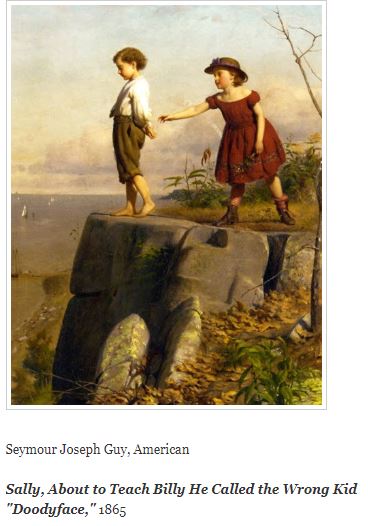
In light of this incident – https://www.yahoo.com/news/washington-teen-seen-pushing-friend-185605180.html – I didn’t think “That is Priceless” was very funny . . .
LikeLike
Some older versions of the ten-dollar bill had a large Roman number X somewhere on them. Reportedly that’s how the “sawbuck” slang got started. Merriam-Webster online seemed to dispute that, claiming that the first use in print of the term was for the bill and not the wood-cutting device.
LikeLike
Brian: that sawbuck you showed was an obvious forgery — they misidentified Lincoln as Washington….
LikeLike
One of the weirdest slang terms for a (German) coin is “Sechser” (meaning “6”), which was used (in Berlin dialect) for the “5 Pfennig” coin, because it was once the successor to an ancient “half shilling”. I’m pretty sure that the change from D-Mark to Euro has eradicated finally the term, Germans don’t even use the word “Pfennig” any longer, the Euro is divided into “cents”.
LikeLike
P.S. Clearly too tired to write, I am.
LikeLike
P.P.S. I just discovered (by clicking on “Dorian Gray” in the tags) that the same artist is responsible for both panels (the first appeared in “Waynovision”).
LikeLike
Bits – In earlier times coins were worth their weight in the metal they were made of. Meaning that if one had a pound sterling coin, it was worth what the amount of sterling silver, by weight, in it was worth the same as that weight of sterling silver. If one went to France with it, it was worth what that weight of silver was worth in France or Germany or Italy or the colonies,etc.
So when one went to buy something if the price was less than the value of the coin, the coin would be cut and the difference handed back to you. The coins could be cut in half, quarters or eighths. The eighths were called bits (and two bits, obviously was a quarter of a coin). While this was done with all coins, it was common to do so with the Spanish dollar so same became known as pieces of eight.
The British government therefore did not put coinage into circulation in the colonies so that the colonies and those in them would have trouble trading with other countries as they would have to rely on paper money or entries on the books of one’s agent.
Colonies would each issue paper money to cover local purchases. An estimate would be made of the expenses that the colony (including the official church of the colony which was part of the colony’s government) would need over the year. Currency would be issued in that amount. Over the year when the colony need to pay for something, it would do so with it’s currency, putting it into circulation. It was accepted within the colony, as, at the end of the year it would accepted to pay one’s taxes. The currency was then burned and destroyed and new currency would be issued for the following year. Unless one had business in another colony one had no use for money from that colony. North Carolina was notorious for having its currency forged. When we do a children’s muster with toy sort of reproduction guns, the children are given 1/3 shilling NY notes when they turn their “guns” in – with our info on the back. Children will ask if it is “real” or if they can use it – My answer to the latter ‘Not in New Jersey”. :-)
LikeLike
Hmmm, for the new seasonal bear village, summer on a island – have to think about that one.
LikeLike
@ Meryl A – I remember learning in school about the Spanish coin that could be split into eight pieces, but looking for it now, it’s pretty clear that it was not done on the fly to make change. I could not find a single example of the supposed “precreased” coin, and the “bits” that I could find seem to have been professionally cut with a saw, rather than quickly broken.
It appears that the actual practice was that merchants precut some of their coins, in order to have a suitable stock of smaller coins, which the government did not bother to mint.
LikeLike