Tuna breath

Texts from Mittens is almost always an SMS-based texting conversation between a cat and his owner (or “Mom”, occasionally “Mama”), in a layout imitating display on a phone screen. Never a drawing or other image of the kind we associate with comics.

Sometimes a different character gets in the conversation. I just today looked at the Characters tab on GoComics, which sort of answers a couple of my long-standing questions. But there are no answers anywhere to fundamental questions or consistent treatment of his unusual abilities (does he tap out messages with a paw on a physical phone, or send them via mental/physical magic connection?), his contact list, his mix of knowledge and ignorance about the human world. Oh never mind, it’s all just for cat people to read and indulgently sigh in recognition. He gets a little shirty but loves his Mom, okay?

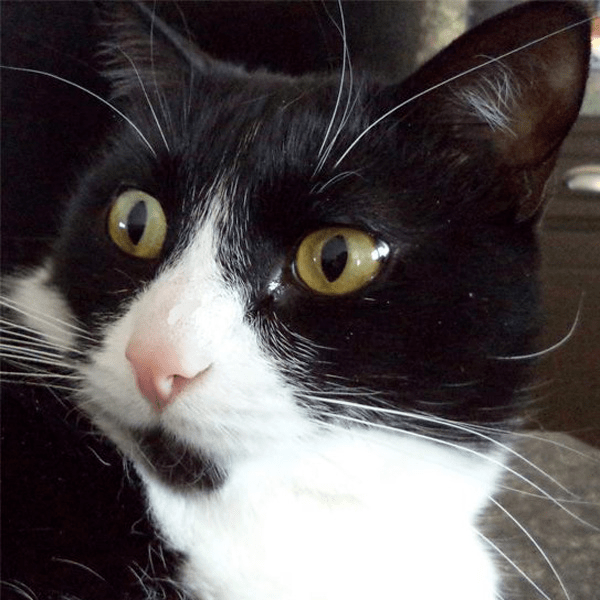
In this one, of course Mittens likes tuna smells. But is Mom taking that into account? Or is she thinking by habit of how tuna breath would affect human companions and coworkers?
Originally “chalk pencil”

Thanks to Carl Fink for sending this in. He says “I do understand the joke, but …” and then details ways he can’t understand how such bad drawing can pass itself off as professional cartooning.

Meanwhile, the usual gang of idiot at CIDU HQ Central has to confess that I don’t completely understand the joke. Is it a tradition in this family that “our mealtimes will be like going out to a nice restaurant”? Does the dad’s remark to what Carl calls “the monstrosity” daughter presuppose something like that?

A chloral? A bromide? A Mickey Finn? A bone in her teeth? A switch of a swatch?

Our first A&J is from Mark M, who asks “Why does she feel that way at 3 o’clock?  Is this an example of an overreaction as CIDU Bill used to talk about?”

Possibly the discussion of overreaction Mark is thinking of included this thread.

(For a quick factual overview of “sleeping pills”, here is a web excerpt from a book by Wallace B. Mendelson, MD.)


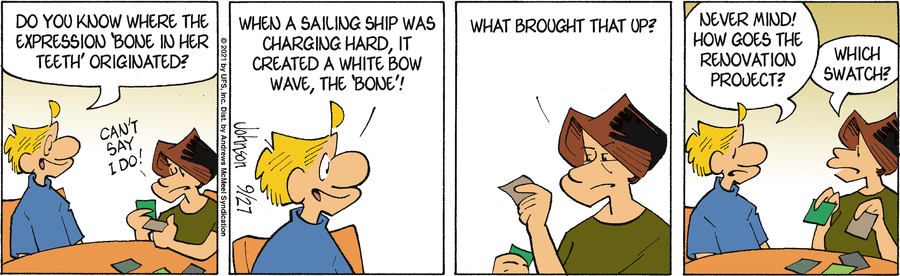
And Jack Applin sent in another puzzling A&J. He says: “I do not understand this Arlo & Janis. Arlo speaks of the expression bone in her teeth, explaining how it comes from the bow wave of a fast-moving boat. OK, sure. However, the way the he says it implies that this is a standard expression, used in other contexts. “

“I might say Do you know where the expression ‘read the riot act’ came from?, because people use that without reference to the 1714 act of the Parliament of Great Britain, e.g., when their mother caught them coming home late.. Who says bone in her teeth without referring to a bow wave?”

Stick the what?

From Le Vieux Lapin, who says:

Is the phrase “stick the dismount” from gymnastics?  I found several instances of it on the web, ranging from a couple of gymnastics references to one in a report on the current US president.  However, nothing I found explains what it means or provides enough context to do better than a slightly-educated guess.  Maybe “land on your feet”?

Often with long-running and high-continuity strips, I want to write off some puzzlement at a particular episode as a matter of “Well, wait to see how it fits with the whole story”. But in this one, I think we were handed a recap right there in the dialogue.

Poly

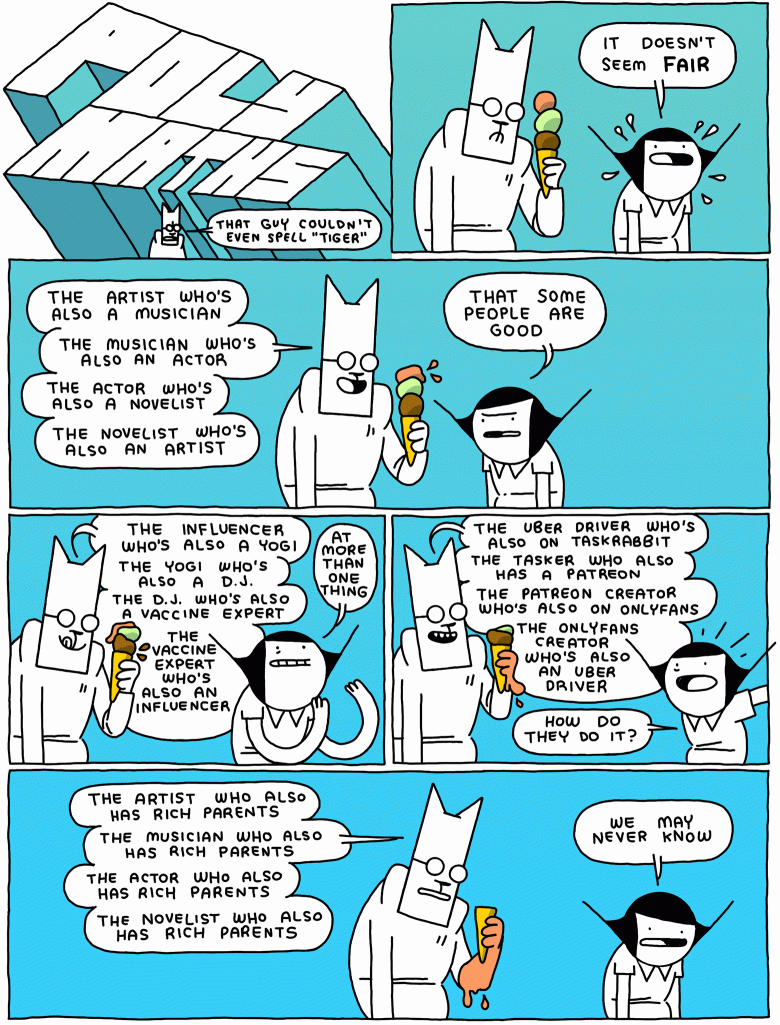
Le Vieux Lapin introduces us to “Cat and Girl” and says:

In ancient times, the word “polymath” described someone with great experties
in multiple fields.  Like so many other words, though, “polymath” has been
devalued in the age of social media.  What does it take to be a polymath
today?  Dorothy Gambrell’s Cat of
Cat and Girl seems to have figured it out

While I am familiar with the word “polymath” I don’t normally run across it every day. But — as these things work — it happens that the next day I ran across this tweet:

P.S. Le Vieux Lapin adds “Cat needs to eat his ice cream cones faster.”

¿Qué quiere decir esta palabra “significa”?

I.e. , What does this word “means” mean? Or maybe What does this Spanish word “significa” mean?

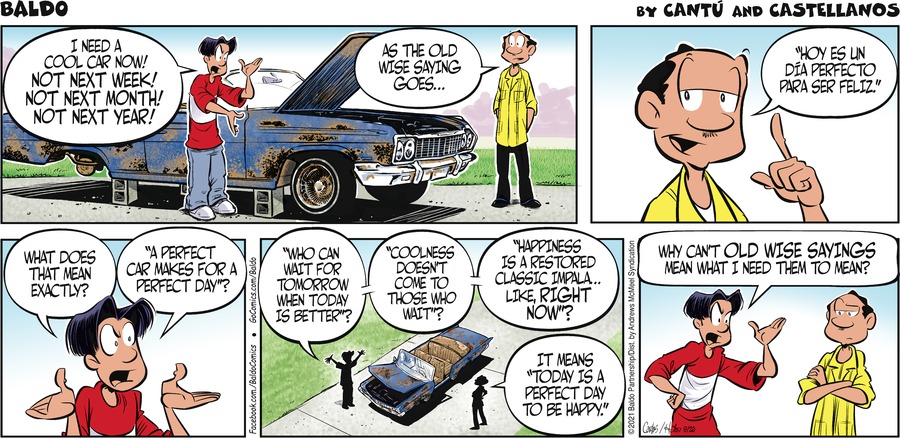
In the Spanish version, Baldo’s question in panel 3 ¿Qué significa eso? he speculatively answers for himself with sort of paraphrases of Sergio’s [Papi’s] saying from panel 2, but tending more toward argumentative applications to his current situation. When Sergio answers in panel 4 by just repeating the saying verbatim and asserting that is the meaning, he is bringing down Baldo’s flights of fancy and special pleading by just repeating the idea, for an “it is what it is” effect. All of this makes easy sense.

In the English version, Sergio’s saying in panel 2 is originally presented in Spanish, then repeated in panel 4 in English translation. So It means … in panel 4 amounts to It would be translated as … . Then when we look at Baldo’s What does that mean … in panel 3, is he still only asking for significance and situational applications (which he then supplies, sometimes ironically)? Or is he in any part asking for help in translation? (Since a translation is what he gets.)