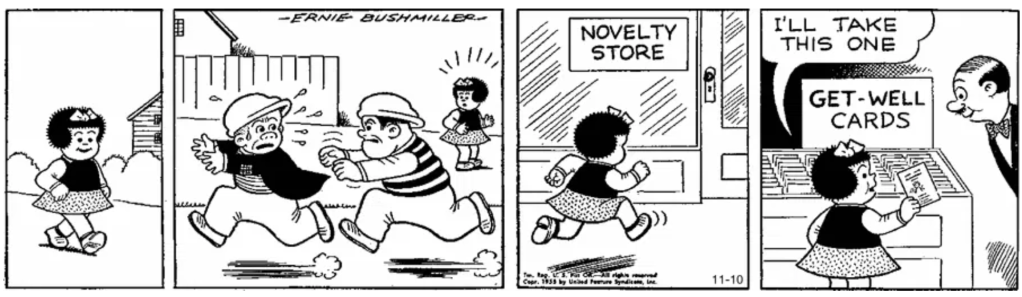
Jack Applin sends this in: “Why would Nancy find a get-well card in a novelty store? I would expect a novelty store to contain joy buzzers, exploding cigarettes, and the like. Has the meaning of “novelty” changed since the time of King Arthur, when this strip was first published?”
It’s not a CIDU, since the intended joke is clear. But I remember dime stores, 5 and 10 cent stores (vaguely), variety stores, but I’m not sure I ever saw a Novelty Store.
 Comics I Don't Understand
I recommend using Google Ngrams when considering this kind of thing. Here we see “novelty store” making a big rise around the turn of the 20th century and dipping again around 1960. Poking through the book results shows us several references to novelty stores generally selling stationery.
They appear to have been the equivalent of the modern variety store, also carrying toys, household goods, and gifts. An article in “Bookseller & Stationer” magazine from 1926 advises novelty store owners to sell staple household items as Christmas gifts. There’s also an article condemning the government monopoly on schoolbooks and a cartoon about a stationer getting the shit beaten out of him over a leaky pen.
Modern use of “novelty store” confirms Jack’s intuition – stores like Spencer Gifts or Archie McPhee’s that are known for gag gifts and unusual items.
In thr 1950s there was a store we walked to and referred to as “the sundry store” (or perhaps it was “the sundries store” — I wasnt reading or writing yet). I did not notice the term agsin until the 90s.
In the town I live in there’s a functional/moral equivalent of a novelty store but it’s got a cutesy name instead. They sell all kinds of of weird stuff, including “funny” greeting cards that tend to cater to a more outre sense of humor (like my own.)
There’s a new-to-me chain of five-and-ten stores sprouting only it is not cents but dollars. Compound inflation.
I was thinking today’s equivalent would be a greeting card store–I believe Hallmark has those in malls. But in (squints) 1958 I’m not sure where one would go to buy get-well cards–by which I mean, what sort of store Nancy could be shown running toward that would have what she wanted. Five-and-dime might be seen as cheap, a bookstore or magazine stand might seen as too expensive…gotta work the joke in there somehow without too much confusion about the peripherals.
I remember novelty stores. There was one in my Grandma’s town. And of course in Boston we had Jack’s Joke Shop and Little Jack Horner’s.
They were not exactly places that welcomed kids. They had greeting cards, all slightly off-color as the expression was at the time. “I heard you were in the hospital. The doctor told me you’ve taken a turn for the NURSE!” “Daffynition: What is a panhandler? A nurse on an important mission!” (Picture of a nurse carrying a bedpan.)
The novelty shop in my Grandma’s town was the first place I saw Ernie Bushmiller’s unsigned comic strip “How To Train Your Dog.”
Sounds like a five-and-dime store.
Wiktionary’s third definition of “novelty” is “a small, mass-produced trinket”.
Vocabulary.com defines “novelty shop” as “a shop that sells miscellaneous articles appropriate as gifts”.
“Novelty” is one of those words that can be anything to anyone. To a pianist, a novelty is a work such as “Kitten on the Keys” by Zez Confrey. To a supermarket shopper, novelties are ice cream sandwiches and Klondike bars. “Bagatelle” is a similar word. To a pianist, a bagatelle is a short supposedly-insubstantial piece like “Fur Elise” by Beethoven. To a kid in a toy store, a bagatelle is a sort of hand-held pinball game.