
As a kid in the back seat, I used to look up after seeing “Watch for Falling Rock” signs to see if there were rocks falling. This, of course, was futile. Drivers on curvy mountain roads should be looking at the road, and looking for fallen rocks, not staring up at the bluff on the off-chance that there’s a boulder coming down right at this very second. Most, but not all, signs I see on the highway now say fallen, not falling.


Mark H. sends this in as a fourth wall breaker, and wonders: “Do cartoon characters count in base eight?”

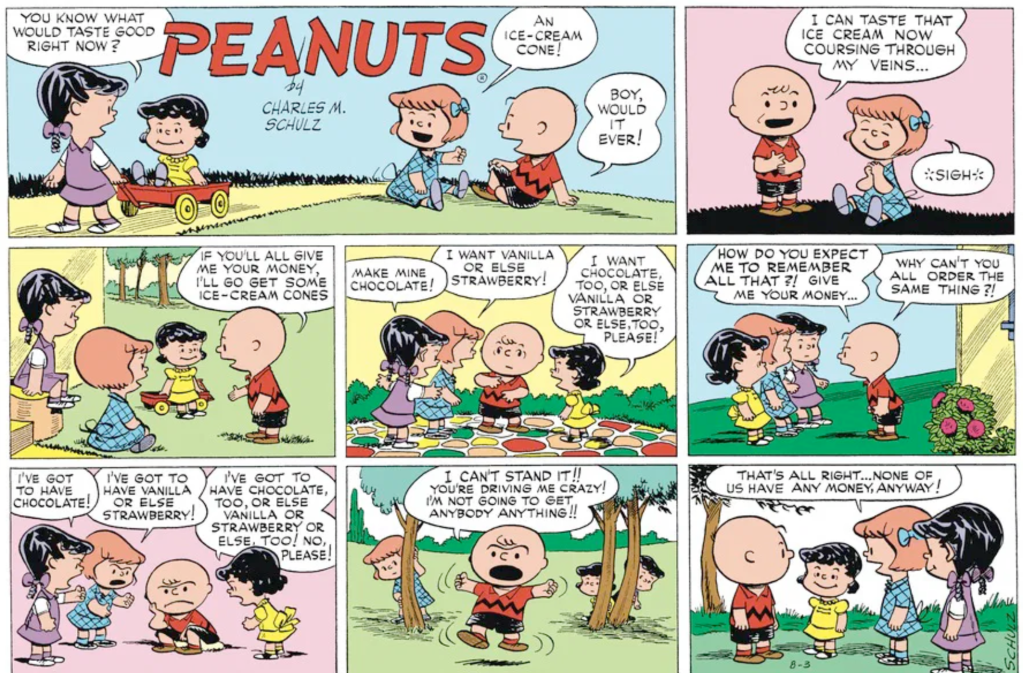
 Comics I Don't Understand
Mark H, you know drawn hands and feet generally only have four fingers and four toes. Look at the girl’s hands.
It took a rethink, but 2 4 fingered hands is the base of Mark’s joke.
The base for counting is not absolutely determined by the number of fingers. I have heard of a remote tribe that uses Base 20 if I remember correctly, counting not only on fingers but elbows shoulders, points on the head, etc.
Who knows how many fingers the ancient Sumerians had, with their Base 60 number system. But it appears that that system was carefully worked out by the mathematicians of the time, because in that base, every integer is divisible by 2, 3, 4, 5, 6, 10, 12, 15, 20 and 30 without getting into the equivalent of “repeating decimals”. Our 60-minute hours have the feature that 1/2, 1/3, 1/4, 1/5, 1/6, 1/10, 1/12, 1/15, 1/20 and 1/30 of an hour each consist of an integral number of minutes, simplifying lawyers’ time sheets.
Mark: I’ve been known to assert that I can’t count to 21 without taking off my shoes AND my pants!
Mayans used base 20, as did some other Mesoamericans. The numerals are made up of three symbols: zero (a shell), one (a dot) and five (a bar). For example, thirteen is written as three dots in a horizontal row above two horizontal bars.
https://en.wikipedia.org/wiki/Maya_numerals