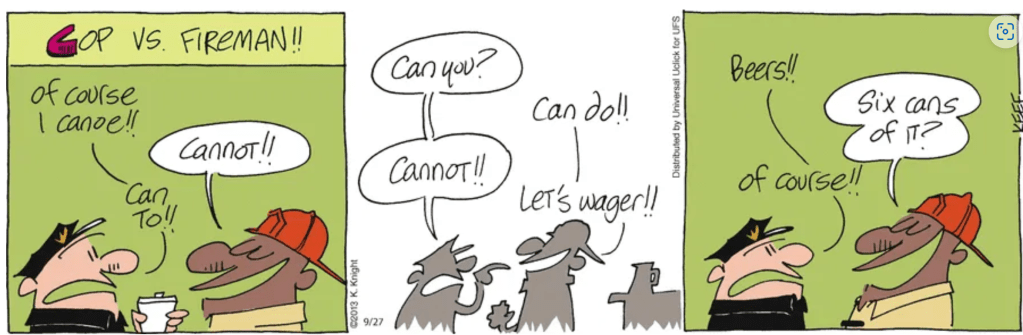
Previous day is no help here; there’s nothing set up there about canoeing (or canoodling). Obviously there’s the repetition of “can”, but anything else?
But while the previous day was no help, the next day clarifies that, much to my surprise, this is about canoeing.

 Comics I Don't Understand
Are these current? There were times when an allusion to Roe vs Wade was more a part of everyday political discourse.
A separate question, do you recognize “Paddle your own canoe” as a should-be-familiar saying in English? If so, what does it mean? Is it like “Stay in your lane”?
My issue with it is from a bit where it is supposed to be like the reveal or punchline, and you say “Oh wow it’s just that old saying Paddle your own canoe!” but falls flat if you’ve never heard that before. (The setup is something that looks like a poem written in French, but if you read it aloud sounds like something in English spoken with an exaggerated or parodic French accent. )
From https://www.futilitycloset.com/2009/08/12/sound-sense/
A favorite kind of school-boy humor is that which takes the form of evolving sentences like the following: Forte dux fel flat in gutture, which is good Latin for ‘By chance the leader inhales poison in his throat,’ but which read off rapidly sounds like the English ‘Forty ducks fell flat in the gutter.’ A French example is Pas de lieu Rhône que nous, which it is hardly necessary to explain makes no sense in French at all, though every word be true Gallic, but by a similar process of reading reveals the proverbial advice, ‘Paddle your own canoe.’
The strip is in reruns.
Keith Knight is known to have a zany and offbeat sense of humor. His comics don’t always make complete logical sense.
Mitch4, “paddle your own canoe” means “go it by yourself”, aka “make your own way”–do it on your own without help.
There was(is?) a men’s cologne named “Canoe” that was advertised with the slogan “Can you Canoe?”.
Mitch4, an entirely English example is: “Defeat of deduct went over defense before detail.”
Immediately preceding strips have been about a bake sale contest between the Police Department and the Fire Department.
This one just shows the further losses of the PD.
One of my dad’s favorites was this pseudo-Latin poem:
Civili der dego,
Forte buses in ero.
Nojo demis trux.
Vadis indem?
Causen Dux.
One camnot row a canoe – it doesn’t have oarlocks.
One paddles a canoe
I have to laugh at the comments. Maybe it was just where I grew up, but paddle your own canoe meant, to put it delicately, to do something alone (hopefully in private) that has a happy ending.
Caesar adsum iam forte
Brutus adorat
Caesar sic in omnibus
Brutus sic in at.
Wikipedia (usual caveats) sez:
Paddle Your Own Canoe is a phrase that implies independence from others. The first known use is in the 1844 book The Settlers in Canada.
https://en.wikipedia.org/wiki/Paddle_Your_Own_Canoe
Nick Offerman (Ron Swanson from Parks and Recreation) has a book by title, so many search hits are for that.
When I was studying computer science in graduate school — a long time ago, long before Java was invented — our textbook was Volume 1 of Donald Knuth’s “The Art of Computer Programming.” It was a fairly expensive book at the time.
One day my copy went missing. I knew I had it when I went into class; by the end of the period I didn’t have it. It was nowhere to be found. When I went outside I saw one of the other students trying to sell it to everyone who passed by on the sidewalk. I grabbed it from him, looked inside to verify that it was my copy, showed him my name in it and said “Peddle your own Knuth!”
Mark: Go to your room and don’t come out until you are truly sorry!
@Mark in Boston: I remember Knuth’s book. The joke is new to me, though. :)