A few oldies to start us off.

JMcAndrew sends in this pair, which get a Geezer Alert. “Shouldn’t she check to see what the contents of the disk are before she gets upset? I like that she’s holding it by the corner because she assumes it’s filthy and Arlo’s very reasonable confusion here. The antiquated technology only makes it funnier 30 years later.”
If only she could. Gene’s not really wrong about compatibility, though. Our first PC was a Kaypro CPM machine, and its floppies weren’t readable by any other machine.


Boise Ed sends this one in: “Hah! I’d love to see this one in the real world.”

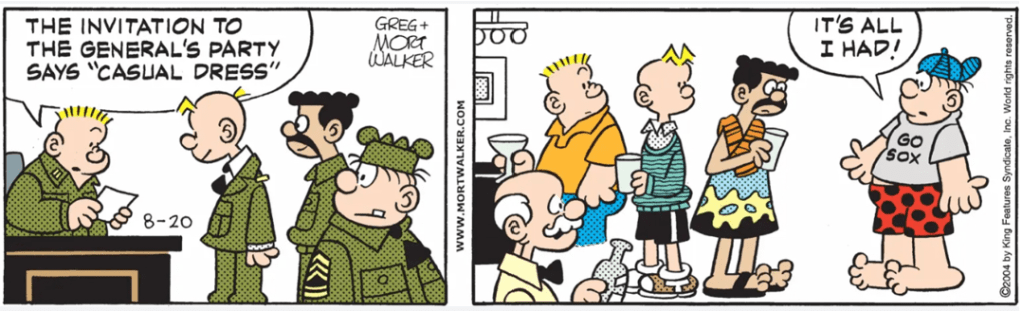
JMcAndrew sends this one in: “Confused about what the creators of this comic think “casual dress” is supposed to be. Is Lieutenant Flap wearing a dashiki? Do they think that Black people wear dashiki as “casual dress”? General Halftrack appears to be wearing a collared shirt and bow tie which is certainly not “casual dress”. I don’t know what is going on with Lieutenant Fuzz. Sarge might be wearing boxer shorts. His shirt just says “Go Sox” but doesn’t say which specific sports team with “Sox” in its name. I’m honestly more disturbed by his grotesque deformed feet than any of these outfits. Also why does Sarge have a different number of toes than Lieutenant Flap?”
Your editor admires the use of “Go Sox” while Sarge is wearing neither red socks nor white socks. No need to offend readers in Boston or Chicago.
JMcAndrew sends this in: “I’m almost afraid to ask what Ditto was doing that resulted in most of the film roll not being viable.”

This definitely gets a Geezer tag. These days, letting a child borrow your phone for a while to take pictures of whatever, and then review them is as common as cell phones.
 Comics I Don't Understand
For us non-runners, could someone explain why a marathon-themed restaurant would be as shown in the Dumb Runner comic?
There was a time when dashiki were worn as casual dress. The mid-70s come to mind.
@Usual John, I had to think about it, but my guess is that those are the things given to Marathon participants. The warm Gatorade makes sense in that context, although I thought it was water they hand out along the route. Do participants get a banana and a bagel too?
OOOH! Geezer stuff. My lane!
Marathon water tables offer a choice of water & electrolyte replacement fluids, like Gatorade. Drinking only water while sweating out all your salts has led to death for a few runners.
In 1984, Joe Morton was in Brother From Another Planet, as a 3 toed alien. Pretty good John Sayles movie. Morton was also in Lone Star, a better Sayles movie.
Is Halftrack’s notion of casual a bowtie?
The party invite should have specified civilian clothes, otherwise “casual” would mean fatigues, wouldn’t it?
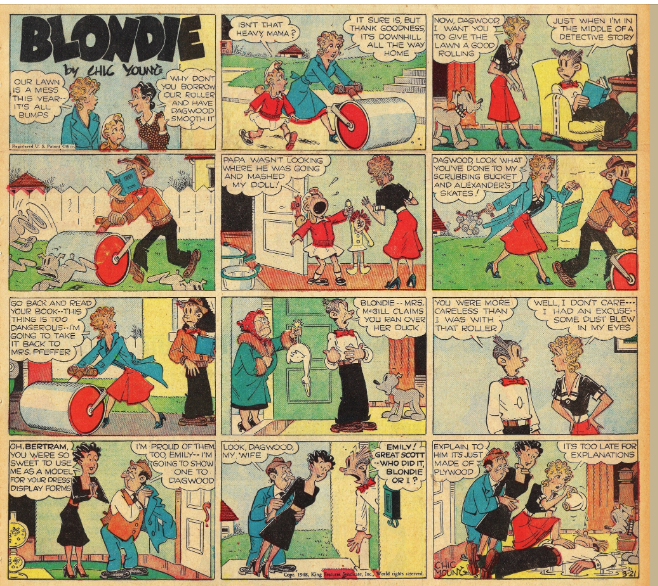
Was there a time when Dagwood and Blonde were still upper class? I’m just surprised at the idea of a lawn roller being a normal household tool for middle class suburbanites. (OTOH, it is shown as not something every family expects to own, and is instead on the borrow-tools-from-your-neighbor schedule.)
Arlo & Janis: Janis presumably assumed that any computer disk that Gene was hiding under his mattress contained nude pictures or the like, since one wouldn’t normally store a disk under a mattress. (The disk could not have been, say, a stash of money in the form of bitcoin; bitcoin wouldn’t be invented until years later.) Any disk Gene had that contained innocuous content would presumably have been kept somewhere that was less blatantly a hiding place.
Back in the day, some photo processors would develop the negatives and if they contained content considered offensive they wouldn’t print the pictures.
The mention of the Kaypro brought back visions of lugging the so-called portable along with an over-sized briefcase back in the 1980s. Thanks for the memories from one geezer to another.
@ootenaboot, ah yes — I don’t know if Kaypro ever officially adopted the term, but “luggable” was very familiar in user groups, distinguishing from portable.
Isn’t it that “formal” means white tie, so “casual” is black tie? I remember being astounded to some reference along those line — a full tuxedo with black tie was somehow gauche and improper, because of course everyone knows that formal means white tie…
snark, snark, you dressed like the waiter…!
larK, formal attire is white tie, semi-formal is black tie, informal is a suit. Casual attire is everyday clothing, which for a general’s party in March I would take to mean something like a buttondown shirt (but no tie). In the summer I would wear a Polo shirt.
Mitch4: Dagwood was upper-class until he married Blondie, at which time his parents disinherited him and were never seen again.
@Mitch4: “I’m just surprised at the idea of a lawn roller being a normal household tool for middle class suburbanites.”
I used to borrow my neighbor’s lawn roller every couple of years. (I should mention that my neighbor owned a landscaping firm.)
Maybe Blondie and Dagwood were eventually retconned into a post-WWII suburban development, but panel two shows an almost rural area with spread-out houses. Also, it’s all downhill from Mrs. Pfeffer, suggesting a house on a hill — a location implying money. The Bumstead’s fenced-in yard implies a tighter, more regimented area, but one close enough to Mrs. Pfeffer’s that Blondie can roll the roller down the street (and back up again!) evidently unassisted, and without causing traffic issues. I’m seeing a small development on what used to be a farm or an estate, maybe on the edge of a growing city. A 1933 strip has them talking about going somewhere by bus (they’re close to an city bus line), buying a car almost on impulse (car salesmen spring out of nowhere and hustle them to their storefront on foot). At the end Dagwood remembers they don’t have a garage, so their house may have been a bit old when they moved in, making it more affordable to an office worker. For decades thereafter Dagwood took the bus to and from work, so the financial district, traditionally downtown, was beyond walking distance (now he carpools). Another possibility is a small town close to a large city; a bedroom community. That might also make their house more affordable.
A while ago Comics Kingdom started running vintage “Hi and Lois” from the beginning. It was explicitly about a young postwar family moving from an apartment into a new suburban house, with jokes about cheap fast construction and such. In time the neighborhood stabilized and even gentrified a hair. “Gasoline Alley” was originally set in a neighborhood of Chicago, but was eventually retconned as a stand-alone small town. “Our Boarding House” is in a slightly weatherbeaten neighborhood, maybe or maybe not adjacent to a big city. Not exactly poor; just increasingly geriactified. I could go on …
Maybe Emily and Bertram (who are new characters to me) were upper class – note that Bertram wears a vest, which Dagwood does not. And of course Dagwood started as very upper class (and Blondie was a flapper who was presumed to be a gold digger). But after their marriage, it was Chic Young’s stated goal to make them as average as possible.
Although their neighborhood is not too dense, that may be because it is not very urban. According to Chic Young in 1946, they live in the small city of Joplin, Missouri.
Years ago, Lt. Flap’s “civilian” attire looked like stereotypical “pimp” garb.
Perhaps it shows the differences in what people think casual clothing is.
Another reason to hid a disk is that there is a surprise being worked on by the disk owner (son in this case) which if someone who does things in the room (mom) sees will spoil the surprise. Example – If I was planning a surprise party for my husband I would put it on an older stick drive with other data on it and stick in my desk drawer with the rest of the old stick drives so he would not come across the plans.