I understood the primary gag in the final panels, but I do not understand the meteorological setup in the first panel:

…
Perhaps it’s just the awkward expression: how can a hurricane “drop a millibar“? Did anything like this actually happen during either of the recent hurricanes?
I might as well include the previous two B&C strips, which feature Horace’s “intentional CIDUs. The solution to the first one was explained in Week 94 of the Invitational, in which Gene Weingarten solicited even more obscure “Horace” material. (The results will appear in the Invitational on Halloween, and the better ones will probably be immortalized in future Barney & Clyde strips.)
The second one I had to look up myself, but Barney’s tip in the last panel was a big help:
P.S. Given the solution, this one might also need a “geezer” tag.
Here’s a third “Horace” strip from last year, which was also included (with its solution) in the Invitational article:

 Comics I Don't Understand
While it’s odd to ask if a hurricane “dropped how many millibars”, it’s not arrant nonsense. It could be that the local barometric pressure dropped by some number of millibars at particular points of the hurricane’s passage.
Well gosh-a-Rootie! When I submitted (by email to the designated address) the two recent B&C “Horace” strips and you guys mailed back to say they were being posted, I thought my accompanying comments would also be posted.
Well, NBD, here they are now:
These are CIDU upon first encounter, even though we can work out the jokes with some stretching.
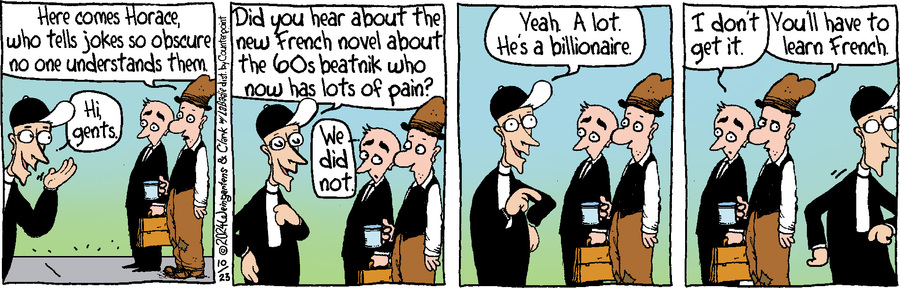
The “French novel/ 60s beatnik” one can fairly easily be pretty-much solved, but it leaves dissatisfaction that there seem to be details that play no role and are like distractors. The solution as I see it (and now that I check, the GoComics commentters also) is that “pain” is French for “bread”, and “bread” was hip slang for “money”, and a billionaire certainly has lots of money. But no reason for it being in a novel, and no reason for us to be left trying to tie this to one of our actual billionaires. Oh well, say lobby.
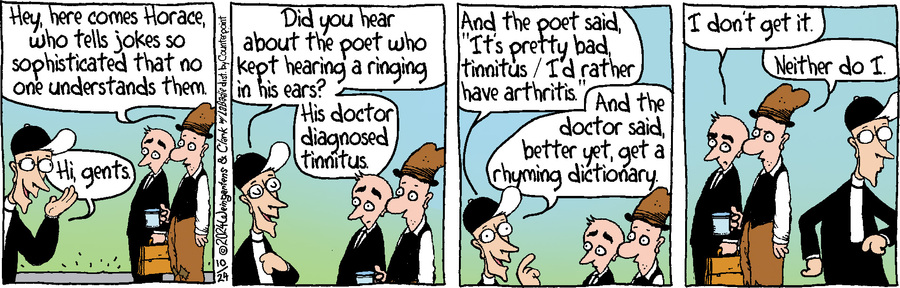
For the “tinnitus” one the basic point has to be that the official pronunciation is TIN-i-tuss, not tin-EYE-tiss. And etymologically, it is not an inflammation or irrittation of tissue, which an -itis word usually is. But this would be something that could be corrected from a regular dictionary, no reason to haul in the rhyming dictionary.
Not impressed with Horace. “Tinnitus” in fact rhymes with “arthritis,” according to the Mayo Clinic, the Cleveland Clinic, and Harvard Health. His preferred pronunciation is unusual.
Ironically the next strip relies on Horace mispronouncing “pain,” which in French does not sound like it does in English.
Hi Andrew, while I agree that the 2nd-syllable stressed form (with “long i”) is heard more often than the 1st-syllable stressed form (with schwa or else “short i”, that makes the latter “unusual” only in a statistical sense, but not quite enough for a prescriptive ruling. (And indeed, my doctor says it with initial stress, as do I in imitation. We also have to discuss arthritis, but never in such a way that it would matter if they rhyme!)
If we set aside specialized dictionaries and turn to general purpose dictionaries, what we get is, as perhaps expected, that all the sources accept both, but in different orders. Dictionary dot com AMERICAN prefers penultimate stress , while Dictionary dot com BRITISH prefers initial. And Merriam-Webster (which does not distinguish by national dialect) prefers initial.
D’nary.com American
IPA / tɪˈnaɪ təs, ˈtɪn ɪ- /
or by what they call “Phonetic (Standard)” [ ti-nahy-tuhs, tin-i- ] with bold for stress.
D’nary.com British
/ ˈtɪnɪtəs; tɪˈnaɪtəs /
M-W tinnitus noun tin·ni·tus
ˈti-nə-təs tə-ˈnī-təs
In any case, Horace is relying on thinking there is no two ways about it and for him only the first-syllable stressed form could be correct. So I agree with you in shrugging off his point in this cartoon. Plus,as I originally said, why would making this “correction” involve a rhyming dictionary. It even more turns on consulting a general dictionary, or per your suggestion a medical dictionary.
“Perhaps it’s just the awkward expression: how can a hurricane “drop a millibar“?”
A hurricane dropping in pressure will have dropped millibars (in pressure). The lower the pressure, the stronger the winds.
What am I missing on this question? It seemed obvious to me what the character was saying.
Maybe I’m confused, but I read this as the meteorologist getting misty over something obscure, then meanwhile the scientist is finding something equally obscure (at least as phrased) and getting misty, and in neither case is the other person particularly interested.
Ah but, what the scientist announces would be of immense significance! (However, not something he could find out with a small optical microscope)
My ENT apparently is so used to correcting people that he didn’t even bother to listen to my pronunciation before proceeding to lecture me on how to pronounce it, even though I had pronounced it “correctly”, which is to say, the same way he was now “teaching” me to pronounce it. I was not impressed.
And (unsurprisingly) I have no clue about the cricket one. I often feel that cricket is like the game “Mornington Crescent” from I’m Sorry I Haven’t A Clue, or maybe like the game Fizzbin from Star Trek, ie: fake games invented solely to gaslight the uninitiated about their rules. In this case it could be that the position he mentions doesn’t exist, so no answer is the correct answer, or maybe the position is called the “HAhaha hahaha ha”?
The cricket position is the “silly point”. Other cricket positions are gully, fine leg, cow corner, third man, backward square leg … As Anna Russell said, “I’m not making this up!”
When I was in high school, the Latin club posted a Latin translation of “Jingle Bells”:
Tinnitus, tinnitus,
Semper tinnitus.
It did not catch on. We still sing it in English.
@Danny Boy: ” I thought my accompanying comments would also be posted.”
Editorial misfire. I indeed posted the ones you send, with your comments, and scheduled them for the next open date, which was November 8.
Thank you for including your comments here, on this bonus posting.
In cricket the fielding positions square of the batsman’s wicket are, on the leg side, square leg and deep square leg and, on the off side, point and deep point so I imagine that as Barney and Clyde don’t have a clue they must be missing the point.
I assume it meant “silly mid-on” or “silly mid-off”.
In response to the question about whether a meterologist actually choked up while reporting an historic drop in barometric pressure during a recent hurricane: yes. John Morales went viral earlier this month for his emotionally charged reporting on Hurricane Milton as it strengthened in the Gulf Coast.
I like the occasional Horace strips; they make me pause and think. Here, one requires the reader to know a French thing and another requires the reader to know a British thing. As for the latter, it’s unfortunate that most Americans are with larK here. I had a fun day playing cricket with the local club, about 50 years ago, but like any foreign language, if you don’t use it, you lose it.
My apologies to both zbicyclist and Danny: It was not my intention to pre-empt the Nov. 8th post, which I was not aware of when I scheduled this one. I merely wanted to call attention to the Invitational contest before the next results appear on Thursday (Halloween), which is sure to generate a number of new “Horace” strips.
Here is the clip the first strip is referring to: John Morales
Oh, it’s fine. There’s nothing I meant to say that hasn’t been said. And we all had an enjoyable thread, about pronunciations and more!
Zbicyclist has cordially been in touch by email, and I agreed that publishing the other post would just be redundant, so he is going to go ahead and delete it, no worries.
My issue with the tinnitus one is that he said the doctor diagnosed it. I would presume that he told this to the poet face-to-face, and didn’t email the diagnosis or write it down somewhere for him to read. Additionally, the poet ‘said’ his rhyme to the doctor after the diagnosis, further reinforcing the idea that they were together in the same room when the diagnosis was made. That’s certainly the implication to me, at least.
That being the case, he would have heard the pronunciation the doctor used and made a rhyme based on that. No need for a dictionary, rhyming or otherwise.