
No, when it comes to the first panel, I can’t even!
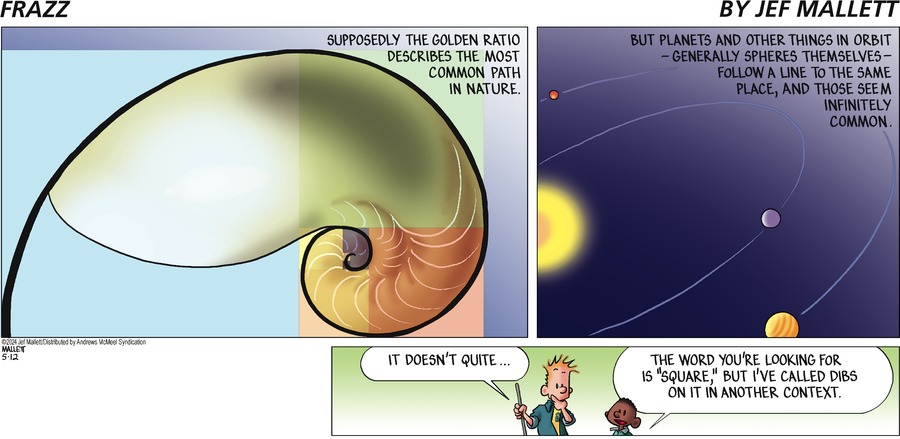
A word I was more likely looking for was “elliptical”.
Well, I’m going to call this a colorist’s error (leading to an interpretive crux) …
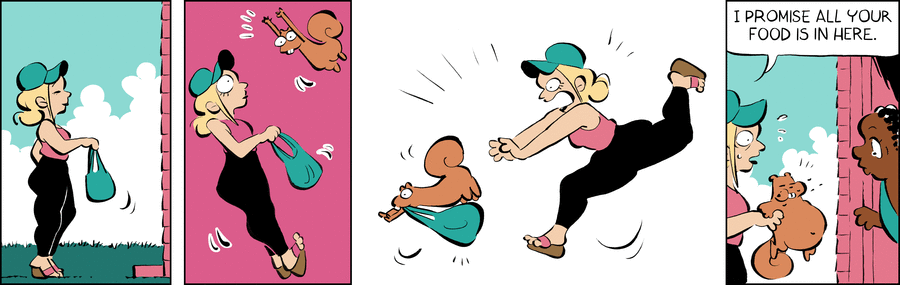
… with me thinking it should be green like the delivery bag, but squirrel-shaped, to show that McKenzie (the delivery person, a main character of the strip) succeeded in trapping the critter inside. And she is then giving the customer a live animal, plus whatever part of the order remains unconsumed in the bag, plus (uh-oh!) food already eaten by the animal.
But on further look, I was wrong. It is meant to be the squirrel, with face details clearly shown. And a large satisfied tummy. (Where is the bag? Did he eat that too?) Is her comment to the customer meant to imply the customer could force regurgitation (or slice the animal open!?!) and treat the semi-digested food as still good for human consumption? Well, she doesn’t simply think this will fly — some of the patches in the sky are not clouds but anxiety-sweat beads — so I guess she conveys a just-kidding with that. But who knows?
 Comics I Don't Understand
You got the graphic right. The joke is that she’s doing something nonsensical, claiming to be delivering “the food” instead of “an animal that ate your food.” Also, that squirrel is the fastest eater in the history of the world.
Caufield is correct that planets orbit in straight lines… but they do so in curved spacetime. That path maps to an ellipse in Euclidian space.
However, that said, I don’t understand the connection to the golden ratio, conch shells, or squares.
Also, 6÷2(1+2) is intentionally ambiguous, designed to spur debate over the correct answer. You get different answers depending on whether your prioritize the implied multiplication as coming before the division or not.
There are two justifications for doing so — one is that implied multiplication falls under the “P” or “B” of PEMDAS or BEDMAS, by virtue of relying on parentheses/brackets to show the operation. The other requires you to use the mnemonic PEMDAS or BEMDAS and believe the “MD” ordering specifies multiplication before division. (The comic, of course, uses BEDMAS, so this second reasoning wouldn’t apply.)
In actuality, the order of operations most commonly specifies that the M and D (and A and S) pair is of equal priority to each other, so you evaluate all multiplication and division strictly left-to-right. That would mean the division would come first regardless of MD or DM (unless, again, you prioritize the implied multiplication).
I tend to favor prioritizing the implied multiplication — but not because it “counts” as a parenthetical operation in PEMDAS. That’s informed by algebra, where forms like 5x<sup>2</sup> are common. The exponent always is evaluated before the multiplication in that case, which would violate the PE ordering — plus, there’s no parenthesis anyway! But the multiplication-by-juxtaposition just seems more direct and more immediate to me than using explicit operators.
All this debate means, though, is that no mathematician would actually write this equation in this way, precisely because it’s ambiguous. Proper use of parentheses would render the intended result clear.
I had never heard of the acronym “BEDMAS” before, but I soon discovered that it is a Canadian variant, and as one might expect, Sandra Bell-Lundy is indeed Canadian.
Nobody likes a hater, so I must be careful about how I say that I HATE IT when people post little ambiguous formulas to social media and proclaim them as ultra-tough math problems that can trip up even some experts. And they’re just order-of-operations dilemmas, supposedly to be resolved by legalistic parsing of the o-o-o precedence rules, of the sort Powers so illuminatingly takes apart for us. Not only are these things not in any sense “advanced math” (let alone “higher math”), they’re barely math at all.
Green bags are for pet poop, at least that’s the color I see my neighborhood’s dog walkers carrying about!
The connection with “square” is the phrase, “That doesn’t square”, i.e., “That doesn’t make sense”. And it’s actually not a bad joke — “That doesn’t square” when talking about spirals and ellipses and circles would indeed be odd!
“called dibs on it in another context” seems random, however.
@Powers,
I always told my students to beware of the invisible parens. In a fraction, both numerator and denominator have invisible parens.
Kannst Ich die erste Problem lösen?
Nein!
My TI-84+ calculator:
017+027
44
JavaScript (press F12, click on Console, and type):
017+027
38
Mark –
That’s because Javascript uses a 0 prefix to indicate octal (base 8). So the sum would be 1×8 + 7 + 2×8 + 7 =38 decimal. Or 46 octal.
Are bedmas like gazintas?
@ Downpuppy (16) – I don’t understand your jump to a foreign language. Perhaps “If today is Thursday, this must be Germany.” ???
@ Max (6) – The most popular color usually depends on whatever the local delivery crews use to fling the daily newspaper into the bushes. Back when I lived in Washington, the Post was flung in blue bags (at first only in wet weather, later on the bags were used every day). Given the recent changes in editorial leadership, recycling those bags for dog poop has become even more appropriate.
I’m assuming the language switch allowed for a pun.
While not the standard way, one interpretation of the first problem would be that it equals 9.
This lets a German speaker say (translated): “Can I solve the first problem?” and answer “Nein”.
“Not the standard way”? I need to not be typing answers at midnight. Ugh…
@ Darren (15) – Boy do I feel silly, especially because I am more than familiar with the “nein/no”=”nine/9” pun, but it works better spoken than in writing, especially at a bar.
P.S. I remember an anecdote about a stutterer who tried to order a “Tanqueray martini” at a restaurant, but then received a tray of ten Tanqueray martinis from the waiter; except that this wasn’t a joke, it really happened to a fellow student who was waiting tables at college.
@LordFlatulence,
/Are bedmas like gazintas?
I used to tell my students (about half of which were not native English speakers) that two ways to think about division were reverse multiplication, and gazintas. Whole class: confused. So I told them ‘You know, like 3 gasinta 6 two times?’ Half laughed, then there was a lot of whispering, then the other half laughed.
I miss teaching. As a teacher you can tell the lamest joke in the world, and they will laugh.
Yep, gazinta is in the same family with the somewhat more transparent take away.
I see only 1 answer!
Problem: 6/2(1+2)= ? [ / stands in for division operator]
Brackets or parentheses: 6/2(3)= ?
Exponents: not applicable
Multiplication: 6/6 = ?
Division: 6/6 = 1
Addition: not applicable
Subtraction: not applicable
My math education ended nearly 60 years ago. I realize I have spelled BEMDAS, but defend it on the grounds of simplifying the problem step by step. If you got 9, please show your work.
@ Mark H. (11): That’s right. The only time I use octal is when I give a chmod command in Linux. The last machine I used that traditionally used octal was probably a PDP-11 in the early 1980’s. JavaScript, invented in 1995, gives you absolutely no direct access to the underlying hardware or the file system and yet it reads a number with a leading zero as octal.
This is the first time I’ve seen gazintas in reference to math. I’d always heard that there are two kinds of cats, gazintas and gazundas.
@ ootenaboot (20) – To get the other answer, you need to include the implied multiplication operator, and evaluate in sequence left to right:
6÷2*(1+2)=6÷2*(3)=(6÷2)*3=(3)*3=9
@ Mark in Boston (21): I used to use both chmod (change mode) and od (octal dump) in Linux.
One way to approach the order-of-operations problems is to remember that dividing by a number is the same as multiplying by its reciprocal. In this case 6 ÷ 2 is the same as 6 * 0.5, so we can rewrite the problem as 6 * 0.5 * (1 + 2). The Associative and Commutative Properties say you can do those multiplications in any order, so you have to get 9 as the answer.